For an aquarium aeration kit wholesale program, the practical goal is not simply to bundle an air pump with accessories. It is to create a compatible, clearly labeled kit that fits a defined tank-size range, delivers useful airflow at real operating depth, and gives end users the parts needed for safe installation.
Buyers should begin with the intended use case: a basic single-tank starter kit, a larger aquarium kit, a dual-tank setup, or a replacement-oriented accessory bundle. Then confirm the pump’s output, outlet configuration, tubing size, valve compatibility, air-stone type, packaging contents, electrical version, and replacement-part plan before approving samples or placing an order.
What Belongs in an Aquarium Aeration Kit
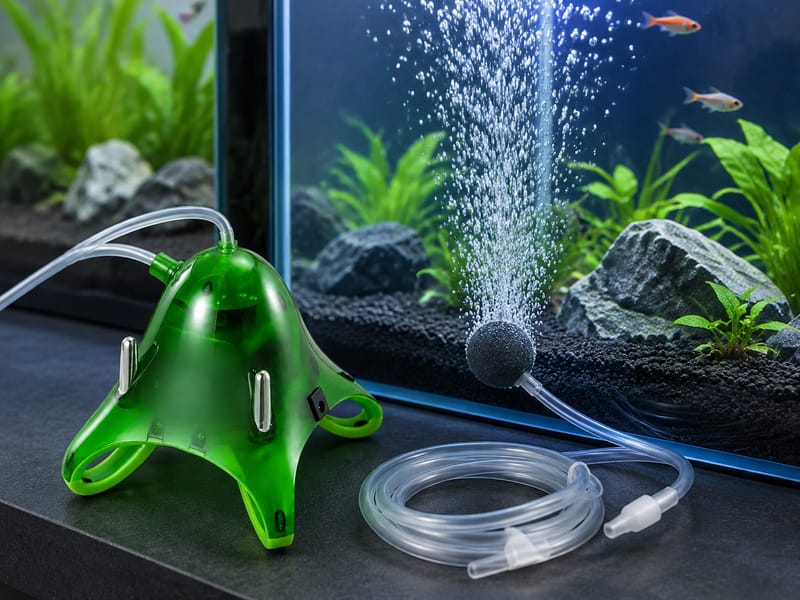
A retail-ready aeration kit usually combines an electric air pump with the small components needed to move air from the pump into the aquarium. The exact contents should match the customer’s expected setup rather than include accessories that create confusion or unnecessary cost.
Common kit components include:
- Air pump: The powered component that generates airflow.
- Airline tubing: Flexible tubing that connects the pump to the air stone or other pneumatic aquarium accessory.
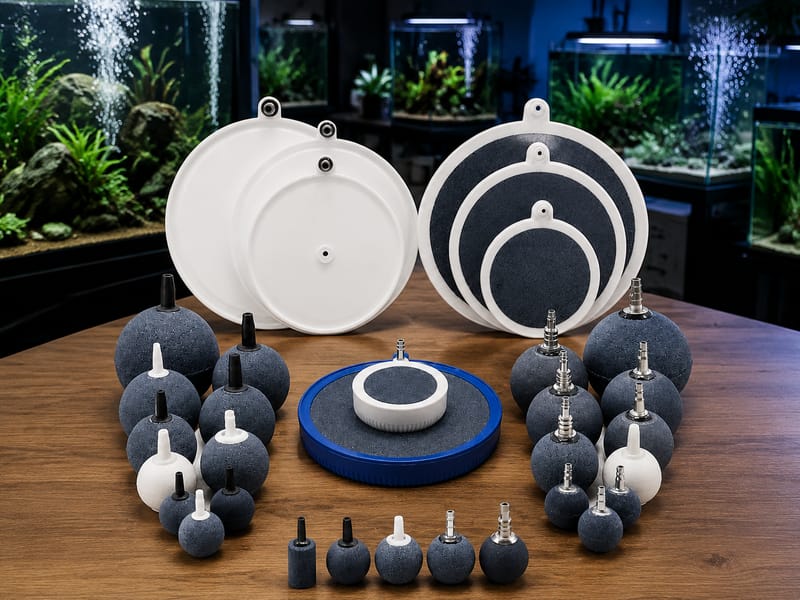
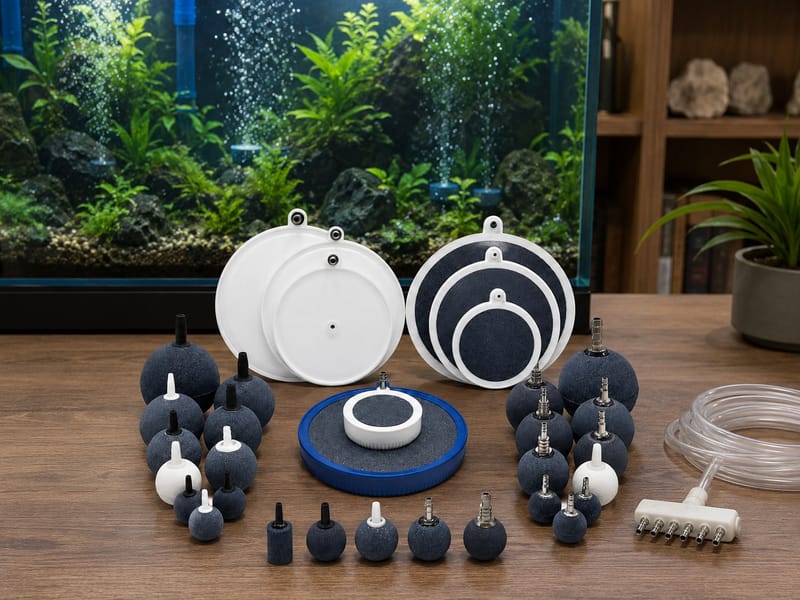
- Air stone or diffuser: Creates a stream of smaller bubbles and helps distribute air in the tank.
- Check valve: Helps reduce the risk of water traveling back through the airline toward the pump during a power interruption or placement error.
- Control valve: Lets the user reduce or balance airflow where appropriate.
- Connectors or splitters: Needed when a kit serves more than one airline or outlet.
- Suction cups or tubing clips: Help route tubing neatly and keep it in place.
- Instructions: Should explain placement, assembly, safety steps, cleaning, and replacement guidance.
Not every kit needs every item. For example, a simple entry-level single-outlet kit may include a pump, tubing, one check valve, and one air stone. A multi-outlet kit may require a manifold, multiple check valves, more tubing, and several diffusers. A retailer may also prefer to sell air stones and valves separately as replenishment items.
The most important rule is that the advertised kit contents must support the installation shown on the package. If a package depicts two air stones but includes only one outlet and no splitter, customers may need an additional component before they can reproduce the setup.
Selecting an Air Pump for the Intended Tank Size
Choose the pump based on the intended aquarium size, water depth, number of outlets, and connected accessories—not tank volume alone. A pump that appears sufficient on paper can deliver less usable airflow when the air stone is placed deeper in the water, when a long airline run is used, or when output is divided between multiple lines.
Ask suppliers to confirm the model-specific operating information, including:
- Rated airflow or output
- Recommended aquarium-size range, if provided for that model
- Number of air outlets
- Voltage, plug type, frequency, and power consumption
- Expected operating depth or pressure information, where available
- Included accessories
- Dimensions and mounting or placement guidance
- Noise-related construction features, if applicable
- Whether flow adjustment is built in or requires an external control valve
Use tank ranges carefully
Tank-size claims are helpful for shelf organization, but they should not be treated as universal performance guarantees. A lightly stocked freshwater aquarium with a shallow air stone may have different needs than a deeper aquarium, a tank with dense stocking, or a setup using a sponge filter.
For retail clarity, use conservative and understandable positioning such as:
- Small freshwater aquarium aeration
- Medium aquarium air pump kit
- Dual-airline kit for two small setups
- Multi-outlet pump for separate air-driven accessories
Any specific gallons, flow rates, wattage, or suitability statements should be confirmed for the actual approved model. Buyers should also make sure packaging does not imply that aeration alone resolves water-quality issues. Aeration can support gas exchange and water movement, but it does not replace filtration, regular maintenance, or responsible stocking.
Consider the connected load
Air pumps may be used with more than decorative air stones. Some end users connect them to sponge filters, under-gravel filter lift tubes, breeding boxes, or other air-driven devices. These accessories can add resistance and change how a pump performs.
If the product line is intended for sponge-filter users, evaluate the kit with that use case in mind. A decorative air-stone kit and a filtration-support kit may need different pump positioning, included fittings, and packaging instructions.
Matching Tubing, Valves, and Air Stones
A compatible kit depends on the full air path. The pump outlet, tubing inner diameter, check valve fittings, control valve fittings, splitters, and air-stone inlet all need to connect securely without forcing, leaking, or requiring unexpected adapters.
Before sample approval, physically assemble the exact kit configuration and check the following:
- Tubing fits the pump outlet securely.
- The check valve connects in the correct direction and is marked clearly.
- Any control valve or gang valve accepts the supplied tubing.
- The air stone inlet fits the tubing without cracking or stretching it.
- Splitters have the correct number of branches and do not create loose connections.
- Suction cups hold tubing in a typical aquarium setup.
- The assembled system starts consistently and produces visible bubbles at the intended depth.
Tubing selection affects the user experience
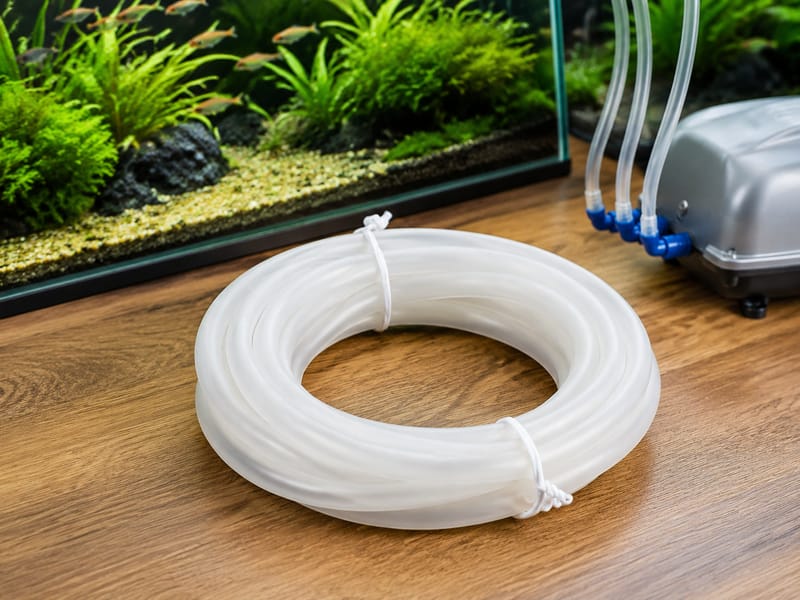
Tubing that is too stiff can be difficult for customers to install. Tubing that is too soft may kink or collapse in tight bends. A practical kit should use tubing that can be routed around an aquarium without creating sharp bends that restrict airflow.
Length also matters. Too little tubing can make the kit unusable if the pump must sit below the aquarium or farther from the tank than expected. Excessive tubing, however, adds material cost, takes up package space, and can make the setup look untidy. Select a length that supports the intended installation scenario, then state the included length accurately on the package.
Air-stone choices should match the kit position
Air stones vary by shape, size, material, bubble pattern, and maintenance needs. A small cylindrical air stone may suit a compact starter kit, while a longer bar-style diffuser may better support a larger display-focused setup. The best choice depends on the pump output and the visual result the kit is designed to provide.
Buyers should avoid pairing a very small pump with an oversized diffuser solely to create a premium-looking package. The result may be weak or uneven bubbles. Likewise, a small air stone connected to a stronger pump may produce an overly concentrated stream unless airflow can be adjusted.
Single-Outlet Versus Multi-Outlet Configurations
Single-outlet and multi-outlet kits serve different retail needs. Neither is inherently better; the correct choice depends on whether the customer needs one air line, two separate applications, or adjustable distribution across several air-driven accessories.
| Configuration | Best suited to | Typical included components | Key buyer checks |
|---|---|---|---|
| Single outlet | One aquarium and one air stone or air-driven device | Pump, tubing, check valve, air stone | Confirm output suits the intended tank range and depth |
| Dual outlet | Two small setups or two air lines in one aquarium | Pump, two airline runs, check valves, two stones or a splitter arrangement | Check whether each outlet performs independently or shares total output |
| Multi-outlet | Multi-tank systems, display tanks, or more complex setups | Multi-outlet pump or manifold, several valves, tubing, multiple diffusers | Verify airflow balance, outlet labeling, and complete accessory count |
| Single outlet with splitter | Value-oriented two-line setup | Single-outlet pump, splitter, two lines, valves, stones | Confirm divided airflow remains adequate for both lines |
A dual-outlet pump may simplify setup for customers with two aquariums, but it does not automatically provide the same airflow per line as two separate pumps. Similarly, using a splitter divides one pump’s available air across multiple lines. That can be appropriate for low-demand applications, but buyers should test the real configuration at normal installation depth.
For multi-outlet products, adjustable controls can improve flexibility, particularly when air stones are placed at different depths or when one line runs a sponge filter and another runs a decorative diffuser. Whether adjustment is included, and how it functions, must be confirmed model by model.
Noise, Airflow, and Energy Evaluation
Noise is one of the most important purchase considerations for aquarium air pumps, especially for bedroom, office, and countertop aquarium applications. However, buyers should avoid unqualified “silent” claims. All air pumps can create some audible operation, vibration, or bubbling sound depending on placement and setup.
A stronger evaluation approach is to review noise as a system issue:
- Pump construction: Internal design, feet, housing, and vibration isolation can affect perceived sound.
- Placement surface: A hard, hollow, or uneven surface may amplify vibration.
- Tubing contact: Tubing pressed against glass, furniture, or a lid can transmit vibration.
- Air-stone bubbling: Bubble noise can be significant even when pump vibration is low.
- Airflow restriction: Kinked tubing, clogged stones, or incorrect valves can alter operating behavior.
Test at realistic conditions
When reviewing samples, do not assess a pump only while it is running open to the air. Connect the supplied tubing, valves, and air stone; place the diffuser at the intended water depth; and operate the full kit on a stable surface.
A useful buyer evaluation should include:
- Startup behavior
- Bubble consistency after several minutes of operation
- Vibration transferred to the surface beneath the pump
- Airflow with each included outlet in use
- Airflow after a control valve is adjusted
- Leakage at connections
- Whether the check valve works correctly in the stated flow direction
- External housing condition and cord routing
- Packaging condition after ordinary handling
Energy use should also be evaluated through the actual model’s stated wattage and electrical specification. Lower power consumption may be attractive for everyday use, but it should not come at the expense of airflow needed for the intended application. Confirm electrical compatibility for the destination market before finalizing a U.S.-bound assortment.
Installation Safety and Maintenance Guidance
An aeration kit should include clear instructions because correct setup protects both the equipment and the user experience. The core installation principle is to keep the pump positioned above the aquarium water level when possible. If the pump must be located below the water line, a correctly installed check valve becomes especially important.
Package instructions should cover these points:
- Place the air pump on a stable, dry surface with adequate ventilation.
- Keep electrical connections away from water and follow the model’s electrical instructions.
- Route the airline tubing from the pump to the aquarium without sharp bends or crushing.
- Install the check valve in the indicated airflow direction.
- Place the air stone securely in the aquarium before turning on the pump.
- Create a drip loop in the power cord where appropriate to reduce the chance of water reaching the outlet.
- Disconnect power before cleaning, moving, or servicing equipment.
- Inspect tubing, valves, and diffusers regularly for wear, blockage, or buildup.
Maintenance messaging should be specific but not overpromising. Air stones can become less effective as pores collect mineral deposits or debris. Tubing may harden, discolor, or kink over time. Check valves and control valves can also need inspection or replacement. A replacement-parts program helps retailers turn routine maintenance into a straightforward repeat purchase rather than a reason for a customer to replace the entire kit.
Kit Packaging, Branding, and Replacement Parts
For wholesale buyers, packaging is part of compatibility. The carton must tell the shopper what is included, what the kit is designed to do, and what additional parts may be needed. Clear packaging reduces returns caused by incorrect expectations.
Useful front- and back-panel details include:
- Intended aquarium or use-case range, when confirmed for the model
- Number of outlets and number of included air lines
- Included pump, tubing, valve, and diffuser count
- Electrical version and power information
- Simple setup diagram
- Check-valve orientation graphic
- Replacement item names or compatible accessory categories
- Safety and maintenance reminders
- Brand, private-label, or retailer-specific identification
Build a replenishment path
A complete kit can create opportunities for related accessory sales, including replacement air stones, extra airline tubing, check valves, splitters, control valves, and alternate diffusers. This is useful for retailers because the customer can maintain or adapt the original setup instead of purchasing another complete pump kit.
Private-label buyers should decide early whether replacement accessories will use universal retail packaging, coordinated branded packaging, or bulk service packaging. They should also confirm whether the tubing size and fittings are consistent across the assortment. Standardizing compatible connections across multiple SKUs can make merchandising and customer support easier.
WKAQOO can support business buyers sourcing aquarium equipment and accessories across related categories, including air pumps, air stones, maintenance accessories, and private-label packaging discussions. Specific components, branding options, packaging details, and order terms should be confirmed for each inquiry.
A Sample Approval Checklist for Buyers
Approve the complete retail kit, not just a pump sample or an air-stone sample viewed separately. The final sample should represent the proposed production configuration as closely as possible.
Use this checklist before moving forward:
Product compatibility
- Pump outlet size matches the supplied tubing.
- Tubing fits all valves, connectors, splitters, and air stones.
- Check valves are installed and labeled in the correct direction.
- The number of accessories matches the outlet configuration.
- Airflow is adequate when all included lines operate at the intended depth.
- Flow adjustment works as described, if adjustment is included.
Performance and usability
- The kit starts reliably under a typical operating setup.
- Bubble output is reasonably consistent across included diffusers.
- Connections remain secure during normal handling.
- The pump sits stably and does not create excessive vibration for its intended positioning.
- Tubing is easy to route without kinking under normal installation.
- Instructions can be followed by a first-time aquarium customer.
Packaging and retail readiness
- Package contents match all package images and written claims.
- Tank-size, output, wattage, and electrical statements are confirmed for the approved model.
- Warning labels, electrical information, and instructions are suitable for the intended market.
- Private-label artwork, colors, logo placement, and user instructions are approved.
- Carton dimensions, inner packs, master-carton information, and packing method are confirmed.
- Replacement-part SKUs and compatible accessories are identified.
Commercial and sourcing confirmation
- Sample terms, minimum order quantity, and pricing are confirmed.
- Required testing, certifications, or market-specific documentation are discussed where applicable.
- Production schedule and current lead time are confirmed before order placement.
- Any color, material, voltage, plug, or packaging variation is recorded in the final specification.
Frequently Asked Questions
Should every aquarium aeration kit include a check valve?
Including a check valve is generally a practical choice, particularly when users may place the pump below the aquarium water level. It should be compatible with the supplied tubing and clearly marked for correct airflow direction. Follow the specific pump’s installation guidance as well.
Can one air pump operate two air stones?
Yes, if the pump output and configuration are suitable for divided airflow. A dual-outlet pump or a single outlet with a splitter can operate two lines, but each air stone will receive only the airflow available after the system is divided and affected by tubing length and water depth.
Is a larger air pump always better?
No. Oversizing can add cost, energy use, and unwanted bubbling or noise. The better choice is a pump with verified output for the intended tank setup, diffuser type, depth, and number of air lines.
What should be sold as replacement parts?
Common replacement items include air stones, airline tubing, check valves, control valves, splitters, and suction cups. Offering compatible replacement parts supports maintenance and helps customers keep the original aeration system in service.
A well-planned aquarium aeration kit wholesale assortment pairs a properly matched pump with complete installation components, accurate packaging, and an accessible replacement-parts path. Before final approval, test the full assembly at realistic operating depth and document every model-specific specification and commercial term.
For a private-label or wholesale aeration-kit project, WKAQOO can help buyers review component compatibility, packaging requirements, sample options, MOQ, and current lead-time details. Contact sales@wkaqoo.com with the intended tank range, outlet count, electrical version, and desired kit contents.