Many aquarium owners in the United States ask the same question: do fish really need air pumps, or are they simply another accessory sold with beginner tanks? The direct answer is simple. Fish do not always need an air pump, but every aquarium does need reliable oxygen exchange. In many setups, that oxygen exchange comes from surface movement created by a filter return, spray bar, waterfall outlet, or circulation pattern. In other setups, a mini air pump becomes essential because stocking, temperature, tank depth, plant load, medication use, or weak circulation reduce dissolved oxygen faster than the water can naturally replace it.
This matters in real homes, offices, classrooms, retail displays, fish rooms, and breeding systems from Miami to Seattle. A small desktop aquarium in Chicago may run safely for years with only a sponge filter powered by air. A heavily stocked goldfish tank in Houston may need both filtration and extra aeration in summer. A planted shrimp aquarium in Portland may not need bubbling all day, but it may benefit from nighttime aeration when plants stop producing oxygen. Understanding this difference helps owners avoid both under-aeration and unnecessary equipment.
Across the United States market, interest in compact and quiet aquarium support equipment continues to grow. Buyers want less noise, lower energy consumption, cleaner layouts, and better reliability for mini and mid-sized aquariums. That shift has made the debate around filters versus air pumps more practical than ever. Instead of asking whether bubbles look attractive, experienced keepers now ask what the water movement is doing, how oxygen is being transferred, and whether the livestock load matches the aquarium’s gas exchange capacity.
Before going deeper, it helps to separate three related but different concepts: oxygen in the water, water circulation inside the tank, and visible bubbles. Bubbles themselves do not magically oxygenate the tank simply because they travel upward. Their main value is the way they disturb the surface and move water vertically. That surface agitation is what increases gas exchange, allowing carbon dioxide to leave and oxygen from room air to dissolve into the aquarium. Once hobbyists understand that, they make better equipment choices.
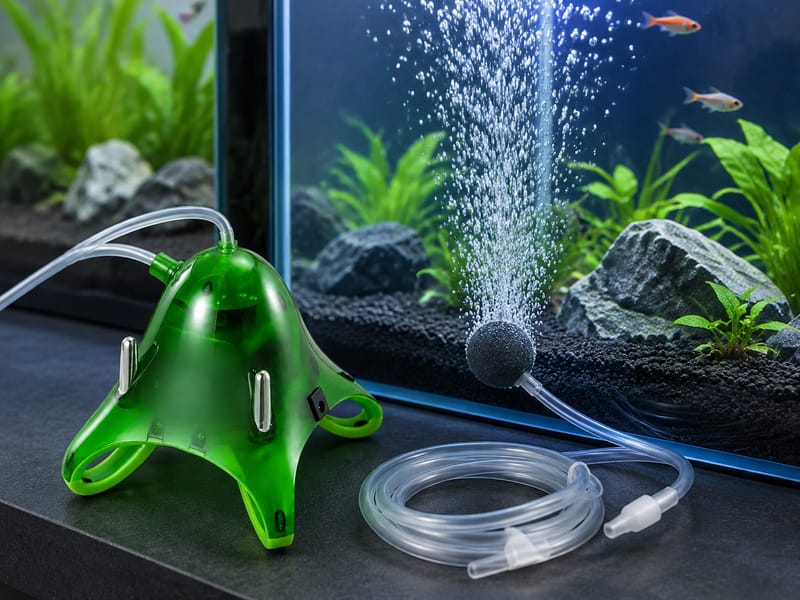
For buyers comparing compact solutions, a ultra-quiet aquarium air pump for U.S. home tanks can be a smart option when silent performance, stable airflow, and compact installation matter. That is especially true for bedroom aquariums, nano fish rooms, quarantine tanks, and small commercial display systems where steady aeration matters more than oversized output.
| Question | Short Answer | Why It Matters | Typical U.S. Example | Risk If Ignored | Recommended Action |
|---|---|---|---|---|---|
| Do all fish tanks need an air pump? | No | Some filters already create enough gas exchange | Small community tank with hang-on-back filter in Denver | Buying unnecessary equipment | Check surface movement first |
| Do all fish tanks need oxygen exchange? | Yes | Fish, plants, and bacteria consume oxygen | Any freshwater or marine aquarium | Stress, suffocation, bacterial imbalance | Ensure steady surface agitation |
| Are bubbles the same as oxygenation? | No | Surface disturbance is more important than bubble visibility | Betta tank in Los Angeles | False sense of security | Observe circulation and fish behavior |
| Can a filter replace an air pump? | Often | Many filters agitate the surface effectively | 20-gallon tank in Atlanta | Overcomplication or under-aeration | Match filter flow to bioload |
| When is a mini air pump necessary? | Sometimes | High demand setups need extra oxygen support | Goldfish tank in Phoenix | Low dissolved oxygen in warm weather | Add air stone or sponge filter |
| Can too little oxygen kill fish quickly? | Yes | Warm water and crowding speed oxygen loss | Shipping, quarantine, or outage events | Rapid fish loss | Use backup aeration plan |
The table above shows the core idea: the question is not whether every aquarium needs bubbles, but whether every aquarium maintains enough oxygen exchange under real conditions. In practice, many tanks in the United States operate safely with no dedicated air pump, while many others perform better with one. The right answer depends on biology, tank design, climate, equipment, and maintenance habits.
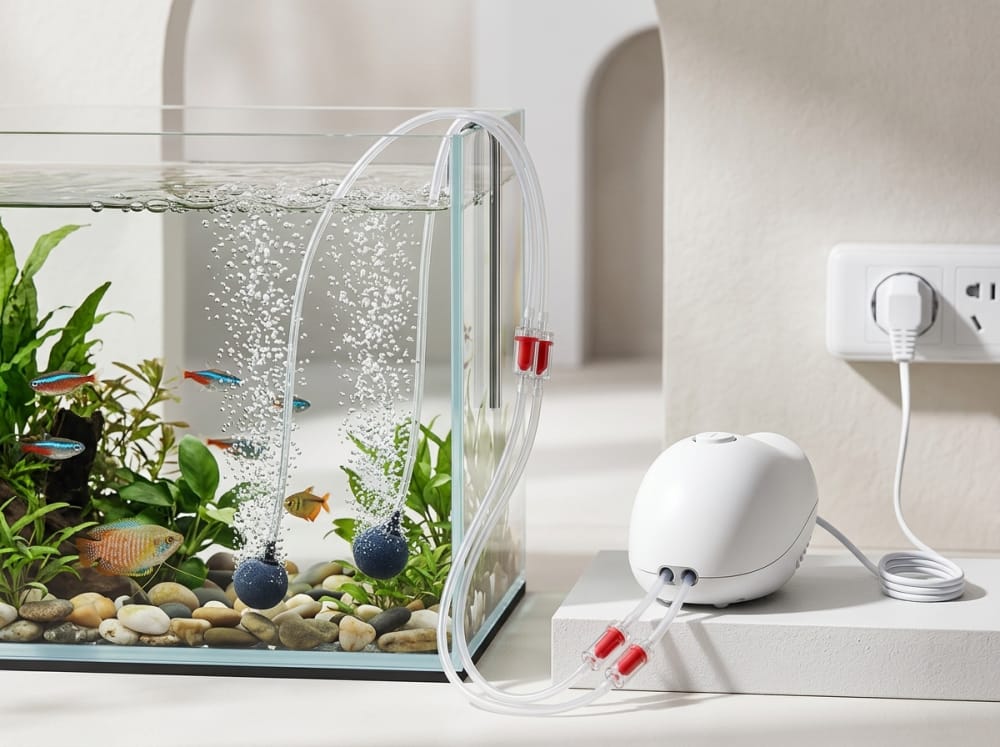
Do Fish Really Need Air Pumps?
Fish need oxygen, not necessarily an air pump. In an aquarium, dissolved oxygen enters the water mostly at the surface. If the water surface is gently but consistently disturbed, oxygen moves in and carbon dioxide moves out. This can happen through a hang-on-back filter, canister return, internal power filter, sponge filter, wave maker, or air-driven device. The air pump is one way to support that process, but it is not the only way.
Freshwater fish such as tetras, rasboras, danios, corydoras, livebearers, and many barbs often do well without a dedicated air pump when the aquarium has balanced stocking and a properly aimed filter return. However, oxygen demand rises with heavier stocking, larger fish, higher feeding rates, warmer water, medication use, decomposition, and bacterial activity. In those conditions, the margin for error becomes smaller. This is why some aquariums appear stable for months and then suddenly show fish gasping near the surface during a summer heat wave or after a filter clogs.
Marine systems can be even less forgiving because reef tanks often carry high biological demand, and warm saltwater holds less oxygen than cooler freshwater. Likewise, bait holding systems near ports such as Tampa, San Diego, and New Orleans often rely on active aeration because fish density and temperature stress increase demand. Commercial holding facilities, aquaculture labs, and retail stores understand that oxygen support is not decorative; it is operational insurance.
For home hobbyists, a mini air pump is especially useful in tanks under 40 gallons when owners want low-noise support, air-driven sponge filtration, backup oxygenation during treatment, or better circulation in dead zones. A compact pump can also support hatching projects, shrimp tanks, fry rearing, and quarantine systems where gentle aeration matters more than strong mechanical flow.
| Tank Type | Common Livestock | Air Pump Always Needed? | Main Oxygen Source | Common U.S. Use Case | Best Practice |
|---|---|---|---|---|---|
| Nano planted tank | Shrimp, micro rasboras | Not always | Filter outlet and plant balance | Apartment setups in New York City | Monitor night oxygen levels |
| Community freshwater tank | Tetras, corys, gouramis | Often no | Hang-on-back filter | Family homes in Ohio | Keep moderate stocking |
| Goldfish tank | Fancy goldfish | Often yes | Filter plus air stone | Warmer garages in Texas | Use extra aeration year-round |
| Quarantine tank | Single or recovering fish | Usually yes | Sponge filter and air pump | Breeders in Florida | Prioritize stability and oxygen |
| Marine reef tank | Corals and fish | Sometimes | Overflow, skimmer, circulation | Advanced hobbyists in California | Use aeration during emergencies |
| Breeding or fry tank | Eggs, fry | Usually yes | Gentle air-driven sponge filter | Home fish rooms in North Carolina | Avoid strong current |
This comparison shows why blanket advice fails. A planted nano display in Boston and a goldfish tank in Las Vegas face very different oxygen realities. Fish need oxygen every minute, but the method of delivering that oxygen can vary. That is the foundation of the filter versus air pump debate.
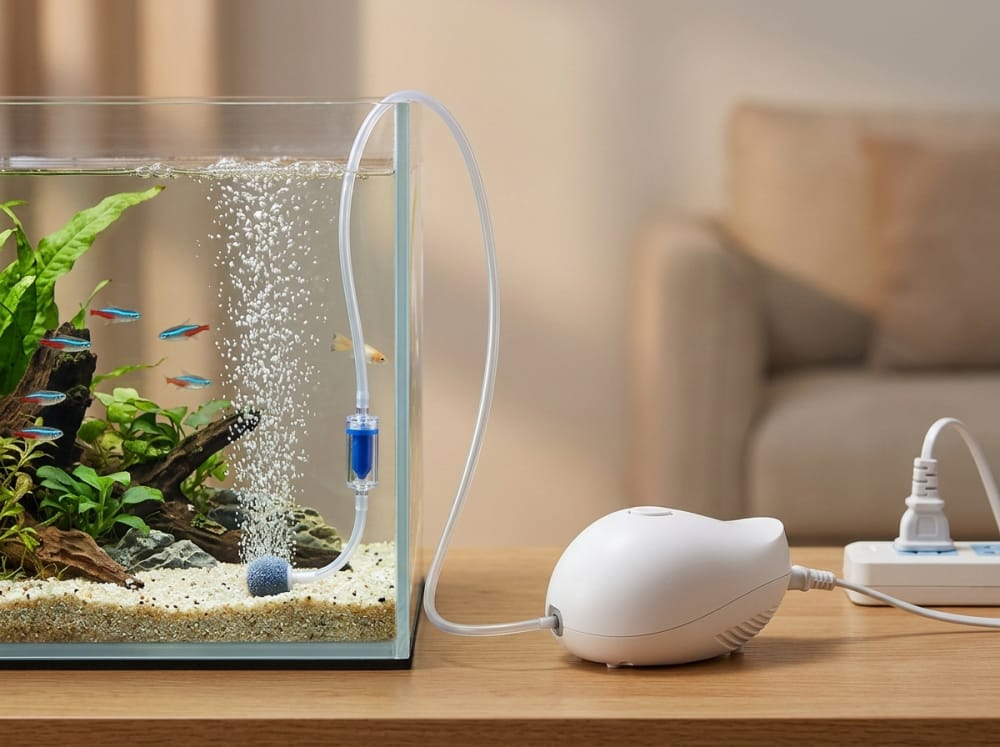
Filter vs Air Pump Debate
When aquarium owners compare a filter and an air pump, they are often comparing two devices that do different jobs, even though both can affect oxygen levels. A filter’s main role is mechanical, biological, and sometimes chemical filtration. An air pump’s main role is to move air through accessories such as air stones, sponge filters, corner filters, and decorative diffusers. The confusion starts because both can indirectly help oxygenation.
A hang-on-back filter pouring water back into the tank may create enough surface agitation to maintain healthy dissolved oxygen for a lightly stocked aquarium. A canister filter with a spray bar can do the same when positioned correctly. By contrast, an air pump connected to an air stone may add less actual oxygen than people assume if the bubbles rise through still water without creating meaningful surface exchange. The best setup depends on tank geometry and livestock load.
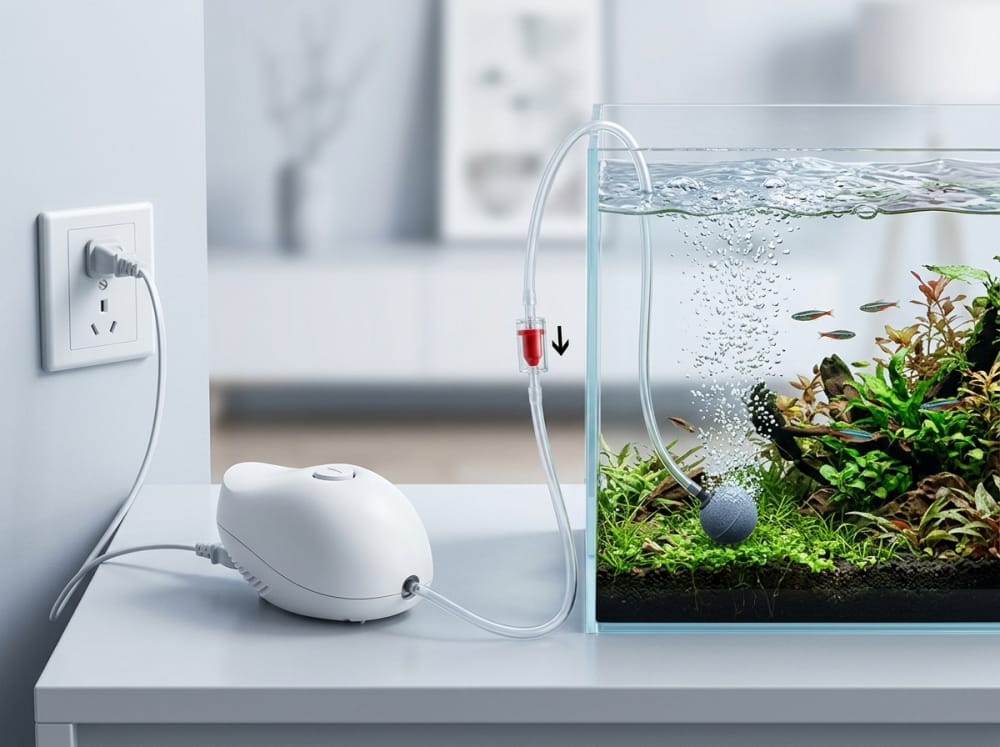
There are also cases where the air pump is part of the filter. A sponge filter uses an air pump to pull water through foam media, combining biological filtration with aeration. This makes sponge filters extremely popular in breeding racks, shrimp systems, quarantine tanks, and retail back rooms across the United States. They are affordable, easy to maintain, and safe for fry.
Noise and efficiency matter too. Many U.S. buyers now prefer compact pumps with vibration control because tanks are often placed in bedrooms, studios, offices, dorm rooms, and reception spaces. The strongest pump is not always the best pump. Oversized airflow can stress certain species, create salt creep in marine systems, or increase evaporation in dry climates such as Arizona and Nevada.
The line chart reflects a realistic market direction in the United States: demand for compact aeration solutions is rising steadily as more hobbyists adopt nano tanks, home offices, smaller living spaces, and backup oxygen systems. Growth is also influenced by stronger awareness of animal welfare, quieter hardware expectations, and a broader interest in resilient aquarium systems.
| Feature | Filter | Air Pump | Best For | Limitations | Buying Note |
|---|---|---|---|---|---|
| Primary purpose | Clean and circulate water | Drive air accessories | Most aquariums need filtration first | Different core functions | Do not treat them as identical |
| Oxygen support | Often strong if surface is disturbed | Helpful if paired with good agitation | Community tanks and hospital tanks | Depends on setup | Watch surface movement |
| Noise level | Usually motor and water noise | Usually vibration and airflow noise | Bedroom tanks | Cheap units can hum | Choose low-vibration models |
| Use with fry | Some filters too strong | Excellent with sponge filters | Breeding and shrimp tanks | Needs check valve and tubing | Gentle airflow is ideal |
| Backup during outages | Limited unless battery system exists | Battery air pumps available | Storm-prone regions | Not full filtration substitute | Keep emergency aeration ready |
| Maintenance burden | Media cleaning required | Stone and diaphragm wear | Routine care plans | Output drops over time | Replace parts on schedule |
The table makes the practical answer clear: a filter and an air pump are not competitors in every case. They are tools that may overlap. In many U.S. household aquariums, the smartest choice is not filter or air pump, but filter first and air pump only when conditions justify it.
Surface Agitation Explained
Surface agitation is the most misunderstood concept in aquarium oxygenation. It does not mean violent splashing. It means moving the top layer of water enough that a fresh interface with the air is constantly renewed. This movement helps oxygen dissolve and carbon dioxide escape. A perfectly still surface may look calm, but it can limit gas exchange, especially in warm or heavily stocked tanks.
Think of the aquarium surface as the tank’s breathing zone. If only a small area moves, oxygen exchange is limited. If the full surface ripples steadily, gas exchange improves. This is why a correctly aimed filter return often performs better than a random bubble column placed in one corner. It is also why dead spots can exist in aquariums that technically have filtration but poor circulation.
Water temperature changes the equation. Cooler water holds more oxygen than warmer water. This is critical in parts of the United States where indoor temperatures rise in summer, especially in cities such as Phoenix, Dallas, Orlando, and Sacramento. During heat waves, even a tank that looked stable in spring may need extra surface agitation or aeration.
Tank dimensions also matter. A long 20-gallon aquarium has more surface area than a tall 20-gallon aquarium, so it often exchanges gases more easily. Deep tanks, aquascapes with dense hardscape, and systems with heavy lids can all affect airflow and circulation. Even decorative choices such as thick plant mats can reduce open surface movement if not managed well.
The area chart highlights a clear trend shift: U.S. aquarium keepers are moving away from the idea that more bubbles automatically mean better oxygenation. Instead, they favor balanced flow, controlled agitation, energy efficiency, and quieter systems. By 2026, expect more compact pumps with adjustable output, lower vibration, and smarter airflow management for mini and mid-sized tanks.
| Surface Condition | Gas Exchange Quality | Visual Sign | Likely Oxygen Result | Common Cause | Fix |
|---|---|---|---|---|---|
| Still surface | Poor | Mirror-like top water | Low margin of safety | Weak return flow | Raise surface movement |
| Light ripple | Good | Gentle moving reflections | Usually adequate | Balanced filter return | Monitor regularly |
| Moderate agitation | Very good | Visible rolling movement | Strong oxygen support | Well-positioned outlet | Ideal for many tanks |
| Localized bubbling only | Variable | One bubbling corner | Can be misleading | Air stone with poor circulation | Improve whole-tank flow |
| Violent splashing | High exchange but inefficient | Noise and spray | High oxygen, high evaporation | Overpowered return | Reduce output |
| Blocked surface by plants | Reduced | Dense floating cover | Night oxygen drops possible | Overgrown floaters | Thin the surface cover |
The explanation here is straightforward: your goal is not dramatic turbulence. Your goal is consistent, tank-wide surface renewal. That is what keeps oxygen stable and livestock comfortable.
Myths About Oxygen Levels
Several myths continue to shape poor buying decisions in the aquarium market. The first myth is that fish can always tell you when oxygen is low before danger becomes serious. In reality, surface gasping is already a warning sign that the system may be under stress. Sensitive species can weaken before obvious behavior appears.
The second myth is that plants remove the need for oxygen management. Plants can produce oxygen during the light period, but at night they consume oxygen just like fish and bacteria. A densely planted tank may be stable all day and still experience a nighttime oxygen dip, especially in heavily stocked aquariums or tanks with strong carbon dioxide injection.
The third myth is that more bubbles always equal more oxygen. Visible bubbles are not the same as dissolved oxygen. Large bubbles rise quickly and may contribute less than expected if they do not create meaningful circulation or surface exchange. A properly placed filter outlet can outperform a decorative bubble column in many situations.
The fourth myth is that small tanks are easier to oxygenate because they hold fewer fish. Small tanks actually change faster. A missed cleaning, overfeeding event, or hot afternoon can reduce oxygen margin quickly in a nano system. This is one reason mini air pumps remain relevant in the United States market, particularly for apartment keepers and desktop aquarium owners.
The fifth myth is that if a fish species can gulp air occasionally, aeration is unimportant. Species such as bettas and gouramis can access atmospheric air, but they still benefit from stable water quality and dissolved oxygen. Labyrinth fish are not a reason to neglect circulation.
The bar chart shows where added aeration is most commonly needed. Quarantine tanks, breeding racks, and goldfish systems rank high because they combine biological stress, limited water volume, or high waste load. Standard community tanks sit lower because many of them already receive enough oxygen support from filtration when properly configured.
| Myth | Reality | Why People Believe It | Actual Risk | Example | Correct Approach |
|---|---|---|---|---|---|
| Bubbles alone oxygenate water | Surface exchange matters more | Bubbles are visible | Low oxygen despite bubbles | Decorative column in a corner | Focus on circulation pattern |
| Plants solve all oxygen issues | Plants also consume oxygen at night | Planted tanks look healthy | Morning stress in dense tanks | CO2 aquascape in Seattle | Check nighttime conditions |
| Bettas never need aeration support | They still need good water conditions | They can gulp air | Chronic stress in warm bowls | Unfiltered desk tank | Provide filtration and movement |
| Coldwater fish are always safe | Waste load still affects oxygen | Cool water holds more oxygen | Overstocked goldfish struggle | School tank in Minnesota | Add aeration if bioload is high |
| Small tanks are simpler | They are less stable | Lower water volume seems easy | Rapid parameter swings | 5-gallon shrimp cube | Use careful monitoring |
| If fish are not gasping, oxygen is fine | Stress can begin earlier | Symptoms are delayed | Hidden chronic weakness | Warm tank in July | Prevent rather than react |
These myths are important because they affect how people buy equipment. Stronger hobby education leads to better outcomes, lower livestock loss, and more rational equipment decisions.
When You Don’t Need an Air Pump
You usually do not need an air pump when the aquarium has adequate filtration, moderate stocking, stable temperature, clean water, and visible surface movement across a meaningful portion of the tank. Many standard community aquariums in U.S. homes run very well this way. If fish behave normally, dissolved oxygen is stable, and the filter return creates consistent rippling, a dedicated air pump may not add much practical benefit.
This often applies to lightly stocked tanks with small schooling fish, shrimp-focused planted tanks with careful maintenance, and aquariums using hang-on-back or canister filtration that already create strong gas exchange. A rimless display in San Francisco, a family aquarium in suburban Illinois, or an office aquascape in Charlotte may all run perfectly without separate aeration if design and maintenance are sound.
Owners also skip air pumps to reduce visual clutter, salt creep, splashing, evaporation, and noise. In dry climates such as Denver or Albuquerque, excessive aeration can slightly increase evaporation, which may matter to owners trying to keep maintenance simple. In planted displays, too much agitation can also drive off added carbon dioxide faster than desired during the photoperiod.
Still, not needing an air pump today does not mean never needing one. Seasonal heat, higher stocking, a clogged filter, medication, bacterial bloom, or a power event can change oxygen demand quickly. Smart keepers often keep a compact pump or battery backup available even if it is not used daily.
| Condition | No Air Pump Likely Fine? | Reason | Typical Setup | What to Watch | Action Threshold |
|---|---|---|---|---|---|
| Moderate stocking | Yes | Lower oxygen demand | 20-gallon tetra tank | Normal activity | Add aeration if crowding increases |
| Strong filter ripple | Yes | Good gas exchange | Hang-on-back return | Stable surface movement | React if flow drops |
| Cool room temperature | Yes | Water holds more oxygen | Basement fish room | Seasonal temperature changes | Support in summer if needed |
| Low bioload planted tank | Often yes | Balanced system | Shrimp cube in Oregon | Nighttime behavior | Add night aeration if stressed |
| Open surface area | Yes | Better air-water exchange | Long shallow tank | Plant overgrowth | Trim floaters when dense |
| Frequent maintenance | Yes | Cleaner system uses oxygen more predictably | Well-kept office aquarium | Filter clogging and waste buildup | Add support if conditions slip |
The takeaway is not that air pumps are unnecessary. It is that a healthy aquarium can meet oxygen needs through different designs. If your current system consistently maintains safe oxygen exchange, extra bubbling may be optional rather than essential.
When You Absolutely Do
There are situations where an air pump moves from optional to strongly recommended or absolutely necessary. The first is heavy stocking. Goldfish, large cichlids, livebearer grow-out tanks, and retail holding systems consume oxygen rapidly and produce significant waste. These tanks benefit from both strong filtration and active aeration.
The second is warm water. Oxygen solubility drops as temperature rises. During U.S. summer peaks, aquariums in warmer climates may see lower oxygen levels even if equipment has not changed. Heat waves in Arizona, Texas, Florida, and inland California often expose tanks that were only barely balanced.
The third is medication or disease treatment. Some medications reduce oxygen availability or stress fish respiration. Hospital and quarantine tanks therefore commonly use sponge filters and air pumps. Recovery tanks in breeding rooms, stores, and hobby fish rooms from New Jersey to California often rely on this simple and dependable setup.
The fourth is power outage preparedness. Storm-prone areas along the Gulf Coast, Atlantic coast, and inland tornado zones benefit from battery-powered aeration backups. During outages, filtration stops and oxygen can fall surprisingly fast, especially in stocked tanks with large fish.
The fifth is breeding and fry care. Young fish and eggs often need gentle, consistent water movement without strong suction. Air-driven sponge filters remain one of the safest and most effective tools for this purpose. The sixth is deep or poorly circulated aquariums with dead zones, where localized low oxygen can develop despite seemingly active equipment.
This comparison chart reflects a common purchasing reality in the United States. Buyers increasingly compare not just price, but noise control, airflow consistency, fit for mini and mid-sized tanks, and emergency reliability. A quality compact pump often delivers better long-term value than a louder low-cost unit that needs earlier replacement.
Real Aquarium Case Analysis
Case analysis helps turn theory into decision-making. Consider a 10-gallon betta and snail aquarium in Brooklyn with a hang-on-back filter adjusted to low flow. The water surface shows a gentle ripple, the stocking is light, and room temperature remains stable most of the year. In this case, a separate mini air pump may not be necessary. However, if the owner uses a lid that traps heat in summer and floating plants cover most of the surface, nighttime oxygen risk may rise. A small air stone on a timer or a better outlet angle could solve the problem.
Now consider a 29-gallon goldfish tank in Houston. Even with strong filtration, goldfish create heavy waste and consume oxygen aggressively. Summer room temperatures can elevate water temperature, and the fish’s metabolism further increases oxygen demand. Here, extra aeration is not just helpful; it is a wise baseline setup. A quiet mini or mid-sized air pump feeding one or two air stones improves margin and supports beneficial bacteria.
A third case is a planted shrimp breeding rack in Portland using multiple sponge filters. In this setup, the air pump is both the filtration driver and the oxygen source. Gentle airflow keeps biofiltration active, protects shrimplets, and creates manageable circulation without high suction risk. This is one reason air-driven systems remain standard in breeding operations nationwide.
A fourth case is a marine quarantine tank in San Diego used for new arrivals. Medication, stress, and limited decor make oxygen support essential. A sponge filter powered by a dependable air pump is often the safest solution because it combines biological support with strong gas exchange and low mechanical complexity.
A fifth case is a classroom aquarium in Minneapolis with a basic internal filter and inconsistent maintenance during school breaks. Even if the tank seems stable during the semester, holidays, feeding changes, and filter neglect raise oxygen risk. Adding a compact air pump can provide useful redundancy and reduce the chance of a preventable problem.
| Case | Location | Tank Setup | Air Pump Needed? | Main Reason | Final Recommendation |
|---|---|---|---|---|---|
| Betta nano tank | Brooklyn, New York | 10-gallon, light stock, HOB filter | Not always | Filter may already oxygenate enough | Use only if surface becomes blocked |
| Goldfish aquarium | Houston, Texas | 29-gallon, high waste load | Yes | Warm water and bioload | Add air stone and strong circulation |
| Shrimp breeding rack | Portland, Oregon | Multiple sponge filters | Yes | Air-driven biofiltration | Use adjustable quiet pump |
| Marine quarantine tank | San Diego, California | Medication-ready simple system | Yes | Stress and oxygen demand | Run sponge filter continuously |
| Office community tank | Charlotte, North Carolina | Moderate stock, canister filter | Usually no | Good return flow | Keep backup pump available |
| Classroom tank | Minneapolis, Minnesota | Variable care schedule | Often yes | Redundancy during inconsistent maintenance | Add compact aeration support |
These case studies show that oxygen decisions should reflect actual conditions, not assumptions. The same species can need different support in different climates, rooms, and maintenance patterns.
Expert Recommendations
Expert advice begins with observation and measurement. Watch fish behavior in the early morning, after feeding, during hot weather, and after maintenance. If fish gather near the top, breathe rapidly, or become unusually inactive, investigate oxygen support immediately. Use a dissolved oxygen meter if managing sensitive livestock, breeding systems, or commercial setups.
For buyers in the United States market, choose air pumps based on tank volume, intended use, noise tolerance, and airflow stability rather than only maximum output. Mini and mid-sized pumps should deliver consistent air pressure, reliable diaphragm life, and low vibration. Adjustable flow is valuable because many tanks need gentle support, not constant high-output bubbling.
Technological capability matters when evaluating equipment suppliers. Manufacturers focused on precision airflow engineering typically produce more stable low-noise pumps, better diaphragm performance, and more consistent output for small aquariums. In compact systems, these refinements matter more than oversized marketing claims because even a small fluctuation in airflow can affect sponge filter performance or nighttime oxygen stability.
Manufacturing capability also matters. Suppliers with specialized production experience in mini and mid-sized aeration products often deliver tighter quality control, better component fit, and more dependable performance across batches. In practical terms, that means fewer vibration issues, fewer weak diaphragms, and more consistent use in home tanks, breeder racks, and commercial support systems.
Service capability matters just as much. U.S. buyers increasingly want clear sizing guidance, practical product matching, and responsive support for replacement cycles, setup questions, and application advice. Companies that focus deeply on a narrow product category usually provide better fit recommendations than general suppliers trying to cover every aquarium category at once. That specialization is often the difference between buying hardware and building a reliable oxygen strategy.
In our view, shaped by a decade of focused experience and dozens of successful client collaborations, the best results come from doing one thing exceptionally well rather than chasing every category in aquatics. That is why focused development in high-performance mini and mid-sized air pumps and air stones remains so relevant for U.S. hobbyists, stores, and aquaculture users seeking dependable, quiet, and efficient aeration.
Looking toward 2026, three trends are especially important. First, quieter and more efficient compact aeration technology will continue to gain market share as tanks move into living spaces and workspaces. Second, sustainability and energy efficiency will influence product design, packaging, and consumer choices. Third, animal welfare expectations and retail standards may push more suppliers and public-facing aquarium businesses to adopt backup oxygen planning, especially in transport, quarantine, and display systems. State-level efficiency expectations and broader supply-chain scrutiny may also encourage longer-life components and lower-waste replacement strategies.
For U.S. buyers comparing local suppliers, distributors near trade hubs such as Los Angeles, Long Beach, Houston, Savannah, and Newark often offer faster fulfillment for aquarium accessories. But speed alone should not decide the purchase. Ask about airflow ratings under load, noise control, diaphragm replacement cycles, compatibility with air stones and sponge filters, and suitability for your exact aquarium dimensions.
Buying advice can be summarized simply. If your filter already keeps the surface moving and livestock is light, an air pump may be optional. If your tank is stocked heavily, runs warm, holds messy fish, supports breeding, or serves quarantine duty, an air pump is often a smart and cost-effective necessity. If you are unsure, choose a quiet adjustable unit and use it as flexible support rather than waiting for a crisis.
Frequently Asked Questions
Can fish survive without an air pump? Yes, many can, as long as the aquarium still has enough oxygen exchange through surface agitation and proper circulation.
Is a filter enough oxygen for most tanks? Often yes for lightly to moderately stocked aquariums, especially when the return flow ripples the surface clearly.
Are air stones better than filters? They are not better in every way. Air stones improve aeration support, while filters provide essential water cleaning and biofiltration. Many systems benefit from both.
Do bettas need bubbles? Not necessarily, but they do need stable water quality, filtration, and an oxygen-safe environment, especially in warm rooms.
When should I add a mini air pump? Add one when fish load is high, water is warm, oxygen stress appears, medication is in use, or you need a sponge filter or backup aeration.
What should U.S. buyers look for in 2026? Low noise, stable airflow, energy efficiency, durable parts, and supplier expertise in mini and mid-sized aeration products.
The final answer is practical and clear. Fish do not automatically need an air pump, but aquariums always need oxygen exchange. In many U.S. tanks, a well-configured filter provides enough surface agitation. In others, especially warm, stocked, breeding, quarantine, or goldfish systems, a mini air pump is one of the simplest ways to protect fish health and strengthen system stability.