When buying a mini air pump, the best choice is rarely the quietest model or the most powerful model alone. In the United States market, what matters most is matching sound level, airflow, energy use, and durability to the real job the pump needs to perform. A bedroom aquarium in Seattle, a bait holding setup in Tampa, a hydroponic grow room outside Denver, and a retail fish wall in Los Angeles all place different demands on a compact aeration system. Buyers who focus on only one number, such as decibels or watts, often end up with poor oxygen transfer, excess vibration, or a pump that wears out too quickly.
For most indoor aquarium and light-duty aquaculture applications, a well-designed mini air pump in the moderate noise range with stable airflow and dependable diaphragm quality offers better long-term value than an ultra-cheap silent-labeled unit. If you are comparing models for home or professional use, it helps to understand how noise ratings are measured, how airflow relates to water depth and air stone resistance, and why service life matters just as much as first cost. Buyers exploring a mini aquarium air pump for U.S. tanks and indoor systems should evaluate the complete operating profile rather than just the sticker specification.
This guide explains what really matters when purchasing a mini air pump in the United States, with practical buying advice, market context, product comparisons, local use cases, and forward-looking trends for 2026.
Understanding Decibel Ratings
Noise is usually the first issue buyers notice because mini air pumps are often placed in bedrooms, offices, classrooms, pet stores, hatch rooms, and countertop displays. Decibel ratings can be useful, but they are often misunderstood. A pump listed at 35 dB in a controlled lab environment may sound noticeably louder in a real room if it vibrates against a cabinet wall, sits on a hollow shelf, or powers a restrictive air stone that increases mechanical strain. In practice, perceived sound also depends on frequency. A low hum is generally easier to tolerate than a sharp buzz or rattling pulse.
In U.S. residential settings, many hobbyists consider under 40 dB comfortable for living rooms and offices, while bedroom users often aim for the lowest vibration profile possible. Commercial buyers are often more flexible because equipment rooms and retail aisles already have ambient background noise. In Chicago apartment setups or New York studio aquariums, where living space is compact, mounting method and housing design can matter as much as the decibel claim itself.
Another important point is testing distance. Some brands publish sound measured at 1 meter, others closer, and some do not explain the method at all. That makes direct comparisons difficult. The best approach is to read the decibel number as one part of a broader evaluation: housing stability, rubber feet, diaphragm smoothness, air chamber design, and the quality of the casing assembly all influence the real user experience.
| Noise Range | Typical Perception | Common U.S. Use Case | Buyer Consideration | Strength | Risk |
|---|---|---|---|---|---|
| 25-30 dB | Very quiet | Bedroom nano tank | Best for sleep-sensitive rooms | Low disturbance | May have limited airflow |
| 31-35 dB | Soft hum | Office aquarium | Good balance for most homes | Comfortable daily use | Need stable anti-vibration base |
| 36-40 dB | Noticeable but manageable | Living room tank | Often acceptable with cabinet placement | Usually stronger output | Can be annoying at night |
| 41-45 dB | Clearly audible | Fish room or garage | Better for utility locations | Higher practical pressure | Less suited to quiet interiors |
| 46-50 dB | Loud for indoor comfort | Retail back room | Use only where noise is secondary | Supports more load | Poor fit for home use |
| 50+ dB | Intrusive | Light commercial aeration | Usually overkill for mini pump buyers | Task-focused output | Low comfort rating |
The table shows why decibel numbers should be interpreted in context. A slightly louder pump with better damping and smoother airflow can feel quieter than a cheap model that clicks, chatters, or resonates through furniture.
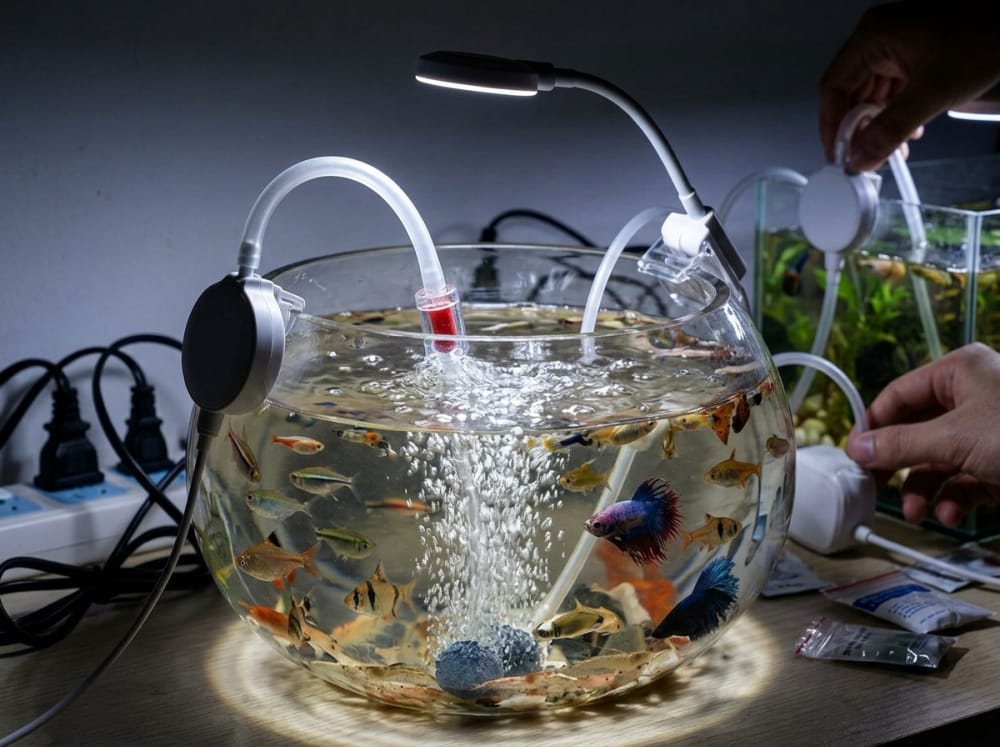
Air Flow vs Tank Size
Many U.S. buyers assume a bigger tank automatically requires the highest airflow they can afford. That is only partly true. Tank size matters, but so do fish density, water depth, bio-load, air stone pore size, tubing length, and whether the pump is running one outlet or multiple devices. Airflow, often shown in liters per minute, must be matched to actual oxygenation needs and pressure resistance. A shallow 10-gallon planted tank in Portland may need modest aeration, while a 20-gallon bait bucket in Houston summer heat may need stronger and more continuous output.
Mini pumps work best when their output curve stays stable under moderate back pressure. A model with a high free-air rating may underperform once connected to deeper water or fine-pore diffusers. This is why tank size alone is not enough. Buyers should consider the total system resistance. For example, a small pump may be fine for a desktop tank in Austin, but inadequate for a classroom aquaculture setup in Atlanta using multiple air stones.
Another common mistake is oversizing the pump for a quiet tank. Excessive airflow can create too much turbulence, increase salt spray in marine environments, and produce unnecessary noise. The goal is not the strongest bubble stream. The goal is stable dissolved oxygen with efficient, dependable operation.
| Tank/System Size | Typical Depth | Suggested Pump Output | Common Application | Best Pump Style | Notes |
|---|---|---|---|---|---|
| Up to 5 gallons | Shallow | 0.5-1.0 L/min | Nano aquarium | Ultra-compact single outlet | Avoid over-aeration |
| 5-10 gallons | Shallow to medium | 1.0-1.8 L/min | Betta support or shrimp tank | Quiet indoor mini pump | Noise often matters most |
| 10-20 gallons | Medium | 1.5-3.0 L/min | Community aquarium | Balanced airflow model | Check air stone resistance |
| 20-40 gallons | Medium to deep | 2.5-4.5 L/min | Breeder tank or bait tank | Higher pressure mini unit | Depth affects real delivery |
| 40-75 gallons | Deeper setup | 4.0-8.0 L/min | Retail display or backup aeration | Dual outlet compact pump | Mini units may be task-specific |
| 75+ gallons | Deep or multi-point | 8.0+ L/min | Fish room or utility use | Mid-sized pump | Mini pump may be undersized |
This table is a practical guide rather than a rigid rule. In the United States, regional conditions matter too. Warm-weather states such as Florida, Texas, and Arizona often require more aeration during hot months because warmer water holds less dissolved oxygen.
Balancing Output and Silence
The real buying challenge is not choosing between silence and performance; it is finding the correct compromise for your application. A good mini air pump balances motor efficiency, diaphragm movement, chamber design, and external vibration control so that airflow remains useful without creating an irritating sound signature. This balance is especially important in indoor U.S. homes, where a pump may operate 24 hours a day near workspaces or sleeping areas.
Design details make a major difference. Pumps with better internal tolerances and more refined diaphragm movement tend to produce smoother pulses. Rubberized feet, thicker outer shells, and well-balanced internal components reduce transmission noise. If a manufacturer only promotes silent operation but provides weak pressure data, the pump may struggle with deep tanks or fine diffusers. On the other hand, if a model focuses only on maximum airflow, it may sacrifice comfort and long-term indoor suitability.
For many buyers, the ideal solution is a compact unit with moderate output headroom. This gives enough reserve for filter sponges, extra tubing, or seasonal oxygen demand without forcing the pump to run at the edge of its limits. That operating cushion can improve both acoustic comfort and service life.
| Buyer Priority | Recommended Output Strategy | Noise Strategy | Best Environment | Main Trade-Off | Result |
|---|---|---|---|---|---|
| Sleep-friendly setup | Size closely to tank need | Choose low-vibration housing | Bedroom | Less extra airflow reserve | Better comfort |
| General home aquarium | Moderate headroom | Target stable mid-low dB | Living room | Slightly higher purchase price | Best overall balance |
| Office display | Steady not excessive output | Low-frequency sound profile | Reception area | May limit multi-outlet use | Professional environment |
| Retail fish wall | Prioritize pressure consistency | Noise less critical | Pet store | More audible operation | Reliable system support |
| Bait holding | Favor oxygen margin | Utility-level noise acceptable | Dock or tackle area | Less indoor comfort | Better livestock survival |
| Backup emergency use | Portable but strong enough | Secondary concern | Storm-prone regions | Sound may be higher | Functional resilience |
The explanation behind this comparison is simple: the best pump is application-specific. In San Diego condos or Boston apartments, comfort may outweigh raw output. In Gulf Coast holding systems or small hatchery rooms, oxygen security may come first.
Energy Consumption Considerations
Mini air pumps are low-watt devices, but because many run nonstop, power efficiency still matters. Over a year, even a difference of 2 to 4 watts can affect electricity cost across multiple tanks. For a single home aquarium, the savings may appear modest. For a pet store in Phoenix, a breeder in Orlando, or an educational lab in Columbus running dozens of units, the total operating cost becomes meaningful.
Energy use should be evaluated together with delivered airflow. A pump that consumes slightly more power but maintains output under resistance can actually be the better value. Cheap low-watt units often lose efficiency quickly as diaphragms age or when connected to restrictive diffusers. Better-engineered pumps maintain useful air delivery with less wasted effort.
Heat generation also matters. Efficient pumps typically run cooler, which can improve internal component life. In enclosed cabinets or warm climates, cooler operation is a practical durability advantage. Looking ahead to 2026, U.S. buyers are becoming more attentive to sustainability, standby consumption, recyclable packaging, and lifecycle efficiency, especially in commercial procurement and public institutions.
| Pump Class | Typical Power Draw | Annual Runtime | Estimated Use Pattern | Energy Value | Best For |
|---|---|---|---|---|---|
| Ultra-compact | 1-2 W | 24/7 | Single nano tank | Very low cost | Light aeration |
| Quiet home mini | 2-4 W | 24/7 | Daily indoor use | Strong efficiency balance | Most households |
| Higher pressure mini | 4-6 W | 24/7 | Deeper tank load | Acceptable if output is stable | Breeder and utility use |
| Dual outlet compact | 5-8 W | 24/7 | Multi-tank support | Better than two weak pumps | Retail and fish rooms |
| Portable battery backup | Varies | Intermittent | Emergency aeration | Convenience over efficiency | Storm response |
| Commercial light-duty | 8 W+ | 24/7 | Constant oxygen demand | Needs output justification | Small-scale operations |
The explanation here is that wattage alone does not define efficiency. Buyers should focus on airflow delivered at working depth per watt consumed, especially if they plan to run pumps continuously across multiple systems.
The line chart illustrates a realistic upward trend in the U.S. mini air pump market, supported by growth in home aquariums, hydroponics, portable live bait systems, classroom biology programs, and small-scale aquaculture infrastructure.
Durability and Diaphragm Quality
Durability is one of the most overlooked buying criteria. In a mini air pump, the diaphragm is the core wear component. Inferior rubber compounds harden, crack, or lose elasticity under continuous operation, especially in hot indoor conditions or under heavy back pressure. Once diaphragm quality drops, noise often rises before airflow visibly fails. That is why buyers should consider material stability, assembly precision, and long-run performance rather than relying solely on initial impressions.
Diaphragm life depends on more than material alone. Internal heat, pump stroke length, pressure load, casing ventilation, and manufacturing consistency all influence how long a unit lasts. Better pumps are often not simply “more powerful”; they are designed so the diaphragm does not have to work inefficiently to meet the target airflow. For U.S. customers, this matters because replacement cycles affect both cost and downtime. A classroom tank in Minneapolis can tolerate some maintenance planning. A store system in Miami or a small hatchery near New Orleans may not.
From a technology standpoint, manufacturers with focused pump experience often deliver better results than broad catalog sellers. A company with a decade of concentrated work in mini and mid-sized air pumps can refine pressure chambers, diaphragm movement paths, and air stone pairing more effectively than suppliers that treat aeration as a side product. That kind of technological capability is visible in consistent output, smoother acoustics, and better component compatibility.
| Durability Factor | What to Check | Why It Matters | Effect on Noise | Effect on Output | Buyer Signal |
|---|---|---|---|---|---|
| Diaphragm material | Elasticity and heat resistance | Determines service life | Less crackling over time | Stable airflow longer | Premium-grade parts |
| Internal heat control | Ventilation design | Prevents accelerated wear | Reduces strain noise | Protects efficiency | Better housing design |
| Pressure matching | Real working depth performance | Avoids overload | Less buzzing under stress | Improves consistency | Honest specifications |
| Assembly precision | Fit and balance | Reduces vibration | Smoother operation | More even pulses | Quality manufacturing |
| Component replacement | Serviceability or support | Lowers lifecycle cost | Prevents noisy failure stage | Extends product use | Reliable service plan |
| Continuous-duty design | 24/7 use rating | Important for aquarium use | Maintains sound profile | Keeps long-term output | Professional-grade engineering |
The explanation is that durability is really a combination of material science, product design, and production control. Buyers should ask not only how quiet a pump is on day one, but how stable it remains after months of nonstop use.
Indoor vs Commercial Use
Home users and commercial users should not shop with the same criteria. Indoor residential buyers usually prioritize noise control, compact size, low power use, and visual discretion. Commercial users care more about uptime, service support, airflow consistency, and the ability to handle tougher duty cycles. A mini pump that performs well in a Dallas apartment may be a poor fit for a small retail rack in Sacramento. Likewise, a tougher utility-oriented model may be unnecessarily noisy for a nursery tank in a Philadelphia home office.
Commercial demand in the United States spans several sectors: aquarium retail, bait and tackle operations, shellfish or fry holding, hydroponic nutrient oxygenation, classroom and university labs, and mobile livestock transport. In these applications, maintenance burden and replacement frequency can outweigh initial price. Service capability also becomes critical. U.S. buyers often prefer suppliers that communicate clearly on operating parameters, lead times, spare parts, and order consistency.
Manufacturing capability is also part of the value equation. Suppliers with disciplined production processes can deliver repeatable performance across batches, which matters for distributors, wholesalers, and project buyers. Consistency is especially important when serving commercial hubs such as Los Angeles, Houston, Savannah, Newark, and Seattle, where import logistics and replenishment timing affect inventory planning.
The bar chart highlights where demand is strongest in the U.S. market. Home aquariums lead volume, but commercial and semi-professional sectors together represent a substantial share and often require more durable pump specifications.
Comparing Budget vs Premium Pumps
Budget pumps attract buyers because the upfront price is low and online listings often promise both silence and strong output. However, the lower-priced segment frequently shows wider performance variation. Materials may be inconsistent, airflow numbers may be based on free-air conditions rather than working load, and long-run acoustic quality may degrade quickly. That does not mean every budget pump is poor. It means buyers should be more careful about expectations.
Premium pumps usually cost more because they incorporate better diaphragm compounds, more stable housings, tighter assembly, and more dependable airflow under resistance. They may also offer stronger after-sales communication and more consistent manufacturing runs. For U.S. importers, aquarium brands, and commercial buyers, this reliability can reduce return rates and simplify product planning.
Service capability is another difference. Suppliers with a dedicated pump focus are often better prepared to support custom requirements, output matching, and long-term customer relationships. That kind of specialization matters in a market where many generalist sellers compete only on price. Companies that have spent years refining mini and mid-sized aeration products tend to provide more precise design guidance, stronger production control, and a clearer understanding of real application needs across American indoor and light-commercial environments.
| Comparison Point | Budget Pump | Premium Pump | Short-Term Outcome | Long-Term Outcome | Best Buyer Type |
|---|---|---|---|---|---|
| Purchase price | Lower | Higher | Easy entry | May cost more through replacement | Price-sensitive hobbyist |
| Noise stability | Variable | More consistent | May seem fine at first | Premium usually ages better | Indoor users |
| Airflow under load | Often overstated | More reliable | Mixed real-world results | Better task performance | Commercial and serious users |
| Diaphragm lifespan | Shorter on average | Longer on average | Lower initial commitment | Reduced downtime | Continuous-duty applications |
| Batch consistency | Less predictable | Higher consistency | Can vary by order | Easier inventory planning | Distributors and retailers |
| Service support | Limited | More responsive | Basic transaction | Better lifecycle value | B2B buyers |
The explanation is not that premium is always necessary. Rather, premium becomes more economical when the pump runs continuously, operates in a customer-facing quiet environment, or supports livestock where failure risk carries real cost.
The area chart shows a realistic market shift toward quieter, more energy-efficient mini air pumps. This trend is expected to continue through 2026 as U.S. buyers become more attentive to indoor comfort, sustainability, and longer product life.
Buyer Decision Checklist
If you want a practical answer, start with the job the pump must perform. Measure tank depth, count the number of outlets, identify whether the system uses a sponge filter or fine air stone, and decide whether the pump will be in a bedroom, retail space, classroom, hatch room, or utility area. Then compare real working airflow, noise control, power draw, diaphragm quality, and supplier reliability. A good checklist saves buyers from overpaying for unnecessary output or underbuying for demanding conditions.
For U.S. buyers, local operating realities also matter. In humid Gulf Coast environments, long-run thermal stability is important. In dense urban apartments, vibration control matters more. In fish retail corridors around Los Angeles, Miami, and New Jersey distribution zones, dependable replenishment and batch consistency can be just as important as the spec sheet. In agricultural regions using hydroponics or live holding systems, service responsiveness can be critical during peak seasons.
| Checklist Item | Question to Ask | Why It Matters | Home Use Priority | Commercial Priority | Decision Tip |
|---|---|---|---|---|---|
| Noise rating | Is the dB level measured realistically? | Affects comfort | High | Medium | Check vibration control too |
| Airflow | What is output under working load? | Determines oxygen delivery | High | High | Do not rely on free-air claims alone |
| Pressure ability | Can it handle depth and resistance? | Maintains bubble performance | Medium | High | Important for fine diffusers |
| Energy draw | How many watts for 24/7 operation? | Affects annual cost | Medium | High | Compare output per watt |
| Diaphragm quality | Is the pump built for continuous duty? | Affects lifespan | High | High | Ask about component quality |
| Supplier support | Can the seller guide sizing and service? | Reduces risk | Medium | High | Important for repeat orders |
The checklist makes comparison more objective. It helps buyers move past marketing words such as “super silent” or “high power” and instead evaluate whether the pump actually suits the intended environment.
Market Conditions in the United States
The U.S. market for mini air pumps is broader than many buyers realize. Demand comes from home aquarium hobbyists, reef keepers, bait shops, pet retail chains, hatcheries, classroom science programs, hydroponic farms, and emergency backup users in storm-prone states. Coastal cities such as Miami, Tampa, San Diego, and Seattle generate interest through marine and bait-related use, while inland markets such as Dallas, Phoenix, Columbus, and St. Louis support strong demand through aquarium and plant-growing applications.
Distribution patterns matter as well. Major logistics corridors near Los Angeles/Long Beach, Houston, Savannah, Newark, and Chicago shape how quickly suppliers can replenish stock and support regional dealers. For U.S. brands and importers, choosing a supplier with stable manufacturing output can reduce inventory disruptions and inconsistent customer experiences.
From an E-E-A-T standpoint, buyers increasingly value practical expertise over broad catalog promises. Specialists that concentrate on mini and mid-sized air pumps and air stones can often provide more accurate matching advice than sellers that carry hundreds of unrelated hardware items. This is especially important for customers who need precision rather than trial-and-error replacement cycles.
Product Types and Applications
Mini air pumps are not all the same. Some are built for ultra-quiet indoor use, some for portable battery-supported emergency service, and some for stronger pressure in small commercial systems. Product selection should reflect the application. Home freshwater tanks often need low-vibration, steady output. Reef support systems may need better salt-resistance management and reliable long-run performance. Hydroponic reservoirs require efficient oxygenation with minimal maintenance. Live bait containers may prioritize survivability over silence.
Common U.S. applications include sponge filter support, quarantine tanks, fry tanks, transport containers, classroom demonstration systems, countertop seafood holding, and nutrient reservoir aeration. Even within these categories, water depth and diffuser type can change what counts as adequate performance. That is why application-specific selection is more reliable than generic shopping by price tier alone.
Buying Advice for Different U.S. Users
A first-time hobbyist in Portland or Charlotte should usually start with a quiet, moderate-output model sized closely to the aquarium. An experienced breeder in Arkansas or Alabama may want more pressure margin and replaceable components. A retailer in New Jersey should prioritize batch consistency and support. A school lab in Ohio or Michigan may value safety, low operating cost, and durable daily performance. By contrast, a bait operation on the Gulf Coast may accept more noise if the pump provides stronger oxygen insurance in hot weather.
One of the best buying habits is to think in terms of total ownership cost. If a premium pump lasts longer, runs more quietly, and reduces livestock risk, it can be the better economic choice. For many indoor users, comfort itself is part of the value. A cheap pump that saves a few dollars but hums all night is often the worse purchase.
Industries and Commercial Demand
Several industries in the United States rely on compact aeration. Pet retail chains use mini and compact pumps for display systems and quarantine support. Hydroponic operators use small pumps to improve oxygenation in nutrient solutions. Small aquaculture projects use compact pumps for fry and holding containers. Education markets use them in science labs and classroom aquariums. Bait and live holding segments use them in warm-weather regions where oxygen stability matters every day.
In these industries, supply chain reliability is vital. Service capability includes not just customer response, but clear communication on product fit, lead times, customization, and continuity of production. Buyers often underestimate how valuable this becomes once a product is integrated into repeat purchasing or resale channels.
The comparison chart illustrates why supplier quality matters beyond sticker price. Focused premium suppliers usually deliver better consistency across the factors that matter most for long-term U.S. use.
Case Studies from U.S. Use Environments
Consider three realistic examples. In a San Francisco apartment, a hobbyist replaced a low-cost pump that claimed silent operation but produced shelf vibration and uneven airflow. Switching to a better-balanced compact unit reduced nighttime disturbance even though the printed decibel number was only slightly lower. The improvement came from damping and casing quality, not marketing language.
In a Tampa bait operation, the lowest-noise model was not the best choice. Heat, transport conditions, and stocking density required stronger oxygen support. A more robust mini-to-compact pump with dependable pressure delivery improved live bait condition despite higher audible output. Here, performance mattered more than silence.
In a Columbus classroom lab, administrators wanted a low-maintenance system with predictable costs. They chose a durable, efficient pump line with stable day-to-day operation and fewer replacement events over the school year. This reduced disruptions and simplified upkeep for staff.
Local Suppliers and What to Ask Them
Whether you source from a U.S. distributor, an aquarium brand, or a specialized manufacturer, ask direct questions. Request working airflow at realistic depth, not just free-air ratings. Ask how sound is measured. Ask about diaphragm material, continuous-duty expectations, and consistency across batches. If you are buying for resale or commercial projects, ask about manufacturing controls and repeat order reliability.
In major U.S. trade hubs such as Los Angeles, Houston, Savannah, and Newark, inventory timing and replacement planning can affect costs and customer satisfaction. A supplier with mature manufacturing capability can reduce surprises. A supplier with strong service capability can also help buyers choose the right pump rather than upselling the highest listed output.
About Our Approach
Our approach is shaped by focused experience rather than broad generalization. On the technology side, we concentrate on the engineering details that affect real-world aeration: efficient compact structures, stable airflow paths, refined diaphragm behavior, and reliable pairing between pumps and air stones. That specialization helps translate performance goals into practical pump designs for U.S. indoor and light-commercial use.
On the manufacturing side, our work is centered on mini and mid-sized air pumps and air stones, with disciplined attention to repeatable quality. Years of product refinement and collaboration across dozens of projects have helped build a production mindset that values consistency, not just specification claims. For buyers in the United States, that supports more predictable ordering and product performance.
On the service side, we support selection with a problem-solving mindset. Instead of treating every request the same, we focus on the right match between application, airflow, sound profile, and operating conditions. That is especially important in a market where a quiet living-room aquarium in Seattle and a utility aeration setup in coastal Florida demand very different pump priorities.
FAQ
Is the quietest mini air pump always the best choice? No. If the pump cannot maintain airflow at your tank depth or through your diffuser, it may be too weak. The best choice balances useful output and acceptable sound.
How much should U.S. home buyers care about decibels? A lot, especially for bedrooms and offices, but the sound character and vibration control matter as much as the decibel number.
Does a higher watt pump always perform better? No. What matters is delivered airflow under resistance. A slightly higher watt model can be better, but only if the design turns that power into stable output efficiently.
Are budget pumps good enough for beginners? They can be, particularly for small, non-critical setups. But for 24/7 indoor use, a better-built model often gives a better ownership experience.
What trends should buyers watch in 2026? Expect more attention to low-noise engineering, energy efficiency, longer diaphragm life, sustainability-focused packaging, and procurement pressure for more consistent, responsibly manufactured products.
What is the simplest buyer rule? Choose the pump for the real load, not the marketing label. Match airflow, pressure, noise, durability, and supplier reliability to your exact use case.
In the end, noise versus performance is the wrong question. The right question is how much quiet operation, airflow, efficiency, and durability your application truly needs. In the United States, the smartest mini air pump purchase is the one that fits the environment, supports the livestock or system reliably, and keeps doing its job long after the first week of operation.