If you are choosing a mini air pump in the United States, the best option is rarely the one with the highest airflow on the box. A strong buying decision balances output, noise, energy draw, tank size, durability, and safe continuous operation. For a small freshwater aquarium in Seattle, a quiet low-watt unit may be ideal. For bait holding tanks near Tampa, a stronger model with better thermal control matters more. For shrimp rooms in Houston or coral systems in San Diego, consistency over 24-hour operation becomes the deciding factor. The right pump is the one that delivers enough air at the depth you actually use, stays quiet in your living or work space, and holds up under daily operation without wasting electricity.
The U.S. market for mini and mid-sized aeration equipment has grown steadily because hobbyists, breeders, aquatic retailers, classroom labs, and transport operators all need compact airflow systems they can trust. Demand is especially visible in trade and logistics corridors such as Los Angeles, Long Beach, Miami, Newark, and Houston, where aquatic supply chains and livestock handling depend on dependable aeration. At the same time, consumers in cities like Chicago, Denver, Austin, Atlanta, and Portland increasingly expect low-noise products that fit apartment living, office settings, and insulated fish rooms. That combination of professional use and lifestyle-based demand has changed what “best” means in an air pump purchase.
Mini air pumps now span several product types. Some are built for basic ornamental tanks and decorative bubble walls. Others support sponge filters, breeding boxes, quarantine systems, hydroponic reservoirs, portable bait buckets, and air stone arrays. Many buyers are surprised to learn that a pump that works beautifully with one outlet and a shallow 10-gallon tank can struggle when paired with multiple splitters, longer tubing, deeper water, or fine-pore stones. That is why a careful comparison of wattage, pressure, and practical output matters more than a simple gallons-per-hour claim.
Across the United States, buyers also pay attention to support and product specialization. In our own work, we focus tightly on mini and mid-sized air pumps and air stones rather than trying to cover every category in aquatics. That specialization shapes how products are designed, built, and supported. Our engineering approach centers on stable airflow, vibration control, and component matching. Our manufacturing approach prioritizes repeatable assembly quality and durable materials for extended use. Our service approach helps customers compare tank size, outlet configuration, and acoustic expectations before they buy, which reduces mismatch and improves long-term satisfaction.
Below, you will find direct buying guidance, market context, formulas, tables, application examples, supplier comparisons, charts, and practical advice for both home and commercial users. The goal is simple: help you choose a mini air pump that performs well in real conditions across the U.S. market, not just on paper.
Understanding Wattage and Output
Wattage tells you how much electrical power a pump consumes, but it does not automatically tell you how much usable air reaches the tank. Output depends on motor efficiency, diaphragm design, chamber geometry, tubing resistance, water depth, outlet count, and the type of air stone or filtration device connected. In practical terms, two pumps rated at 3 watts can behave very differently once they are installed in a real aquarium room in Phoenix, a classroom in Boston, or a bait station along the Gulf Coast.
For mini air pumps, useful performance is best evaluated through a combination of airflow rate and pressure stability. Airflow is often listed in liters per minute, while pressure may be described with a maximum depth or back-pressure tolerance. If you use a fine-pore air stone, a deep sponge filter, or a gang valve feeding several tanks, pressure matters just as much as raw airflow. A low-pressure pump may produce a nice bubble stream in a shallow desktop tank, yet become weak and erratic when pushed to 20 or 24 inches of water depth.
In the United States, many small-tank buyers overspend on wattage because they assume more power always means better filtration. That can lead to excess turbulence, unnecessary noise, and higher operating cost. On the other hand, underpowered pumps are common in multi-tank fish rooms, especially among breeders who split one outlet too many. A better approach is to match output to the actual load. For example, a 5-gallon shrimp tank with a nano sponge filter may need only light, stable airflow. A 20-gallon quarantine setup with medication and higher oxygen demand may require a stronger air stream. A portable live bait bucket in coastal Florida may need enough reserve output to stay reliable during warmer months when dissolved oxygen drops faster.
| Pump Class | Typical Wattage | Common Airflow Range | Best Tank Use | Depth Tolerance | Buying Note |
|---|---|---|---|---|---|
| Nano desktop | 1.5-2.0 W | 0.8-1.5 L/min | 3-10 gallon tanks | Low | Best for light aeration and small sponge filters |
| Quiet home mini | 2.0-3.0 W | 1.5-3.0 L/min | 10-20 gallon tanks | Moderate | Good balance for living rooms and bedrooms |
| Dual outlet mini | 3.0-4.5 W | 2.5-4.5 L/min | 15-30 gallon or two small tanks | Moderate | Useful when airflow is split carefully |
| Breeder compact | 4.5-6.0 W | 4.0-7.0 L/min | Rack systems and quarantine rooms | High | Better for deeper tanks and multiple accessories |
| Portable bait aerator | 2.0-5.0 W | 1.5-5.0 L/min | Bait buckets and transport | Moderate | Runtime and battery compatibility matter |
| Mid-sized performance | 6.0-8.0 W | 6.0-10.0 L/min | Commercial small systems | High | Often more than needed for a single small tank |
The table shows why wattage alone should not drive your choice. The explanation is straightforward: the same power class can serve very different jobs depending on pressure handling and outlet configuration. Buyers should use wattage as a cost and heat indicator, then verify whether the delivered airflow matches their tank depth and accessories. This is especially important if the pump will run near sleeping areas or operate continuously in enclosed cabinets.
One practical way to shop is to start with the air device first. Ask what the pump must drive: an air stone, sponge filter, breeder box, undergravel uplift, or transport container. Then ask how deep the tank is and whether airflow will be split. If the answer includes fine stones, long tubing, or multiple outlets, choose a pump with a stronger pressure margin than the tank volume alone might suggest.
Noise Rating Comparison
Noise is one of the biggest reasons buyers return air pumps in the United States. A pump that sounds acceptable in a retail aisle may become unbearable on a nightstand in Brooklyn, in a nursery in Minneapolis, or in a home office in Raleigh. Noise ratings are usually listed in decibels, but published numbers can be misleading because testing conditions vary. Distance from the pump, surface material, cabinet resonance, tubing vibration, and the connected air stone all affect what you actually hear.
As a general guide, air pumps below 35 dB are considered very quiet in controlled conditions. Units in the 35-45 dB range are often acceptable for daytime household use. Once you move beyond that range, perception shifts quickly, especially in quiet rooms. But decibels are only part of the story. Tone matters. A soft, low hum is easier to live with than a high-pitched buzz or intermittent rattling. Mounting feet, housing rigidity, internal balancing, and diaphragm quality all influence sound character.
For apartment dwellers in New York City or San Francisco, noise reduction often outweighs maximum output. For fish stores in Dallas or warehouse prep rooms near Newark port facilities, constant background activity may make sound less important than airflow reliability. This is why buyers should compare not only rated decibels, but also construction features such as rubber feet, suspended motor mounts, reinforced housings, and anti-vibration casing geometry.
| Noise Range | Common Perception | Best Environment | Risk of Vibration Transfer | Typical Pump Type | Practical Advice |
|---|---|---|---|---|---|
| Under 30 dB | Near-whisper quiet | Bedrooms, offices | Low | Premium mini pump | Best for sleep-sensitive settings |
| 30-35 dB | Soft hum | Living rooms, study spaces | Low to moderate | Quiet home model | Usually acceptable without modification |
| 35-40 dB | Noticeable but manageable | General home use | Moderate | Standard mini pump | Use a mat to reduce furniture resonance |
| 40-45 dB | Clearly audible | Garages, utility rooms | Moderate to high | Dual-outlet utility model | May be too loud for nighttime use |
| 45-50 dB | Distracting indoors | Shops, workrooms | High | High-output compact | Choose only when airflow need is higher |
| Over 50 dB | Commercial feel | Industrial or back-room use | High | Heavy-duty aeration unit | Not ideal for small home aquariums |
This table is useful because it translates decibel figures into real listening conditions. The explanation buyers need is simple: a noise number means little unless you connect it to room type, mounting surface, and tolerance for continuous sound. A quiet-rated model is often worth paying more for in home settings because the quality of life benefit lasts as long as the pump does.
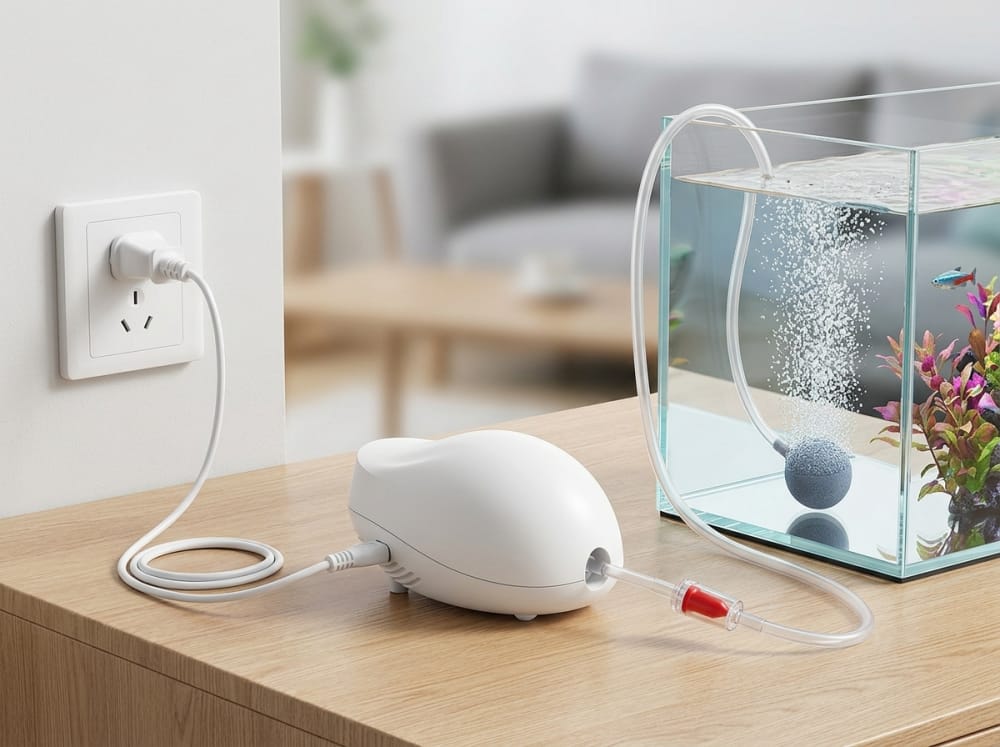
If low noise is your priority, it is worth considering a quiet mini air pump for U.S. aquarium setups that is designed specifically for reduced vibration and stable indoor use. Models in this category are especially attractive for tanks placed in bedrooms, reception counters, therapy offices, classrooms, and small apartment kitchens where mechanical hum becomes much more noticeable.
Energy Efficient Models
Energy efficiency matters because mini air pumps usually run 24 hours a day. A difference of even 1 or 2 watts becomes meaningful over a full year, especially in fish rooms with multiple tanks. In areas with higher residential utility rates, such as California, Massachusetts, and parts of New York, buyers increasingly compare annual operating cost along with purchase price. Efficient pumps do more than save power. They usually generate less heat, place less stress on diaphragms, and often maintain more stable long-run performance.
An energy-efficient air pump is not just a low-watt unit. It is a pump that delivers the required air volume at the lowest practical electrical draw without being pushed to its limit. A 2-watt pump struggling at full load all day can be less efficient in practice than a well-designed 3-watt pump operating comfortably within its optimal range. Motor architecture, internal airflow design, diaphragm elasticity, and pressure balance all contribute to real efficiency.
In the U.S. market, energy-conscious buyers include home aquarists, breeders, science labs, classroom programs, and hydroponic hobbyists. For example, a teacher in Columbus running three classroom tanks may care about low energy use and low noise equally. A breeder in Sacramento may focus on scaling costs across a room of sponge-filter tanks. A seafood holding operator near Baltimore may place more value on uptime and oxygen reserve, but still benefit from efficient pump selection when several units run continuously.
| Wattage | Daily Runtime | Annual kWh | Estimated Cost at $0.16/kWh | Typical Use | Efficiency Comment |
|---|---|---|---|---|---|
| 1.5 W | 24 hours | 13.14 | $2.10 | Nano tank | Very low cost but limited pressure |
| 2.5 W | 24 hours | 21.90 | $3.50 | Small home tank | Often the sweet spot for quiet use |
| 3.5 W | 24 hours | 30.66 | $4.91 | 10-20 gallon tank | Good balance when pressure is needed |
| 5.0 W | 24 hours | 43.80 | $7.01 | Dual outlet use | Efficient if supporting multiple tanks |
| 6.5 W | 24 hours | 56.94 | $9.11 | Breeder rack | Reasonable when output is fully utilized |
| 8.0 W | 24 hours | 70.08 | $11.21 | Commercial small system | Can be wasteful for one small aquarium |
The explanation behind this table is important: annual cost alone looks small per pump, but multiplied across several units or several years, efficient selection becomes a real budget factor. More importantly, a right-sized efficient pump usually improves reliability because it is not overworked. For buyers planning long-term operation, annual cost should be considered together with diaphragm life, noise stability, and replacement interval.
Looking toward 2026, energy efficiency will become even more visible in product selection. U.S. consumers are responding to sustainability goals, utility cost pressure, and a wider market preference for longer-lived equipment rather than disposable low-cost hardware. We also expect tighter attention to packaging waste, recyclable components, lower standby loss in battery-assisted systems, and more transparent performance labeling.
Tank Size Matching Formula
A simple tank-volume label is not enough to size a mini air pump correctly. The better method is to estimate effective air demand by combining tank size, water depth, equipment resistance, stocking level, and whether the pump serves one or several outlets. Buyers often use rough rules, but a practical formula gives a far better starting point.
A useful matching formula for mini pump selection is:
Required airflow (L/min) = Tank factor + Depth factor + Device factor + Split factor
Where:
Tank factor = gallons × 0.05 for light aeration, or gallons × 0.08 for sponge filtration
Depth factor = add 0.3 L/min for every 10 inches above 12 inches of depth
Device factor = add 0.3 to 1.0 L/min for fine air stones, dense sponge filters, or undergravel uplift tubes
Split factor = add 15% to 25% total reserve if using gang valves or more than one outlet
For example, a 20-gallon aquarium in Nashville using a sponge filter might start at 20 × 0.08 = 1.6 L/min. If the tank is 18 inches deep, add 0.3 L/min. If the sponge is dense, add 0.4 L/min. That gives 2.3 L/min. Add 20% reserve for stable long-term performance, and the target becomes about 2.8 L/min. That is much more informative than simply choosing any pump labeled for “up to 20 gallons.”
| Setup | Tank Size | Depth | Equipment | Estimated Air Need | Recommended Pump Class |
|---|---|---|---|---|---|
| Shrimp desktop tank | 5 gallons | 10 in | Small sponge filter | 0.5-0.8 L/min | Nano desktop |
| Betta support aeration | 10 gallons | 12 in | Gentle air stone | 0.8-1.2 L/min | Quiet home mini |
| Community tank | 20 gallons | 18 in | Standard sponge filter | 2.3-2.8 L/min | Quiet home or dual outlet mini |
| Quarantine tank | 29 gallons | 18 in | Fine air stone and sponge | 3.0-3.8 L/min | Dual outlet mini |
| Breeder rack section | 2 x 10 gallons | 12 in | Two sponge filters | 2.2-3.0 L/min | Dual outlet mini |
| Bait holding bucket | 8 gallons | 14 in | Portable air stone | 1.2-2.0 L/min | Portable bait aerator |
The explanation here is that formulas prevent underbuying and overbuying. They also help compare pumps across brands that may use different tank-size claims. If you know your required liters per minute and reserve margin, you can judge whether a product specification is realistic. This is especially valuable for breeders, retail stores, and small commercial users who need consistency across multiple installations.
Durability and Material Quality
Durability is where many cheap mini air pumps fall short. They may work well for a few weeks, then become louder, weaker, or unreliable as the diaphragm stretches, housing fasteners loosen, or internal heat degrades elastomers. Material quality matters because these pumps often run non-stop in humid environments. Whether the unit sits in a coastal shop in Miami, a dry climate in Las Vegas, or an insulated fish room in St. Louis, moisture, dust, temperature fluctuation, and vibration all test the build quality.
Key durability indicators include diaphragm material, check valve reliability, housing rigidity, motor winding quality, outlet nozzle strength, and the grade of rubber used for vibration feet. Better pumps often use more stable polymer blends and more consistent assembly tolerances. These details are not always visible on a product page, but they affect service life directly. A flimsy housing can amplify vibration. Weak rubber feet flatten early. Poorly secured internals increase buzz and shorten mechanical stability.
In our category, technological capability starts with engineering precision. We put significant emphasis on airflow path design, noise damping geometry, and component alignment so that performance remains stable over extended use. Manufacturing capability matters just as much. Consistent assembly, diaphragm fitting accuracy, and material control are what separate a pump that stays predictable from one that drifts in sound and output after a short period. Buyers who care about longevity should look for brands that clearly specialize in air pumps and air stones rather than treating them as side items.
| Component | Low-End Sign | Higher-Quality Sign | Why It Matters | Failure Risk if Weak | Buyer Check |
|---|---|---|---|---|---|
| Diaphragm | Thin generic rubber | Elastic wear-resistant compound | Controls airflow stability | Output drop and noise rise | Check replacement cycle information |
| Housing | Flexible shell | Rigid molded body | Reduces resonance | Buzzing and case vibration | Read reviews for rattling |
| Feet or pads | Hard plastic contact | Soft anti-vibration pads | Limits surface transfer | Amplified tabletop noise | Look for rubber isolation |
| Outlet fitting | Loose thin nozzle | Secure reinforced fitting | Protects tubing seal | Air leaks or breakage | Inspect joint stability |
| Motor coil quality | Minimal heat tolerance | Stable winding and insulation | Supports continuous use | Heat fatigue or failure | Check continuous-use claims |
| Assembly consistency | Variable fit and finish | Uniform build quality | Improves reliability batch to batch | Inconsistent performance | Prefer specialized manufacturers |
The explanation is clear: durability is not one feature but a system of materials and manufacturing discipline. A slightly higher upfront cost often buys better elastomers, tighter tolerances, and lower failure rates. That matters most for users who cannot afford downtime, such as breeders during fry growth periods or retailers maintaining live inventory.
From a U.S. sourcing perspective, durability also supports sustainability. A pump that lasts longer creates less packaging waste, fewer replacement shipments, and lower total material consumption over time. That aligns with 2026 trends in responsible buying and more selective procurement among both consumers and small businesses.
Continuous Operation Safety
Mini air pumps are often expected to run day and night, which makes continuous-operation safety a core buying factor. Safe operation depends on thermal management, motor quality, ventilation clearance, stable electrical design, and correct use of accessories such as check valves. A pump that performs well for one hour on a test bench is not automatically suited for months of uninterrupted service in a cabinet or warm room.
The first rule is never to block ventilation. Pumps need air movement around the housing to release heat. The second rule is to place the unit above water level when possible, or use a reliable check valve to prevent back-siphoning. The third rule is to avoid pushing a small pump beyond its intended load. Overloading increases heat, diaphragm fatigue, and sound. This is especially important in summer conditions in places like Houston, Orlando, or inland California, where ambient room temperatures can rise sharply.
Service capability also matters here. Buyers benefit when a supplier provides practical guidance on tubing length, valve placement, maintenance intervals, and realistic operating limits rather than just shipping a box. Our support philosophy centers on helping customers match the pump to the application before purchase, because good sizing is one of the simplest ways to improve safety and lifespan at the same time.
| Safety Factor | Recommended Practice | Risk if Ignored | Who Needs It Most | Frequency to Check | Practical Note |
|---|---|---|---|---|---|
| Ventilation clearance | Leave open space around housing | Heat buildup | Cabinet users | At setup | Do not bury pump behind insulation or clutter |
| Check valve use | Install on below-rim layouts | Backflow damage | Home and commercial users | At setup and monthly | Replace if resistance or leaks appear |
| Load margin | Keep 15-25% output reserve | Overwork and early wear | Multi-tank setups | At purchase | Do not size to exact minimum only |
| Heat monitoring | Touch-check for unusual warmth | Thermal fatigue | Continuous users | Weekly | Warm is normal, excessive heat is not |
| Tubing inspection | Replace hardened or kinked tubing | Pressure strain | Older systems | Monthly | Restricted tubing reduces effective airflow |
| Cleaning schedule | Keep intake area dust-free | Efficiency loss | Fish rooms and workshops | Monthly | Dust and lint raise operating stress |
The explanation for this checklist is that safety is mostly preventive. Most failures come from blocked airflow, water backflow, overload, or neglected accessories rather than sudden electronics defects. A properly sized, well-ventilated pump can run very safely for extended periods.
Cost vs Performance Balance
The best-value mini air pump is not always the cheapest and not always the premium model. Good value means paying for the performance you will actually use. In the U.S. market, this balance differs by user type. A casual aquarium owner in Charlotte may prioritize low noise and simple setup. A breeder in Tulsa may accept higher noise if one pump supports multiple tanks efficiently. A marine store in San Diego may value reliability and service response more than the lowest initial price.
To judge cost versus performance, compare total ownership cost instead of shelf price alone. Include purchase price, electricity use, expected lifespan, replacement parts, sound quality, and the likelihood of needing an upgrade. A cheap pump that needs replacing every year is often more expensive over three years than a well-built model that runs quietly and reliably with lower maintenance.
Manufacturing capability contributes directly to this value equation. Brands with controlled production, tighter quality consistency, and specialization in aeration equipment can usually deliver more predictable long-term performance. That does not guarantee every model is premium, but it does improve the odds of getting a pump that behaves as advertised.
The line chart illustrates a realistic growth pattern in the U.S. compact air pump segment, driven by home aquariums, small-scale breeding, and specialty aquatic retail. The explanation is that market growth increases both competition and product variety, which is good for buyers, but it also means more uneven quality. As a result, cost-performance analysis becomes more important, not less.
This bar chart compares demand by application type. The explanation is that home aquariums still lead the market, but breeder rooms, transport use, and hydroponics create substantial demand for compact, dependable aeration. Buyers should identify which usage profile they fit before deciding how much to spend. A bedroom display tank and a bait circulation setup are not the same buying problem.
Top Performing Air Pumps
Top-performing mini air pumps in the United States typically share six traits: stable airflow under load, low vibration, reasonable energy draw, durable diaphragms, safe 24-hour operation, and honest matching to tank size. The best models are not always the strongest. They are the most balanced for the intended job.
For small indoor aquariums, leading performers are usually ultra-quiet units in the 2 to 3.5 watt range. For dual-tank or deeper sponge-filter use, the best performers often move into the 3.5 to 5 watt category with better pressure tolerance. For portable aeration in coastal fishing markets from Charleston to Galveston, battery compatibility, compact footprint, and moisture resistance become equally important performance markers.
Local supplier networks also influence what buyers consider top performing. In trade hubs like Los Angeles, Miami, Houston, and Newark, products move quickly through distributors serving retailers, aquaculture support businesses, and transport operators. In inland cities such as Kansas City, Indianapolis, and Salt Lake City, buyers often rely more on online comparison and after-sales guidance. That is where service capability becomes a major advantage. A supplier that helps customers pick the right pump, install it correctly, and understand maintenance will often deliver better outcomes than a seller focused only on price.
The area chart shows the market trend shift toward quieter and more efficient compact pumps. The explanation is that performance is being redefined. Buyers increasingly rank low noise, lower power draw, and dependable continuous service as core performance features rather than nice extras. This trend is likely to accelerate through 2026 as apartment living, energy awareness, and sustainability concerns shape buying habits.
This comparison chart illustrates why specialization matters. The explanation is not that every specialized supplier is automatically better, but that focused product development usually improves noise control, output tuning, and after-sales fit guidance. In a category as application-sensitive as mini air pumps, those differences matter in daily use.
| Performance Area | Entry-Level Result | Strong Result | Best For | Warning Sign | Why It Matters |
|---|---|---|---|---|---|
| Noise control | Audible hum | Soft stable sound | Homes and offices | Buzzing on hard surfaces | Improves daily comfort |
| Output under depth | Drops noticeably | Remains consistent | Deeper tanks | Weak bubbles after setup | Protects oxygen delivery |
| Energy use | Average | Low for output level | 24-hour users | High wattage for modest air | Reduces long-term cost |
| Durability | Short replacement cycle | Long stable service life | Breeders and retailers | Rapid noise increase | Prevents downtime |
| Thermal stability | Runs warm under load | Handles continuous use | Continuous operation | Case overheats | Improves safety |
| Support quality | Limited guidance | Application-based help | All buyers | Only vague tank claims | Reduces selection mistakes |
This table explains what separates average pumps from top-performing ones. The strongest products create fewer compromises across all six areas rather than dominating just one.
Market, Industries, and Applications in the United States
The United States market for mini air pumps is broader than many people assume. Home aquariums remain the largest segment, but compact aeration also serves breeding rooms, independent fish stores, science education, bait and live holding, aquaponics, hydroponics, laboratory setups, and temporary livestock transport. The spread of e-commerce has made premium compact pumps easier to source in inland states, while coastal trade corridors continue to drive demand through marine supply chains and specialty distributors.
Cities with active aquarium communities and logistics infrastructure, such as Los Angeles, Miami, Houston, Newark, Chicago, Atlanta, and Seattle, influence product availability and buyer expectations. Near ports and trade hubs, there is stronger awareness of reliability, replacement speed, and application matching. In residential markets, especially in dense urban areas, quiet operation and energy efficiency dominate decision-making. These regional differences explain why no single product wins every comparison.
Applications also shape the ideal specification. In ornamental freshwater tanks, low noise and modest airflow are often enough. In quarantine systems, oxygen support and stable bubble production matter more. In bait buckets or transport containers, portability and moisture resistance become critical. In hydroponics, continuous bubbling and energy control are especially relevant because multiple reservoirs may run at once. Buyers who define the application first usually avoid the most common mistakes.
A simple case study illustrates the point. A small breeder outside Atlanta ran three low-cost mini pumps across a rack of fry tanks. Each pump was inexpensive, but noise increased after two months and airflow became inconsistent when more sponge filters were added. After switching to fewer, better-matched compact pumps with stronger pressure reserve, energy use stayed manageable, sound improved, and maintenance calls fell. Another example comes from a bait operator near Tampa who found that choosing a pump solely on quiet rating reduced oxygen performance during warm-weather transport. In that case, moving up to a higher-pressure portable unit solved the problem. The lesson in both cases is the same: match the pump to the real load, not just the marketing claim.
Our Company Approach
Our company works with a narrow, specialized focus in aeration rather than trying to cover every possible aquarium accessory category. That focus is part of why customers in the United States come to us when they want dependable mini and mid-sized air pumps and air stones with clear application fit. Over the past decade, our work with a wide range of clients has helped refine a practical understanding of what users actually need in daily operation.
On the technology side, we concentrate on airflow precision, acoustic control, and performance consistency. The design process prioritizes output that remains useful under real tank depth and accessory resistance, not just ideal test conditions. On the manufacturing side, we emphasize repeatable assembly quality, careful component matching, and material choices that support long-term stability in humid, continuous-use environments. On the service side, we help customers compare pump class, tank depth, outlet count, and expected sound level before they buy, so they can avoid the common mismatch between advertised capacity and real application demand.
This specialized approach is especially valuable in the U.S. market because customers have diverse use cases, from apartment nano tanks in Manhattan to breeder systems in Arizona and retail holding stations near Gulf and Atlantic logistics routes. Buyers need practical guidance, not just a long specification sheet.
FAQ
What is the best mini air pump for a bedroom aquarium? Choose a low-vibration unit in the quiet home mini category, typically around 2 to 3 watts, with strong noise control and rubber isolation feet.
Does higher wattage always mean more usable air? No. Real output depends on efficiency, pressure tolerance, depth, tubing length, and the resistance of the air stone or sponge filter.
How do I know if one pump can run two tanks? Use a matching formula, add the airflow needs of both setups, and keep at least 15 to 25 percent reserve so the pump is not overloaded.
Is a louder pump always stronger? Not necessarily. Noise can come from poor housing design, vibration transfer, or low-quality assembly rather than higher true performance.
Are energy-efficient models worth it? Yes, especially for 24-hour operation. They reduce long-term electricity use and often run cooler and more consistently.
What trends should buyers expect in 2026? Expect stronger demand for quieter pumps, better efficiency labeling, more sustainable packaging, longer-life materials, and product designs aligned with continuous-use safety and lower waste.