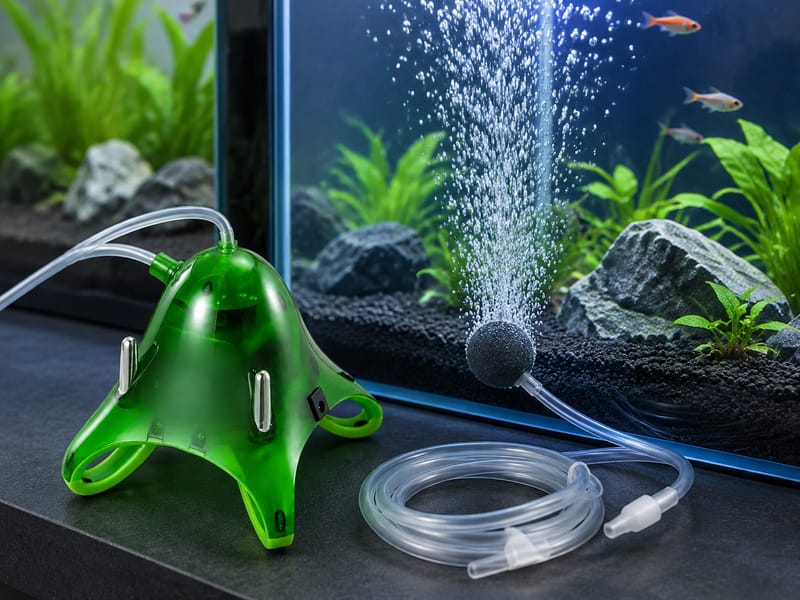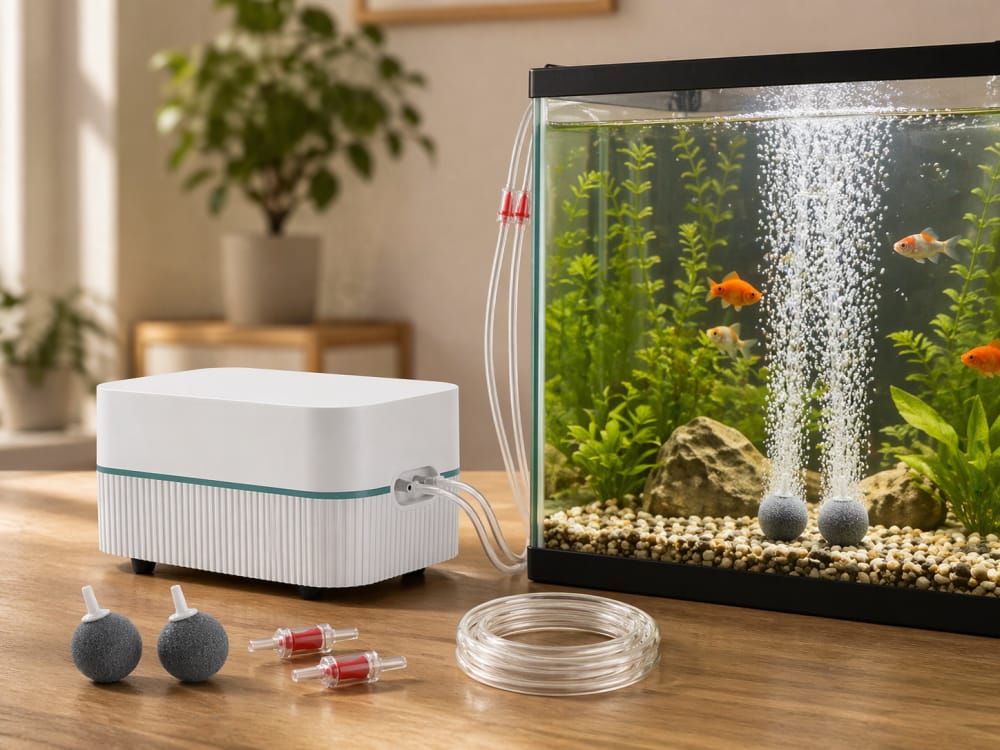
Silent mini air pumps are ideal when you want steady aeration without turning your living room, bedroom, office, or fish room into a noisy mechanical space. In the United States, aquarium keepers increasingly want compact pumps that deliver reliable oxygen transfer, low vibration, and long service life while keeping electricity use under control. The best buying decision is not simply about selecting the smallest or cheapest unit. It is about matching air output, pressure, outlet configuration, build quality, and installation method to the actual aquarium setup.
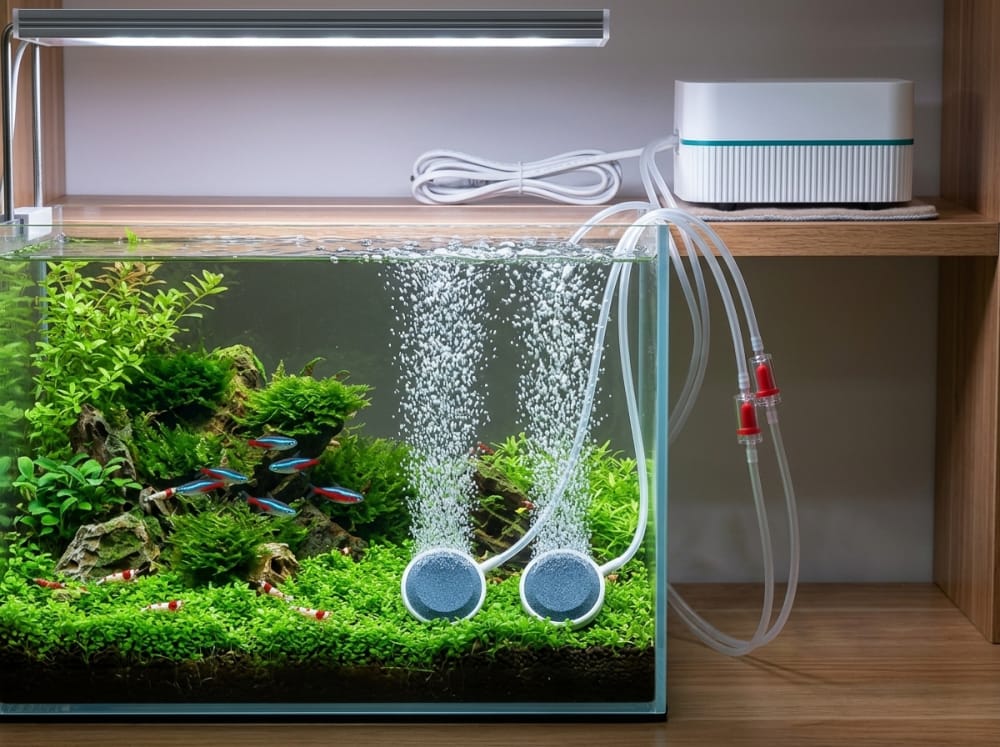
For most home aquariums, a silent mini pump works best when it is chosen by tank depth, stocking density, number of air accessories, and how quietly it can operate over time. A nano planted tank in Seattle, a shrimp rack in Austin, a betta display in Miami, or a bait holding setup near the Port of Los Angeles all place different demands on an air pump. The right product should support stable dissolved oxygen, protect fish health, and run quietly enough for everyday indoor use. If you need stronger distribution for multiple tanks or accessories, a dual outlet aquarium air pump can be a practical upgrade over a basic single-port design.
This guide explains the specifications that matter, shows how to estimate flow requirements, compares single and dual outlet designs, and outlines real installation practices that reduce noise. It also looks at market conditions in the United States, common use cases across hobby and commercial settings, and the product trends expected to shape 2026, including higher efficiency motors, stricter sustainability expectations, and more refined noise isolation design.
In today’s U.S. aquarium market, quiet air pumps are used not only for decorative home aquariums but also for quarantine systems, retail fish walls, educational labs, bait and live transport support, small aquaculture projects, and hydroponic reservoirs. Buyers in New York often prioritize bedroom-safe noise levels, customers in Chicago may care about year-round dependable indoor performance, and fish store operators in Houston often focus on outlet flexibility and serviceability. The common thread is simple: silent performance is valuable only when airflow remains stable and the pump remains easy to maintain.
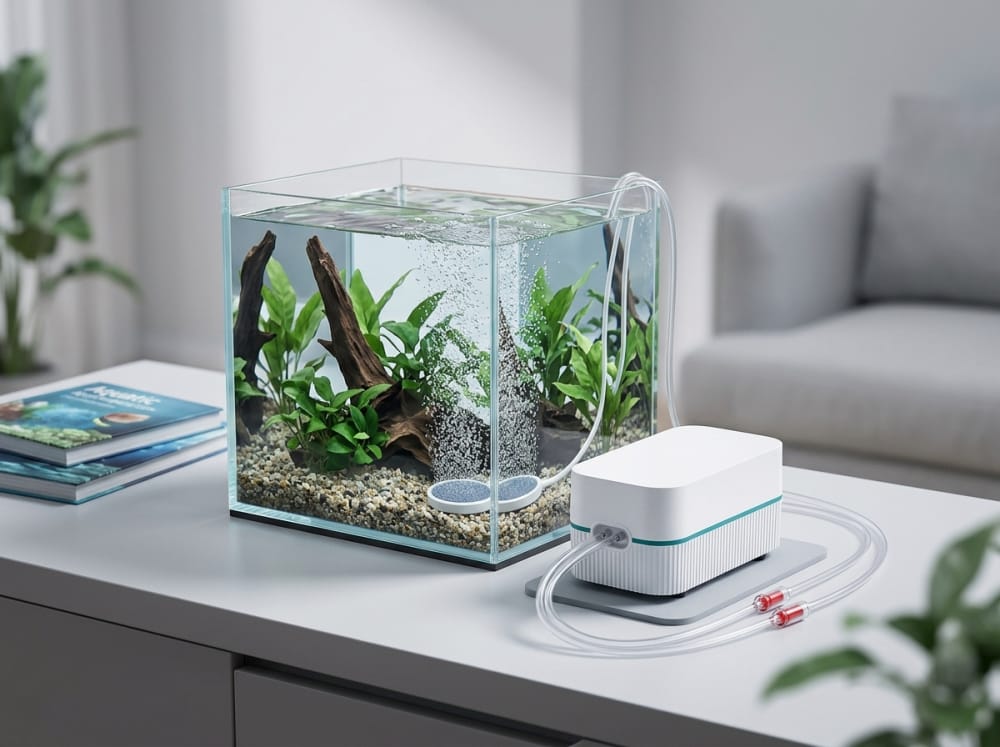
Key Specifications to Check
When comparing silent mini air pumps, buyers in the United States should start with technical specifications instead of marketing terms. “Ultra quiet” and “whisper silent” sound appealing, but they only become meaningful when paired with measurable performance. The most important specifications are air flow rate, pressure capability, power consumption, number of outlets, rated tank size, noise level, diaphragm or motor durability, and compatibility with common U.S. aquarium accessories such as standard 3/16 inch airline tubing, check valves, sponge filters, nano air stones, and breeding box aeration lines.
Air flow rate is usually shown in liters per minute or liters per hour. Pressure matters because a pump must push air through tubing, valves, manifolds, and water depth. A pump may show decent flow in free air but struggle in a deeper tank in Denver or Salt Lake City where setup conditions can vary and users may run longer airline lengths. Noise level is generally stated in decibels, but in practice the sound character matters too. A low hum is often less intrusive than intermittent rattling or table vibration.
Power draw affects long-term operating cost. Mini air pumps do not consume much electricity individually, but when you run multiple tanks in a fish room, classroom, or retail wall, efficient pumps reduce annual energy waste. Material quality is another major factor. Better housings, improved diaphragm compounds, secure feet, and internal damping features often separate a genuinely quiet pump from a short-lived low-cost alternative.
| Specification | What It Means | Why It Matters | Typical Home Range | Best Use | Buyer Tip |
|---|---|---|---|---|---|
| Air Flow Rate | Total volume of air delivered | Determines aeration strength | 0.8 to 3.5 L/min | Nano to medium tanks | Match to accessories, not just tank gallons |
| Pressure | Force used to push air through water depth | Essential for deeper tanks and longer tubing | 0.012 to 0.03 MPa | Sponge filters and deeper aquariums | Choose extra pressure if tank depth exceeds 18 inches |
| Power Consumption | Electricity draw during operation | Impacts running cost and heat | 1.5 to 5 W | Continuous daily use | Efficient pumps matter in multi-tank rooms |
| Noise Level | Measured sound output | Critical for bedrooms and offices | 25 to 40 dB | Quiet indoor spaces | Look for anti-vibration design, not only low dB claims |
| Outlet Count | Number of air ports | Affects flexibility and load sharing | 1 or 2 outlets | Single tank or multiple devices | Dual outlets are useful for split airflow |
| Service Life | Expected operating durability | Influences value over time | 8,000 to 20,000 hours | Long-term operation | Ask about diaphragm replacement support |
The table above shows why choosing by price alone often leads to poor results. A pump with attractive cost but weak pressure may fail to drive a sponge filter effectively, while a louder unit can become annoying in apartments in San Francisco or Boston where living spaces are tighter. Serious buyers compare the full performance profile, not a single specification.
Technological capability also matters. Manufacturers with focused experience in mini and mid-sized air pumps typically refine magnet balance, diaphragm response, and chamber sealing more effectively than generalist factories. That specialization helps reduce wasted vibration and improves consistency between units. For a quiet pump, internal engineering precision is just as important as the external shell design.
Air Flow Rate Calculation
Calculating air flow rate is one of the most useful steps in buying the right mini air pump. A common mistake is to assume a tank only needs a pump based on aquarium volume in gallons. In reality, the air requirement depends on what the pump is doing. A single decorative air stone in a lightly stocked 10-gallon aquarium needs far less output than a sponge filter in a 20-gallon breeder with shrimp, fry, or heavy feeding.
A practical rule for U.S. hobbyists is to start with the tank volume, then adjust for water depth, fish load, and accessories. For light aeration, many setups perform well with around 0.03 to 0.05 liters per minute per gallon. For sponge filtration or stronger circulation support, the demand can rise to 0.06 to 0.10 liters per minute per gallon. Deep tanks, long tubing runs, gang valves, and fine-pore air stones require additional pressure head and often a slightly oversized pump.
Here is a simple working formula:
Estimated air flow needed = Tank gallons x use factor x depth adjustment
For example, a 20-gallon tank with a sponge filter may use a factor of 0.08 L/min per gallon. If the tank is taller than average, you can apply a depth adjustment of 1.15. That gives 20 x 0.08 x 1.15 = 1.84 L/min. In that case, choosing a pump rated around 2.0 to 2.5 L/min gives useful headroom. Headroom matters because pumps become noisier and less efficient when pushed close to maximum operating load for long periods.
| Tank Size | Light Aeration Need | Sponge Filter Need | Suggested Pump Range | Depth Adjustment | Notes |
|---|---|---|---|---|---|
| 5 gallons | 0.2 L/min | 0.4 L/min | 0.5 to 0.8 L/min | 1.0 to 1.1 | Best for nano tanks and betta support |
| 10 gallons | 0.4 L/min | 0.8 L/min | 0.8 to 1.2 L/min | 1.0 to 1.15 | Common for shrimp and quarantine tanks |
| 20 gallons | 0.8 L/min | 1.6 L/min | 1.8 to 2.5 L/min | 1.0 to 1.2 | Good range for stronger sponge filtration |
| 29 gallons | 1.2 L/min | 2.3 L/min | 2.5 to 3.0 L/min | 1.1 to 1.2 | Taller tanks need better pressure reserve |
| 40 gallons | 1.6 L/min | 3.2 L/min | 3.0 to 4.0 L/min | 1.1 to 1.25 | Mini pumps may work only for light loads |
| 55 gallons | 2.2 L/min | 4.4 L/min | 4.0+ L/min | 1.15 to 1.3 | Often better with larger non-mini units |
This table gives buyers a fast planning reference. It is especially useful for apartment hobbyists in cities such as Philadelphia or Atlanta who want quiet equipment but still need enough airflow for sponge filters, fry systems, or breeder racks. A slightly oversized quiet pump running at moderate load is often better than a tiny pump straining near its limit.
Below is a realistic U.S. market growth chart for silent mini aquarium air pump demand from 2021 to 2026. It reflects rising adoption in home aquariums, nano aquascaping, and compact indoor setups.
The line chart suggests a steady expansion path, supported by consumer demand for lower noise equipment, more interest in planted nanos, and broader online access to specialized aquarium products across the United States.
Matching Pump to Tank Volume
Matching a pump to tank volume is not the same as using volume alone. Tank gallons are the starting point, but the final choice should include livestock type, temperature, biological load, and whether filtration already creates surface agitation. In warm-water tropical tanks in Florida, Texas, or Southern California, oxygen demand can become more important because warmer water holds less dissolved oxygen than cooler water. Overstocked community tanks, breeding colonies, and fry grow-out systems also need more stable aeration than low-stock display aquariums.
For a simple nano display under 10 gallons, a mini air pump with gentle, adjustable output is usually enough. For 10- to 20-gallon tanks, buyers should choose a pump that can handle a sponge filter with some overhead. For 20- to 40-gallon tanks, mini pumps can still work well, but only if the unit has sufficient pressure and a realistic rating. Beyond that range, mini models are more suitable for supplemental aeration than primary system support.
Location also affects purchasing preferences. In New York City apartments, smaller pumps with lower vibration and compact footprints are preferred. In suburban fish rooms in Ohio or North Carolina, owners may choose stronger dual outlet pumps to support multiple tanks. Around Gulf Coast trade routes and marine supply channels near Houston or Tampa, buyers sometimes prioritize ruggedness and shipping durability because inventory may move frequently between retail, hobby, and holding systems.
| Tank Scenario | Volume | Livestock Load | Recommended Pump Type | Expected Noise Priority | Buying Guidance |
|---|---|---|---|---|---|
| Nano planted tank | 3 to 8 gallons | Low | Single outlet mini | Very high | Choose adjustable low-flow output |
| Betta support tank | 5 to 10 gallons | Low to medium | Single outlet mini | Very high | Use soft aeration to avoid excessive current |
| Shrimp breeder tank | 10 to 20 gallons | Medium | Single or dual outlet mini | High | Prioritize stable sponge filter airflow |
| Community aquarium | 20 to 29 gallons | Medium | Stronger mini or dual outlet | Medium to high | Allow reserve capacity for deeper water |
| Fry rack system | Multiple 5 to 10 gallon tanks | Medium to high | Dual outlet mini | Medium | Use gang valve only if pressure is adequate |
| Supplemental large tank aeration | 40+ gallons | Variable | High-output mini as secondary | Medium | Do not rely on undersized mini pumps alone |
The table helps explain why the same pump can perform well in one setup and poorly in another. A good fit depends on total system demand. Buyers should also remember that the quietest practical pump is often the one that is not overloaded. That is true in both home and commercial aquarium environments.
Manufacturing capability plays a direct role here. Producers with dedicated pump lines and controlled assembly procedures tend to maintain tighter tolerances in diaphragm seats, magnet alignment, and housing closures. That consistency reduces unit-to-unit variation, which is especially important when distributors and retailers in the United States need dependable model performance across repeated orders.
Single vs Dual Outlet Guide
Single outlet and dual outlet mini air pumps each serve clear roles. A single outlet pump is usually the best choice for a single aquarium with one air stone or one sponge filter. It is simple, compact, and often slightly quieter because there are fewer airflow paths and less internal complexity. A dual outlet pump is the better option when one aquarium uses two devices, when airflow needs to be balanced across two tanks, or when the user wants flexibility for future expansion.
For many U.S. buyers, the decision comes down to layout. If you keep a 10-gallon shrimp tank in Portland and only need one sponge filter, a single outlet unit is typically enough. If you maintain two small breeding tanks in Phoenix or one 20-gallon tank with two sponge filters in Nashville, a dual outlet design offers better distribution and simpler setup. Dual outlets can also reduce the need for tee splitters, which often create uneven air delivery.
That said, dual outlet pumps must still have enough total pressure and flow. A weak pump with two outlets can underperform if both ports are used at the same time. Buyers should look at total output, not only the number of ports. If each line must power a fine air stone or dense sponge, a stronger model is worth the extra cost.
| Feature | Single Outlet Pump | Dual Outlet Pump | Best For | Main Advantage | Main Limitation |
|---|---|---|---|---|---|
| Setup Simplicity | Very simple | Moderate | One-tank users | Easy installation | Less expansion room |
| Footprint | Usually smaller | Slightly larger | Desktop aquariums | Space-saving | Limited output paths |
| Flexibility | Low to medium | High | Multi-device systems | Supports split use | Needs strong total airflow |
| Noise Potential | Often lower | Can still be low | Bedroom setups | Fewer vibration variables | Less adaptable |
| Cost | Lower | Moderate | Budget buyers | Affordable entry point | May need replacement when system grows |
| Future Expansion | Limited | Better | Breeders and hobby rooms | Extra utility | Can be oversized for one tiny tank |
This comparison makes clear that the right choice depends on present and future use. If your system may expand, it can be economical to start with a better designed dual outlet unit instead of replacing a single outlet pump later. Buyers who want a flexible solution can review a quiet dual outlet air pump option for U.S. aquariums when planning multi-tank or dual-device use.
In commercial settings, dual outlet models are common in small retail fish systems, quarantine rooms, and classroom labs because they reduce cable clutter and allow more compact hardware deployment. In cities with active aquarium retail channels such as Los Angeles, Dallas, and Orlando, this flexibility helps stores adapt tank layouts quickly.
The bar chart shows where demand is concentrated in the United States. Home aquariums remain the largest segment, but breeding, retail, and hydroponic uses also create steady demand for compact, quiet aeration solutions.
Noise Reduction Technology
Noise reduction is the defining feature of a quality silent mini air pump, but many buyers misunderstand where noise actually comes from. Most sound is not just airborne motor sound. It also comes from vibration transfer through shelves, cabinets, stands, airline tubing tension, and hard surfaces. A quiet pump therefore needs both internal and external control measures.
Internally, good pumps use better magnet balance, optimized oscillation chambers, reinforced diaphragms, improved shell stiffness, and damping structures that reduce resonance. Externally, soft rubber feet, suspended placement, thicker pads, and correctly routed airline tubing can cut noticeable sound. Some of the quietest setups in U.S. homes use a pump mounted above tank level on a foam pad with a check valve installed and the tubing looped loosely rather than pulled tight against furniture.
Noise perception also changes by room type. A 32 dB pump in a busy family room in Denver may seem nearly silent, while the same pump in a bedroom in Minneapolis can feel more obvious at night. That is why practical installation matters as much as specifications. If the shell is touching a cabinet wall or the airline is stretched tightly, vibration can amplify far beyond the published dB rating.
Technological capability becomes especially visible in noise control. Companies that specialize in air pumps often develop more precise internal structures and acoustic isolation strategies over years of production. With roughly a decade of focused design refinement behind some specialist manufacturers, the result is better chamber stability, smoother airflow pulses, and reduced casing buzz. That kind of category-specific experience is often more valuable than broad but shallow manufacturing claims.
| Noise Source | Typical Cause | Effect on User | Best Solution | Cost Impact | Importance |
|---|---|---|---|---|---|
| Motor hum | Basic internal oscillation | Constant background sound | Better magnetic balance | Medium | High |
| Housing vibration | Poor damping or hard feet | Table or shelf buzzing | Rubber feet and foam pad | Low | Very high |
| Air pulse rattle | Uneven chamber output | Intermittent ticking sound | Refined chamber design | Medium | High |
| Tubing resonance | Tight or poorly routed airline | Amplified vibration noise | Looser routing and clips | Low | Medium |
| Cabinet echo | Hard enclosed surfaces | Sound becomes louder indoors | Isolation mounting | Low | High |
| Wear-related noise | Aging diaphragm or loose parts | Noise increases over time | Maintenance and replacement parts | Medium | Very high |
The table explains why silent operation is both a product and an installation issue. Buyers who understand these causes are more likely to achieve the low-noise result they actually want.
Below is an area chart showing how buying priorities in the U.S. mini pump market have shifted over time, with noise control and efficiency becoming stronger factors.
The area chart highlights a realistic shift: silence remains the leading purchase driver, but energy efficiency is catching up quickly as buyers look for better long-term value.
Energy Efficiency and Lifespan
Mini air pumps are low-watt devices, but efficiency still matters, especially in 24/7 operation. A pump that draws only a few watts may seem insignificant until it runs non-stop in a fish room, pet store, educational facility, or hydroponic setup. Over a year, an efficient model can reduce operating cost, heat buildup, and wear stress while delivering steadier performance.
In the United States, rising awareness of utility costs and sustainability goals is influencing how aquarium equipment is selected. Hobbyists in California may pay close attention to energy use because household utility rates are relatively high. Schools and commercial operators in states like Illinois and New Jersey may also prefer equipment that keeps long-term maintenance and operating costs predictable. For 2026, the trend is moving toward better diaphragm materials, more efficient electromagnetic drive systems, and designs that sustain performance without excessive heat.
Lifespan depends on more than hours claimed on packaging. Real durability comes from thermal stability, material quality, internal precision, and support for service parts. A pump used in a dusty garage fish room in Arizona will not age the same way as a pump used in a climate-controlled office in Washington, D.C. Good airflow pathways, durable casings, and replacement diaphragm access help extend service life significantly.
Service capability is another buying factor that deserves more attention. Reliable suppliers support buyers with technical guidance, model selection advice, and after-sales communication when parts or troubleshooting are needed. In the U.S. market, especially for repeated business purchases, responsive support often matters as much as the initial unit price.
| Factor | Low-Efficiency Pump | High-Efficiency Pump | Effect on Lifespan | User Benefit | 2026 Trend |
|---|---|---|---|---|---|
| Power Use | Higher per output unit | Lower per output unit | Less heat supports longer life | Reduced operating cost | Growing demand |
| Heat Management | Basic shell venting | Balanced thermal design | Protects diaphragm and coil | More stable performance | Improving steadily |
| Material Quality | Generic rubber parts | Refined wear-resistant parts | Slower wear rate | Fewer replacements | Key premium feature |
| Output Stability | Drops under load sooner | Maintains flow better | Reduces internal stress | Better oxygen delivery | Expected standard |
| Maintenance Support | Limited | More service-friendly | Extends usable life | Lower total ownership cost | More important in U.S. B2B orders |
| Sustainability Value | Weak | Stronger | Encourages longer product use | Less waste | Increasing policy relevance |
The explanation is straightforward: a better pump may cost more up front, but the total value becomes clear when it runs quietly and efficiently for years. Sustainability expectations are also rising. By 2026, buyers can expect more discussion around responsible materials, packaging reduction, efficient power use, and longer replacement cycles as both consumers and commercial buyers push for less waste.
Installation Best Practices
Even the best silent mini air pump can become noisy or unreliable if installed poorly. Correct installation improves sound control, airflow stability, and safety. The first rule is to place the pump on a stable surface with vibration isolation. A soft pad, rubber mat, or suspended mount often makes an immediate difference. The second rule is to prevent backflow by using a check valve, especially if the pump sits below the waterline. The third rule is to keep airline runs efficient, avoiding excessive length, sharp bends, and unnecessary splitters.
In humid coastal areas such as Miami, New Orleans, or San Diego, keeping the pump dry and well ventilated helps preserve lifespan. In colder northern climates, users should avoid sealing the pump into cramped cabinets where condensation or restricted airflow may become a problem. If installed inside furniture, leave enough space around the unit for cooling and acoustic breathing.
For sponge filters, use airline tubing of consistent quality and avoid oversized gang valves that choke pressure. For bedroom tanks, test different placements before finalizing the setup. Sometimes moving the pump six inches or loosening one tight tube is enough to eliminate the sound users find irritating.
Manufacturing strength also supports installation reliability. Producers with established assembly control and repeated quality checks tend to provide cleaner outlet fit, more consistent shell closure, and sturdier feet. That reduces setup frustration for retailers, installers, and end users across the United States.
Case studies from common U.S. scenarios show how installation changes outcomes. A Chicago apartment user reduced perceived night noise by placing the pump on a cork-rubber pad and lowering output slightly through a control valve. A Dallas fish room owner switched from one overloaded single outlet pump to a balanced dual outlet model and cut both noise and maintenance issues. A Seattle shrimp keeper improved sponge filter consistency by shortening airline tubing and elevating the pump above the tank rim.
Top Recommended Models
The best recommended model depends on the application, not just brand visibility. For U.S. buyers, top-performing mini air pumps usually fall into several categories: ultra-quiet single outlet models for nano and bedroom tanks, balanced dual outlet models for multi-device or multi-tank use, stronger compact pumps for medium aquariums, and service-friendly units for commercial or frequent-use environments.
When evaluating recommended models, pay attention to actual use case fit. A nano desktop setup in San Jose benefits from a compact low-vibration single outlet unit with soft airflow. A 20-gallon breeder in Indianapolis may need a stronger pressure-focused mini pump. A small retail holding rack in Orlando may justify a dual outlet model with better distribution flexibility and easier replacement planning. Home hobbyists should prioritize quiet sound character, while business buyers should also factor in consistency, packaging reliability, and reorder stability.
Below is a practical comparison chart illustrating how product types compare by flexibility, quietness, and suitability in the U.S. market.
The comparison chart shows why compact dual outlet pumps are increasingly attractive. They deliver strong all-around value for users who want flexibility without jumping to bulky commercial air systems.
Here is a final selection table with practical recommendation categories rather than brand-only rankings, since the best model should match the job it needs to perform.
| Model Category | Typical Tank Range | Outlet Type | Main Strength | Best User | Recommendation Reason |
|---|---|---|---|---|---|
| Ultra-Quiet Nano Pump | 3 to 8 gallons | Single | Low vibration | Desktop and bedroom users | Excellent for minimal-noise environments |
| Balanced Home Mini Pump | 5 to 15 gallons | Single | Quiet daily operation | General hobbyists | Best entry point for one-tank systems |
| Dual Outlet Compact Pump | 10 to 25 gallons or two small tanks | Dual | Flexibility | Breeders and multi-tank users | Supports two lines without splitters |
| High-Pressure Mini Pump | 15 to 30 gallons | Single or dual | Depth handling | Sponge filter users | Better for taller aquariums |
| Retail Support Mini Pump | Small rack systems | Dual | Consistent performance | Stores and labs | Good for repeated operating cycles |
| Energy-Saving Long-Life Pump | All small to medium setups | Single or dual | Efficiency and lifespan | Value-focused buyers | Lower long-term ownership cost |
The table is useful because it shifts the focus from generic promotion to practical selection logic. Buyers can quickly identify which product class best matches their tank volume, outlet needs, and noise expectations.
For local supplier evaluation in the United States, it helps to compare fulfillment reliability, stock continuity, technical documentation, and support responsiveness. Buyers sourcing through distribution centers near Los Angeles, Chicago, Savannah, Houston, and Newark often prioritize lead time and consistency, while hobby users buying online may care more about clear sizing information and post-sale support. A trustworthy supplier should be able to explain airflow ratings, suitable tank ranges, and proper installation in plain language.
From a company perspective, the strongest value comes from focused specialization. A manufacturer centered on high-performance mini and mid-sized air pumps and air stones can channel its engineering resources into quieter airflow, consistent assembly quality, and application-specific design instead of spreading effort across unrelated product categories. That focused approach supports better technical capability, stronger manufacturing discipline, and more reliable service support for U.S. distributors, retailers, and end users.
In practical terms, technological capability should mean refined pump structure and stable output. Manufacturing capability should mean dependable production consistency, quality control, and durable assembly. Service capability should mean responsive communication, informed model guidance, and support that helps customers choose correctly the first time. These are the traits serious U.S. buyers should look for when selecting long-term supply partners.
FAQ
What size silent mini air pump do I need for a 10-gallon tank? For a standard 10-gallon aquarium, a pump in roughly the 0.8 to 1.2 L/min range is usually enough. If you are running a sponge filter, choose the higher end of that range.
Is a dual outlet pump louder than a single outlet pump? Not necessarily. Sound depends on design quality, vibration control, and installation. A well-made dual outlet pump can be quieter than a poorly built single outlet pump.
Can a mini air pump run continuously? Yes, quality aquarium air pumps are designed for continuous use. Lifespan improves when the pump is not overloaded, is kept dry, and has proper ventilation.
How do I make my aquarium air pump quieter? Place it on a soft pad, use a check valve, avoid tight tubing, keep it off hard resonant surfaces, and make sure the pump is properly sized for the tank and accessories.
Are silent mini pumps good for hydroponics too? Yes, many compact air pumps are used in small hydroponic reservoirs. The same principles of airflow, pressure, noise control, and efficient installation still apply.
What trends should buyers watch in 2026? Expect better energy efficiency, improved noise isolation, more durable diaphragm materials, stronger sustainability messaging, and greater demand for flexible dual outlet compact models in the U.S. market.
Choosing the right silent mini aquarium air pump in the United States comes down to fit, not hype. If you compare the key specifications carefully, calculate airflow honestly, match the pump to actual tank conditions, and install it with noise control in mind, you can achieve quiet, dependable aeration for years. Whether you are supporting a nano aquascape in Brooklyn, a shrimp rack in Raleigh, a retail fish system in Las Vegas, or a compact breeding setup in Sacramento, the best pump is the one that delivers stable air, low vibration, efficient operation, and serviceable long-term value.