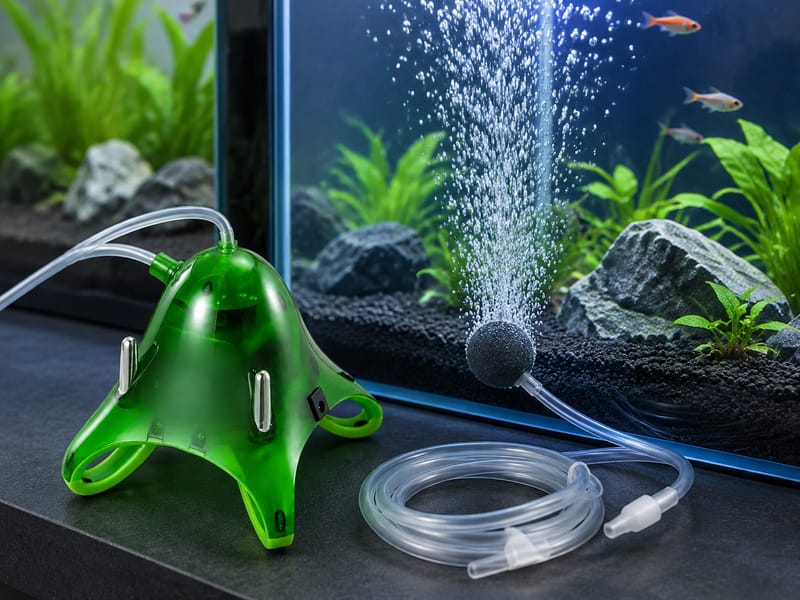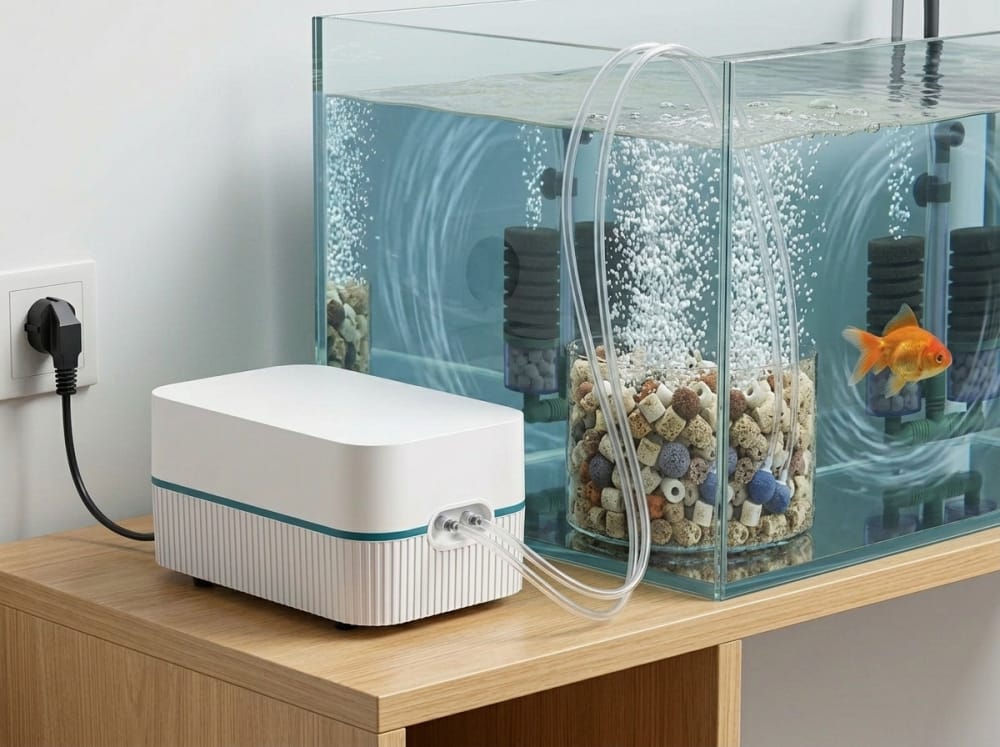
Air pumps do far more than add bubbles. In aquariums across the United States, they help move water, support filter bacteria, improve surface gas exchange, and reduce stagnant areas that weaken fish health. For hobbyists, breeders, aquatic retailers, classrooms, and commercial fish systems, proper aeration can make the difference between a stable tank and one that struggles with waste buildup, low oxygen, and uneven conditions. In cities such as Miami, Houston, Los Angeles, Seattle, and Chicago, where aquatic supply chains connect through major ports and distribution hubs, dependable aeration equipment remains one of the most practical upgrades for both freshwater and marine systems.
When an air pump drives air through an air stone, sponge filter, diffuser, or breeding box line, it creates a column of rising bubbles. That movement lifts water upward and encourages circulation throughout the tank. This gentle but consistent motion helps suspended waste reach filtration media, supports bacterial colonization, and keeps oxygen levels more even from top to bottom. In many tanks, especially nano and mid-sized aquariums, the effect is not dramatic like a wavemaker, yet it is highly useful because it stabilizes the biological environment without overwhelming livestock.
For buyers in the United States market, the best air pump choice depends on aquarium size, stocking level, noise expectations, outlet needs, and the type of filtration in use. A planted nano tank in Portland has different needs than a cichlid grow-out rack in Dallas or a bait holding system near Tampa Bay. Still, the core principle remains the same: stronger and more consistent air delivery improves circulation patterns and supports beneficial bacteria when the setup is matched correctly to the aquarium.
This guide explains how air pumps contribute to water movement and circulation, boosting biological filtration, supporting nitrifying bacteria, improving surface gas exchange, reducing dead zones, enhancing tank stability, optimized air pump setup, and recommended product solutions for the United States. It also covers market demand, product types, buying advice, industry applications, practical case examples, local sourcing considerations, and what to expect through 2026 as sustainability and efficiency standards continue to shape aquarium equipment choices.
| Use Case | Typical Tank Size | Main Aeration Goal | Common Device | Priority in the U.S. Market | Expected Benefit |
|---|---|---|---|---|---|
| Nano home aquarium | 5 to 15 gallons | Gentle circulation | Single outlet pump | Low noise | Stable oxygen and less waste settling |
| Community freshwater tank | 20 to 55 gallons | Balanced movement | Air stone or sponge filter | Reliable daily operation | Improved filtration support |
| Breeding rack | Multiple small tanks | Distributed air flow | Multi-outlet manifold | Efficiency | Consistent fry-safe aeration |
| Retail display system | 40 to 120 gallons | Visual activity and oxygenation | Dual outlet pump | Dependability | Cleaner displays and better fish vigor |
| Quarantine tank | 10 to 40 gallons | High dissolved oxygen | Sponge filter system | Rapid setup | Stress reduction and stable biofilter |
| Bait or holding system | 50 to 150 gallons | Continuous aeration | Heavy-duty pump | Durability | Lower mortality during holding |
The table above shows why air pump selection should be based on application rather than only tank size. In the United States, buyers increasingly compare air output, noise, lifespan, and maintenance simplicity before purchase because energy use and long-term reliability matter as much as initial cost.
Water Movement and Circulation
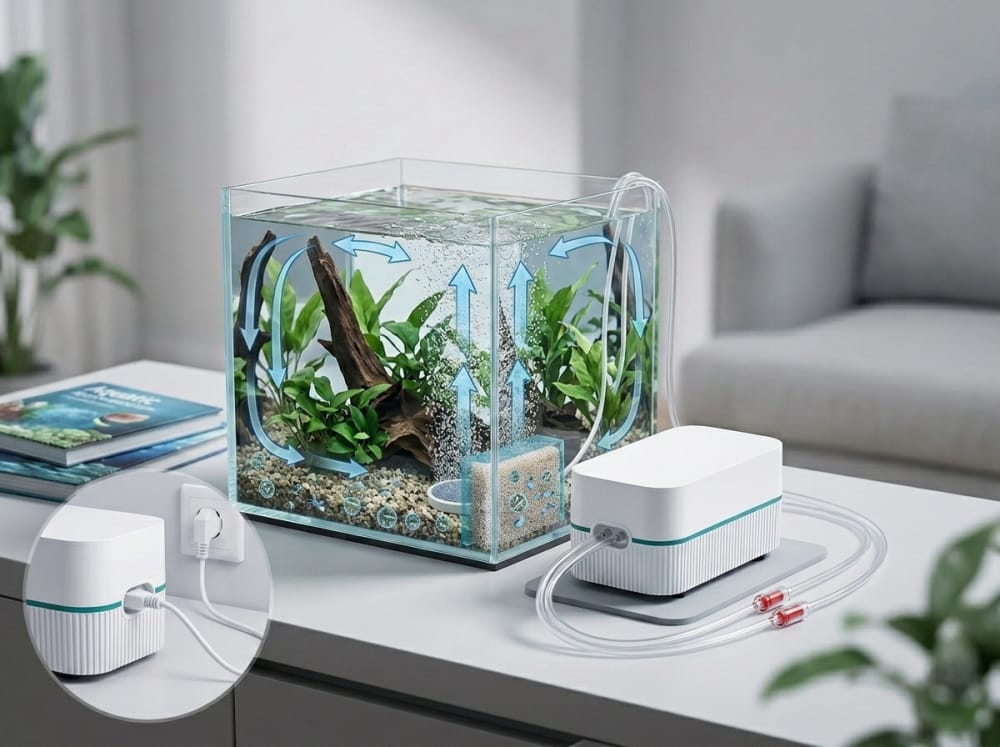
Water movement and circulation are among the most overlooked benefits of aquarium air pumps. Many owners think of aeration strictly as oxygen delivery, but the larger operational value is often the circulation pattern created by rising bubbles. As bubbles travel upward, they drag surrounding water with them. This creates vertical lift and triggers a broader circulation loop across the aquarium. Water from lower zones moves upward, surface water shifts laterally, and other parts of the tank refill the space left behind. The result is a slow but effective redistribution of heat, oxygen, nutrients, and suspended debris.
In home aquariums from New York apartments to suburban Phoenix fish rooms, this circulation matters because small systems can develop uneven pockets very quickly. Areas behind decor, under driftwood, or in corners with little current can collect uneaten food and fish waste. Over time, those pockets become dead zones that increase organic load and place extra pressure on the filter. Adding a well-matched air stone or sponge filter often restores movement in those quiet areas without the stronger current that some species dislike.
Air-driven circulation is especially useful in tanks housing bettas in divided setups, shrimp in planted systems, livebearers in breeding tanks, and juvenile fish in grow-out systems. Unlike aggressive powerheads, an air pump can produce circulation that is broad, gentle, and adaptable. Airline valves, gang valves, and diffuser quality all affect the final flow pattern. Positioning also matters. A diffuser installed near the rear lower third of the tank often improves tank-wide movement better than one centered in the front.
In coastal and inland U.S. markets alike, aquarium retailers frequently recommend combining mechanical filtration with supplemental aeration where fish density is moderate to high. This is common in stores around Los Angeles, Orlando, and Newark, where shipment turnover can be heavy and tanks need a dependable way to maintain circulation between maintenance intervals. Air pumps offer a low-complexity solution that keeps water moving even in systems where compact internal filters do not reach every corner.
The chart above reflects a realistic growth trend in compact aquarium aeration demand in the United States. Growth is supported by continuing interest in nano aquariums, home aquascaping, classroom science tanks, and small commercial holding systems. The market is also influenced by online sales channels serving distribution centers near Long Beach, Savannah, and New Jersey logistics corridors.
| Circulation Issue | Visible Sign | Likely Cause | Air Pump Fix | Best Placement | Outcome |
|---|---|---|---|---|---|
| Waste settling in corners | Debris buildup | Weak lateral movement | Add air stone | Rear corner low position | More debris reaches filter |
| Film on water surface | Oily sheen | Poor top agitation | Increase bubble lift | Near back wall | Cleaner gas exchange zone |
| Uneven temperature | Fish gather in one area | Thermal layering | Gentle aeration | Opposite heater side | More even temperature |
| Weak plant-side flow | Leaf debris trapped | Dense aquascape blockage | Small diffuser | Behind hardscape | Better hidden circulation |
| Stagnant quarantine tank | Cloudy water | Minimal filtration | Sponge filter | Back corner | Biological support and flow |
| Rack system inconsistency | Different tank conditions | Uneven air split | Use balanced manifold | Centralized airline routing | More uniform performance |
This table explains how water movement problems often present visually before they become chemical problems. In practice, early circulation corrections are cheaper and easier than reacting after ammonia, nitrite, or bacterial haze appears.
Boosting Biological Filtration
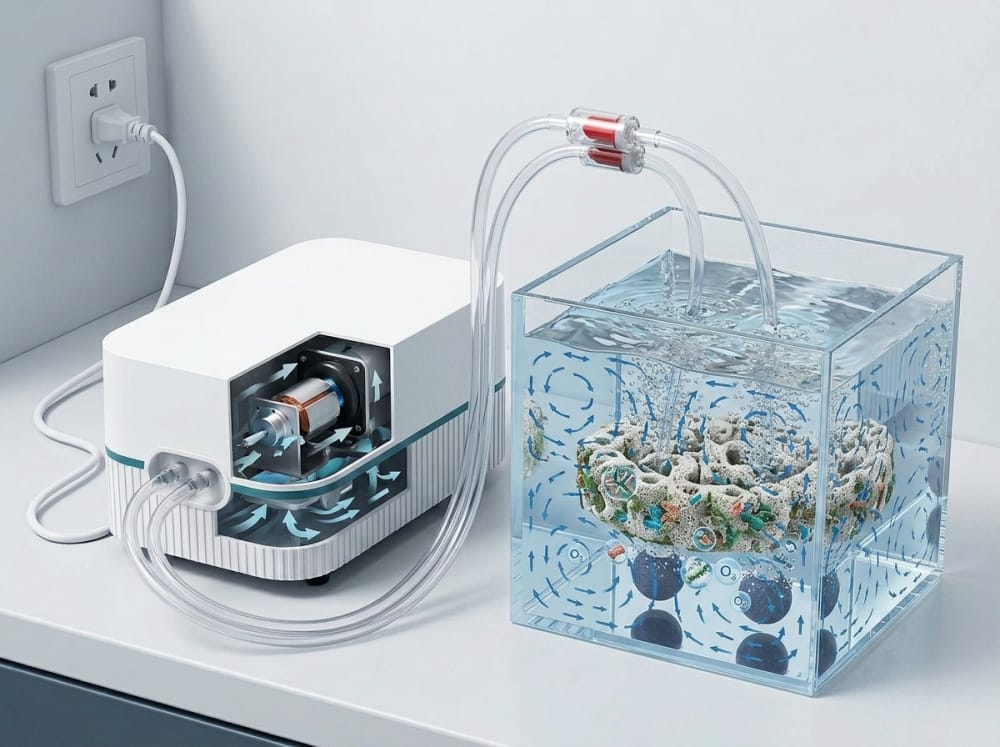
Biological filtration depends on surface area, oxygen availability, and a steady supply of ammonia-bearing water reaching bacterial colonies. Air pumps help with all three when paired with sponge filters, moving bed chambers, corner filters, or bio-media chambers that benefit from continuous water contact. The bubbles themselves are not the biofilter, but the current they create continuously brings water and dissolved waste past bacterial surfaces.
In the United States aquarium market, sponge filtration remains one of the most practical and cost-efficient biological filtration methods for quarantine tanks, shrimp systems, breeding rooms, and retail backup systems. Air pumps make these filters work by pulling water through the sponge as rising bubbles lift water in the uplift tube. As water passes through the sponge pores, debris is trapped and bacteria colonize the material. This two-part effect makes the setup extremely valuable for small and mid-sized tanks where stable biofiltration is the goal.
For aquarists in areas with frequent temperature swings, such as the Midwest and Northeast, stable biological filtration matters because fish feeding rates and microbial activity can shift across seasons. A consistently performing air-driven filter can help keep the nitrogen cycle more resilient during these changes. In commercial settings, including aquatic wholesalers near major freight hubs in Atlanta and Chicago, redundancy is also important. Even if one filter flow path weakens, supplemental aeration often maintains enough circulation to protect the bacterial bed.
Buyers comparing filtration options should look beyond gallons-per-hour claims and focus on whether the air pump can maintain pressure at the needed depth. Deep tanks, long airline runs, and multiple outlet splits reduce effective output. A stronger but still compact dual outlet model often performs better than an entry-level single outlet pump when running two sponge filters or one diffuser plus one backup line.
For applications requiring dependable dual-line distribution, many U.S. buyers favor a dual outlet aquarium air pump for balanced filtration support because it simplifies rack systems, quarantine setups, and mid-sized display tanks that need more than one aeration point.
Supporting Nitrifying Bacteria
Nitrifying bacteria convert ammonia into nitrite and then nitrite into nitrate. These bacteria are essential for aquarium stability, yet they are often misunderstood. They do not float freely in large numbers waiting to fix a tank instantly. They grow on surfaces where oxygen-rich water flows past them consistently. Air pumps contribute to this process by improving water contact with filter media and helping maintain dissolved oxygen levels that support aerobic bacterial activity.
When fish are fed heavily or stocking density is high, the biological load increases. That means nitrifying bacteria need both sufficient colonization space and stable environmental conditions. In tanks with weak movement, oxygen can decline in dense filter media, especially if debris accumulates. Air-driven sponge filters and aerated bio-compartments reduce that risk. They are particularly effective in fry systems, hospital tanks, classroom aquariums, and backup filtration banks because they deliver oxygen-rich flow without introducing sharp suction risks.
Across the United States, water chemistry differs by region. Hobbyists in Denver, Minneapolis, and Austin may all start with different tap water conditions, alkalinity levels, and temperatures. While air pumps cannot correct chemistry alone, they help create a more reliable environment for nitrifying bacteria by keeping water in motion and limiting localized depletion zones. This is why aeration often appears in successful cycling strategies, especially in new setups where bacterial colonies are still establishing.
Supporting nitrifying bacteria also means avoiding unstable operation. An undersized or inconsistent pump can lead to fluctuating filter performance. If the output weakens at night due to overheating, clogging, or poor diaphragm quality, water flow through the biofilter becomes less predictable. Over time, this can reduce bacterial efficiency. In U.S. retail and service environments, stable output is often more valuable than the lowest purchase price.
| Bacterial Support Factor | Why It Matters | Role of Air Pump | High-Risk Situation | Recommended Adjustment | Expected Result |
|---|---|---|---|---|---|
| Oxygen-rich flow | Supports aerobic bacteria | Keeps water moving through media | Overstocked tanks | Increase aeration points | More stable nitrification |
| Media contact time | Improves waste conversion | Creates steady flow pattern | Weak uplift in sponge filter | Use higher pressure pump | Better ammonia processing |
| Debris control | Prevents clogging | Lifts solids toward filter path | Heavy feeding | Clean sponge regularly | More active bacteria zone |
| Temperature consistency | Reduces stress on bacteria | Helps mix heated water | Tall tanks | Place diffuser opposite heater | Even microbial activity |
| Redundancy | Protects cycle during issues | Maintains backup circulation | Retail systems | Use dual outlet design | Lower failure risk |
| Start-up stability | Helps new cycle establish | Improves early water movement | New tank setup | Run aeration continuously | Faster bacterial colonization support |
The explanation from this table is straightforward: nitrifying bacteria need steady oxygenated water. Air pumps improve that condition indirectly but meaningfully, making them a core support component in biologically stable aquariums.
Improving Surface Gas Exchange
Surface gas exchange is where carbon dioxide leaves the water and oxygen enters. The key factor is not bubble oxygen transfer alone, but how well the water surface is disturbed and renewed. A stagnant surface slows exchange. An active surface, even with gentle rippling, improves it significantly. Air pumps help by creating vertical circulation that continuously replaces the top layer of water.
This is especially important in tanks with lids, warmer water, high fish density, or medication use. Warm water holds less oxygen than cool water. During summer heat in states such as Florida, Texas, and Arizona, dissolved oxygen levels can drop quickly in indoor tanks, fish rooms, and temporary holding systems. Supplemental aeration helps maintain safer conditions by increasing surface turnover. In marine or brackish holding systems near Gulf Coast bait operations, this can be especially important during transport staging and temporary storage.
Surface gas exchange is also tied to pH stability in some systems. Excess carbon dioxide can accumulate overnight, particularly in planted tanks or enclosed rooms. A well-placed air stone can help release that buildup, though users should balance aeration with planted tank goals. In low-tech planted aquariums, night-time aeration is often beneficial when plants are no longer producing oxygen.
Retailers and service technicians across the United States often use visible surface movement as a quick health indicator. If the top of the tank looks still and oily, gas exchange is probably underperforming. If the surface is active but not violently splashing, the exchange rate is usually better. Air pumps provide a simple path to achieve that balance, especially in tanks where return nozzles or internal filters are not enough.
The bar chart above highlights where demand for compact and mid-sized aeration products is strongest in the United States. Home aquariums lead, but specialized segments such as breeding rooms, retail stores, and bait holding systems remain important because they require dependable continuous operation.
Reducing Dead Zones
Dead zones are areas in an aquarium where water movement is weak enough that debris settles, oxygen becomes less consistent, and biological waste can accumulate. These zones often form behind rock structures, under driftwood shelves, inside dense plant masses, or in corners opposite the main filter output. Over time, dead zones can encourage nuisance algae, bacterial film, and unstable water quality.
Air pumps help reduce dead zones by introducing flexible circulation points. Unlike fixed filter returns, airline tubing can be routed exactly where extra movement is needed. This makes air-driven solutions useful in tanks with complex aquascapes or in multi-tank systems where individual flow problems vary from one aquarium to the next. Even a small diffuser placed strategically can break up a stagnant pocket and restore useful water movement.
In shrimp breeding setups popular in parts of California and the Pacific Northwest, dead zones are common because gentle filtration is preferred and decor can be dense. Air-driven sponge filters are widely used there because they combine biological filtration with enough movement to keep the system healthy without pulling in shrimplets. In African cichlid grow-out systems found in many Midwest hobby rooms, added aeration helps keep solids suspended long enough to reach mechanical filtration.
Reducing dead zones also lowers maintenance pressure. Instead of repeatedly vacuuming the same problem corner or dealing with recurring cloudiness, aquarists can correct the underlying flow pattern. This is one reason experienced service providers in metropolitan markets such as Boston, San Diego, and Washington, D.C. often add subtle supplemental aeration during maintenance upgrades.
| Tank Layout | Where Dead Zones Form | Problem Created | Air Setup Recommendation | Suitable Pump Type | Maintenance Benefit |
|---|---|---|---|---|---|
| Rock-heavy aquascape | Behind stones | Detritus buildup | Micro air stone behind structure | Quiet compact pump | Less trapped waste |
| Dense planted tank | Under stems | Low circulation | Low-output diffuser | Adjustable output pump | Cleaner lower leaves |
| Breeding rack | Back corners | Uneven tank conditions | One sponge filter per tank | Multi-line pump | Simpler routine care |
| Quarantine tank | Decor edges | Cloudy water pockets | Single sponge filter | Reliable entry or dual outlet pump | Faster cleanup |
| Retail display | Under ornaments | Visible debris | Hidden diffuser line | Dual outlet pump | Better presentation |
| Bait system | Tank bottom edges | Stress from poor water quality | Long air bar | Higher-output pump | Lower holding losses |
The table shows that dead zones are highly layout-specific. The practical solution is not always stronger filtration; often it is smarter aeration placement that reshapes the internal circulation pattern.
Enhancing Tank Stability
Tank stability means more than keeping ammonia at zero. It includes steady oxygen levels, consistent bacterial performance, uniform temperature distribution, reduced debris accumulation, and fewer abrupt changes in water chemistry. Air pumps support this stability by providing a simple, continuous, and low-risk form of water movement. Because the mechanism is straightforward, air pumps are often used as a reliability layer in systems where failure would create rapid stress.
In the United States, many aquarists keep tanks in climate-controlled homes, but that does not eliminate stability challenges. Power outages, seasonal heating shifts, overfeeding, new fish additions, and delayed maintenance can all destabilize a system. A well-sized air pump cannot solve every issue, yet it can soften the impact of several common stressors. During hot spells in Atlanta or Las Vegas, extra aeration protects oxygen levels. During cycling or post-treatment recovery, air-driven filtration keeps bacterial surfaces active. During heavy stocking periods, added circulation helps waste reach filtration faster.
For businesses, stability has direct financial value. Retail stores, import holding facilities, and breeders lose money when fish experience avoidable stress. Compact and mid-sized air pumps remain attractive in these settings because they are easy to scale and maintain. One dependable unit can support a pair of sponge filters, a small rack section, or a quarantine bank with minimal complexity.
From an operational perspective, tank stability also improves predictability. Feeding response, fish coloration, plant health, and maintenance timing become easier to manage when circulation and aeration are consistent. This matters in customer-facing displays in cities like San Francisco and Nashville, where visual quality is part of the business value, and in educational environments where teachers need straightforward equipment that keeps systems dependable between classroom sessions.
The area chart above illustrates a realistic trend shift in the U.S. market: buyers are moving toward quieter, more efficient, longer-lasting aeration systems. This trend is expected to continue through 2026 as energy awareness and equipment quality expectations rise.
Optimized Air Pump Setup
An optimized air pump setup starts with the correct match between pump capacity and system resistance. Resistance comes from water depth, airline length, outlet splits, check valves, diffusers, and clogging over time. A pump may look adequate on paper but underperform in real use if it is driving two lines through long tubing into deeper tanks. That is why setup design matters as much as the pump itself.
For most small and mid-sized aquariums in the United States, optimization means choosing the shortest practical airline route, using quality check valves, balancing line splits with a gang valve if needed, and cleaning diffusers before they become heavily restricted. Soft diaphragms, stable casing design, and consistent airflow output are also important. Noise control matters in apartments, offices, bedrooms, and reception spaces, making vibration isolation a key setup detail. A pump placed on a soft pad or hung correctly can sound much quieter than the same pump resting directly on a hard stand.
Placement should reflect the biological goal. If the target is surface gas exchange, put the diffuser where rising bubbles will enhance top movement. If the target is dead-zone control, place the air stone near the stagnant region. If the target is biological filtration, prioritize a properly sized sponge filter with enough uplift to pull water through the media consistently. In breeding rooms, centralized airline management reduces clutter and simplifies maintenance across many tanks.
For United States buyers seeking an efficient two-line setup for quarantine systems, paired sponge filters, or mid-sized aquariums needing better flow distribution, a properly selected dual outlet air pump for U.S. aquarium setups can offer a practical balance between output flexibility and manageable footprint.
| Setup Element | Best Practice | Why It Matters | Common Mistake | U.S. Buyer Tip | Result |
|---|---|---|---|---|---|
| Airline length | Keep it short and direct | Preserves pressure | Excess tubing loops | Measure route before purchase | Stronger delivered airflow |
| Outlet balancing | Use gang valve | Equalizes distribution | One line dominates | Useful for rack systems | More uniform tank performance |
| Check valve | Install above water risk points | Prevents backflow | No check valve used | Essential in home and retail systems | Safer operation |
| Diffuser maintenance | Clean routinely | Maintains output | Replacing pump too soon | Inspect monthly | Longer service life |
| Pump base | Use soft anti-vibration pad | Reduces noise | Hard cabinet placement | Important for apartments | Quieter setup |
| Depth matching | Select pump for real water depth | Affects usable pressure | Buying by tank volume only | Check exact operating depth | More reliable aeration |
The explanation here is practical: optimized setup protects performance. Many air pump complaints come from line design, diffuser restriction, or poor placement rather than true pump failure.
Recommended Product Solutions
Recommended product solutions depend on the aquarium type, user priorities, and operating environment. In the United States, the most useful categories for mini and mid-sized aeration include quiet single outlet pumps for nano aquariums, dual outlet pumps for multi-point aeration, air pumps paired with sponge filters for quarantine and breeding, and pressure-capable units for deeper or more complex systems. Product selection should reflect whether the goal is circulation support, bacterial growth support, oxygen stability, or a combination of all three.
For home users, low-noise construction is often the first priority. For breeders and stores, consistency over long operating hours matters more. For service technicians, flexible outlet configuration and simple maintenance are essential. Product buyers in major U.S. supply corridors such as Los Angeles, Houston, Miami, and Newark also pay attention to replacement part availability, packaging durability, and shipping efficiency because these factors affect downtime and resale confidence.
Our company focuses specifically on high-performance mini and mid-sized air pumps and air stones rather than trying to be a generalist across unrelated categories. That specialization shapes three strengths relevant to United States customers. First, technological capability: design work is centered on precise airflow control, efficient diaphragm performance, stable output, and compact structures suited for real aquarium use. Second, manufacturing capability: production planning is built around consistent assembly standards for small and mid-sized aeration products, helping buyers maintain quality across repeat orders. Third, service capability: after years working with dozens of clients, support is structured around matching the right pump and air stone combination to the actual tank application rather than offering one-size-fits-all recommendations.
That focused approach is useful in a market where buyers increasingly prefer purpose-built equipment. In other words, instead of chasing every possible aquatic product segment, the emphasis stays on doing aeration equipment exceptionally well. For customers needing a practical two-line option, the dual outlet air pump solution for compact and mid-sized aquariums is especially relevant where balanced output, flexible setup, and dependable daily use are required.
The comparison chart makes one market point clear: U.S. buyers are not judging air pumps on airflow alone. Noise, balance, space efficiency, maintenance simplicity, and suitability for real setups are all major purchase factors.
| Product Category | Best For | Main Advantage | Potential Limitation | Recommended U.S. User | Why It Works |
|---|---|---|---|---|---|
| Mini single outlet pump | Nano tanks | Quiet and compact | Limited multi-line capacity | Apartment hobbyist | Good for light circulation |
| Dual outlet pump | Mid-sized tanks or two devices | Flexible airflow distribution | Needs balancing for split lines | Home aquarist or breeder | Supports filtration and aeration together |
| Pump with sponge filter | Quarantine and fry systems | Safe biological filtration | Sponge cleaning required | Breeder or retailer | Strong bacterial support |
| Pump with air stone | Display tanks | Simple installation | Less mechanical capture | General hobbyist | Improves surface activity fast |
| Multi-line rack setup | Fish rooms | Scalable operation | More plumbing complexity | Advanced hobbyist | Efficient for many tanks |
| Higher-pressure compact pump | Deeper systems | Maintains output at depth | Can cost more | Commercial holding user | Reliable in tougher conditions |
This table explains the buying logic clearly. The right product is the one that fits the operating goal, not simply the one with the biggest airflow claim.
FAQ
Do air pumps actually increase oxygen in aquarium water? Yes, but mostly by improving surface gas exchange and circulation rather than by direct oxygen transfer from each bubble alone. The movement they create renews the surface and distributes oxygen-rich water more evenly.
Are air pumps necessary if I already have a filter? Not always, but they are often beneficial. Many filters leave weak-flow areas or provide limited surface agitation. Supplemental aeration can improve biological performance and stability, especially in stocked tanks, quarantine systems, and warm-weather conditions.
What tank sizes benefit most from dual outlet air pumps? Dual outlet models are useful in many 20 to 75 gallon applications, two smaller tanks, or setups running both an air stone and a sponge filter. They are also practical in breeding and quarantine systems.
How do I know if my aquarium has dead zones? Look for recurring debris piles, surface film, cloudy corners, or fish avoiding certain areas. These are common signs that circulation is uneven and a targeted aeration point may help.
What trends should U.S. buyers watch in 2026? Expect stronger demand for quieter pumps, more efficient diaphragm systems, recyclable packaging, and product designs that align with sustainability expectations. Policy pressure around energy-conscious equipment, reduced waste, and longer service life will continue to shape buyer preferences. Smart monitoring may also expand, especially in commercial and breeding environments where airflow consistency is tied to operating risk.
Where are air pumps commonly used beyond home aquariums? They are widely used in retail fish systems, breeding rooms, classroom science labs, bait holding tanks, quarantine stations, aquatic research support, and small aquaculture support systems across the United States.
In the end, air pumps remain one of the most effective ways to improve aquarium circulation, support beneficial bacteria, strengthen filtration performance, and maintain tank stability. For U.S. buyers, the best results come from choosing a product built specifically for mini and mid-sized aeration needs, then matching that product carefully to tank depth, layout, livestock, and filtration strategy. Whether the goal is reducing dead zones in a planted tank in Seattle, improving gas exchange in a reef support system near Miami, or maintaining a healthier quarantine setup in Chicago, a properly designed air pump delivers value far beyond simple bubbles.