Choosing an aquarium LED lighting supplier is not just a matter of comparing fixture price or wattage. Professional buyers should first match the lighting range to the aquarium types their customers keep, then verify usable coverage, controllability, heat performance, electrical suitability, mounting, packaging, and service requirements.
The right supplier relationship depends on whether you need a straightforward freshwater retail assortment, higher-output planted-tank lighting, reef-capable options, or a private-label program. Requesting a clear specification sheet and evaluating representative samples before placing a larger order can prevent common issues such as uneven tank coverage, confusing controls, incompatible mounts, or packaging that is not ready for retail distribution.
Define the Aquarium and Customer Use Case
Start with the aquarium, not the light fixture. An LED unit that works well over a low-tech freshwater community tank may be unsuitable for heavily planted aquariums, reef displays, paludariums, or turtle setups. Your assortment should reflect the livestock, aquascaping styles, aquarium sizes, and price expectations of your retail channel.
Common use cases include:
- Freshwater community tanks: Buyers often prioritize natural-looking white light, simple controls, reasonable energy use, and a fixture length that fits standard tanks.
- Planted aquariums: Plant-focused customers may need stronger output, useful red and blue spectral components, dimming, and a more deliberate lighting schedule.
- Saltwater and reef aquariums: These applications can require different spectrum priorities, higher intensity, controllable channels, and mounting flexibility. Do not assume a fixture is reef-suitable without confirming its intended use and output characteristics.
- Nano aquariums: Compact tanks need appropriately scaled coverage. Excessive intensity or a fixture that spreads beyond the tank can create glare and algae-management challenges.
- Turtle and semi-aquatic displays: Lighting needs may differ from conventional aquarium illumination. If ultraviolet output, heat, or specialized animal-care lighting is needed, verify those requirements separately rather than treating any LED fixture as interchangeable.
- Display and retail tanks: Retailers may value visual appeal, dependable daily timing, easy cleaning, and a fixture that can accommodate frequently changing livestock or aquascapes.
For assortment planning, separate products into clear tiers. A basic entry-level light may suit first-time aquarium owners, while a programmable, higher-output fixture can serve planted or premium display applications. This makes shelf selection easier and reduces customer confusion.
Before requesting quotes or samples, create a use-case brief that answers:
- What aquarium types will this fixture serve?
- What tank lengths and depths are common in your market?
- Is the primary goal viewing, plant growth, coral support, color enhancement, or a combination?
- Do customers expect app control, onboard controls, or a simple timer?
- Will the product be sold as a replacement light, included with a tank system, or bundled with accessories?
- What electrical plug, input voltage, labeling, and testing requirements apply to the intended sales channel?
A detailed use-case brief gives an aquarium LED lighting supplier a practical basis for recommending suitable models, rather than relying on broad terms such as “high brightness” or “full spectrum.”
Brightness, Spectrum, and Color Controls
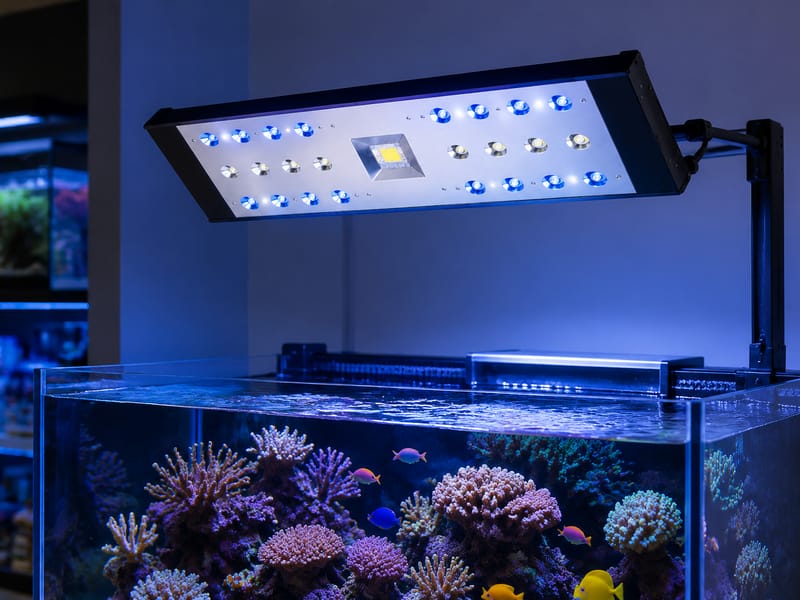
Brightness claims should be examined in context. Wattage alone does not tell a buyer how effectively a light illuminates an aquarium, because LED efficiency, optics, fixture height, tank depth, spread, and dimming settings all affect the result.
Ask suppliers to clarify the measurements and conditions behind performance claims. Depending on the product category, useful information may include:
- Light output measurement method
- Photosynthetically active radiation (PAR) data, when relevant to planted or reef use
- Measurement distance and water-depth conditions
- Beam angle or optical design
- Number and type of LED channels
- Dimming range and control steps
- Recommended mounting height
- Suggested aquarium dimensions and intended use
For general freshwater retail fixtures, a balanced white appearance with enough color support to make fish and plants look natural may be more important than complex channel control. For planted-tank or reef-oriented products, buyers may need more control over intensity and spectrum, but complexity should be justified by the target customer.
What “full spectrum” should and should not mean
“Full spectrum” is commonly used in aquarium lighting, but it is not a complete buying specification. It does not by itself establish plant performance, reef suitability, color rendering, or appropriate intensity. Treat it as a starting description and ask how the fixture is configured and what aquarium applications it is designed to support.
A practical review should consider:
- Whether the light produces a visually balanced appearance
- Whether color channels can be adjusted independently
- Whether the available spectrum matches the intended aquarium type
- Whether settings can be saved and repeated
- Whether the fixture can be dimmed enough for shallow tanks or sensitive setups
Color controls: useful feature or unnecessary complexity?
Color controls can add value when they let users tune viewing appearance, reduce intensity during acclimation, or set a more appropriate schedule. However, too many controls can increase returns if the interface is difficult to understand.
For a broad retail program, consider offering both:
- Simple fixtures with basic white/blue modes or fixed lighting profiles
- Advanced fixtures with channel-level adjustment, sunrise/sunset effects, programmable schedules, or external/app-based control
Request product instructions during sample evaluation. A feature is only commercially useful if an end user can set it up without excessive retailer support.
Choosing Fixture Length and Tank Coverage
Fixture length is one of the most important and most misunderstood buying criteria. A light can physically fit over an aquarium while still leaving dim areas at the ends, creating excessive glare, or concentrating too much output in the center.
Build your range around the tank sizes your customers actually buy. Standard aquarium lengths are useful starting points, but tank rim design, brace position, canopy use, water depth, and mounting height can all change fit and coverage.
| Evaluation factor | What to compare | Why it matters |
|---|---|---|
| Fixture body length | Fixed length or adjustable range | Determines basic tank fit and shelf assortment planning |
| Effective illuminated area | Supplier-recommended tank length and depth | Helps avoid dark corners or overextended coverage |
| Mounting height | Legs, brackets, hanging kit, or canopy placement | Changes intensity, spread, glare, and evaporation exposure |
| Tank rim compatibility | Minimum and maximum rim width; framed or rimless suitability | Prevents returns caused by mounts that do not fit |
| Water depth | Recommended depth for the intended use | Affects usable intensity at substrate or coral level |
| Fixture overlap | Coverage when multiple units are used | Important for long tanks and modular display systems |
When reviewing coverage, do not rely only on a “fits X-inch tank” label. Ask whether the recommendation refers to physical fit, visual illumination, or performance for plants or corals. Those are different claims.
For example, a basic fixture may physically span a long tank but be best suited to low-light viewing conditions. A more demanding planted or reef application may require stronger output, different mounting, or multiple fixtures. Product recommendations should reflect that difference clearly in retailer training and consumer-facing copy.
A common mistake is ordering one adjustable fixture to cover too many aquarium sizes. Adjustable legs can simplify inventory, but they do not guarantee the same light distribution across every tank length. Test the smallest and largest supported sizes during sampling.
Energy Use, Heat Management, and Service Life
LED lighting is generally selected partly for energy efficiency, but buyers should assess total electrical and thermal design rather than treating “LED” as a complete answer. The fixture, driver, dimming system, housing, ventilation, and operating schedule all influence energy draw and long-term performance.
Request confirmation of:
- Rated input voltage and frequency
- Rated wattage and typical operating modes, if available
- Power adapter or integrated driver configuration
- Plug type for the intended market
- Dimming behavior and standby power, if relevant
- Housing material and heat dissipation approach
- Fanless or fan-assisted operation, where applicable
- Replaceability of external adapters, controllers, or mounting components
- Expected service-life statement and the basis for it, if provided
Why heat management deserves attention
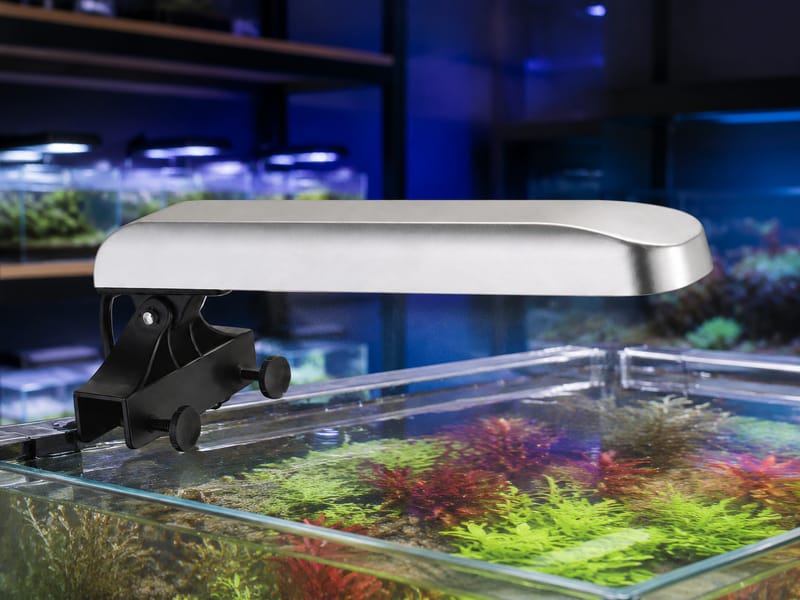
Heat can shorten component life, affect color consistency, and create reliability concerns. A fixture may feel warm during normal operation, but excessive heat, unstable dimming, discoloration, noisy fans, or power interruptions during a sample review deserve follow-up.
Look for practical design details rather than vague claims. These may include adequate heat-sink area, sensible ventilation, secure driver placement, and a housing design that does not trap heat unnecessarily. For enclosed canopies, confirm whether the fixture is designed for that installation condition; an open-top fixture may not perform the same way inside a restricted canopy.
Service life is another area where buyers should avoid assumptions. LED emitter life and fixture life are not always the same, because drivers, adapters, cables, switches, and control modules can become the limiting components. Ask what spare parts, replacement components, or support options may be available for the specific model, and confirm those terms for the order.
Mounting, Water Resistance, and Electrical Safety
Aquarium lighting operates near splashing water, salt creep, condensation, and wet hands. Mounting and electrical safety should therefore be evaluated as core purchasing criteria, not as afterthoughts.
First, determine how the light will be installed:
- Resting on adjustable tank-mounted legs
- Attached to a rimless-tank bracket
- Mounted on an arm or rail
- Suspended with a hanging kit
- Installed within a canopy or tank system
Each approach has trade-offs. Tank legs are convenient for entry-level retail products but may limit mounting height. Hanging systems offer placement flexibility but require suitable installation conditions. Brackets may create a cleaner premium presentation but must fit the tank glass or frame correctly.
Check the water-resistance rating and its limits
If a fixture has an ingress-protection (IP) rating or other water-resistance statement, ask exactly which components it covers. The rating may apply to the light body but not the power adapter, controller, plugs, or cable connections. It also may not mean the fixture can be submerged.
Confirm:
- Whether the fixture is intended for open-top aquarium use
- How splash exposure is addressed
- Whether cable connections need to remain dry
- Whether the adapter requires a protected location
- Whether a drip loop is required in installation instructions
- Cleaning instructions and limits on water exposure
For United States distribution, electrical requirements depend on the product, channel, state, retailer, and intended installation. Buyers should confirm applicable safety testing, labeling, plug configuration, documentation, and any retailer-specific compliance requirements before ordering. Do not assume that a product intended for one market is automatically suitable for another.
Also inspect sample build quality: cable strain relief, connector fit, mounting stability, sharp edges, screw quality, and the clarity of warnings can all affect product safety and return rates.
Controls, Timers, and Accessory Compatibility
Controls influence both product appeal and customer support needs. A well-designed timer can reduce inconsistent lighting schedules, while a confusing controller can create avoidable returns.
Common control approaches include:
- Manual on/off switch
- Inline dimmer
- Built-in timer with preset operating periods
- Multi-channel controller
- Remote control
- App-based control
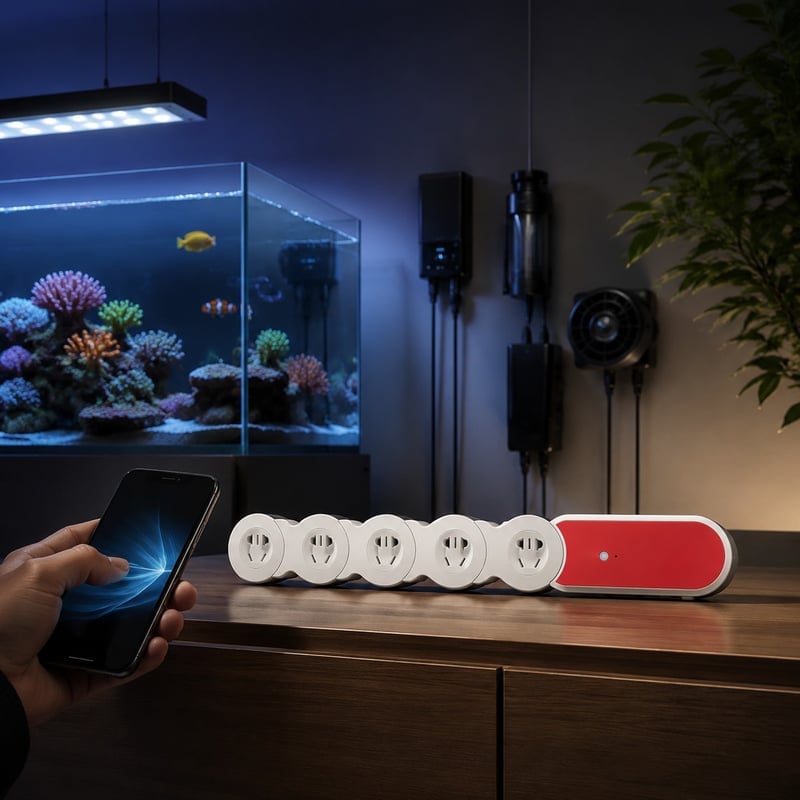
- External smart-plug compatibility
No single approach is best for every program. Simple controls usually suit value-oriented freshwater fixtures. Built-in timers can be a strong convenience feature for mainstream aquarium owners. Advanced programmable systems can serve enthusiasts, but they should have understandable setup instructions and reliable recovery behavior after a power interruption.
Ask suppliers how the fixture behaves when power is restored. Does it return to the previous setting, turn on at full output, require reprogramming, or follow a saved schedule? This detail matters for homes, retail displays, and aquarium systems connected to external timers.
Verify compatibility before creating bundles
Lighting is often sold alongside aquariums, lids, filtration equipment, and aquascaping products. Verify compatibility instead of assuming accessories will work together.
Check:
- Tank rim thickness and bracket range
- Glass thickness for rimless mounts
- Hood or canopy clearance
- Compatibility with existing lids and feeding doors
- Power adapter placement
- Controller connection type
- Availability and interchangeability of replacement legs, brackets, adapters, and remotes
- Whether multiple fixtures can be synchronized, if that is important
A buyer building a broader aquarium assortment may also want to coordinate lighting with filtration, air, circulation, heating, and tank-system categories. WKAQOO supplies products across these aquarium categories and can support sourcing discussions for buyers consolidating a multi-category range. Individual model compatibility and availability should still be confirmed before a program is finalized.
Sample Evaluation, Packaging, and Private Labeling
A sample review should simulate how the light will be received, installed, operated, and supported in the real sales channel. Do not evaluate only the fixture while overlooking the adapter, mounting parts, instructions, retail carton, and labeling.
A practical sample checklist includes:
- Inspect the carton. Check print clarity, barcode space, handling protection, component organization, and whether the package communicates the use case accurately.
- Confirm included parts. Verify the fixture, adapter, mounting hardware, controller, remote, instructions, and any claimed accessories.
- Test installation. Mount the unit on representative framed and rimless tanks if those applications are claimed.
- Observe coverage. Look for uneven illumination, excessive glare, shadows from braces, and light spill beyond the aquarium.
- Operate every control. Test dimming, channels, timer functions, settings retention, and remote or app connection where applicable.
- Check operating temperature. Observe the fixture and adapter during a reasonable run period under normal installation conditions.
- Review instructions. Confirm that setup, safety warnings, cleaning guidance, timer instructions, and troubleshooting are understandable.
- Document variations. Record fixture dimensions, cable length, plug type, package dimensions, gross weight, and all version-specific features.
Private-label requirements to clarify early
Private-label lighting can involve more than applying a logo. Brand owners should clarify the scope of customization before approving a product concept. Possible discussion points include colors, logo placement, retail carton artwork, labels, instruction manuals, inserts, bundled accessories, and branding consistency across related aquarium products.
However, customization options, minimum order quantities, sample terms, artwork requirements, packaging formats, production schedules, and lead times vary by product and inquiry. Confirm these points in writing for the exact model and configuration you plan to buy.
For private-label programs, keep product claims disciplined. Packaging should not imply aquarium suitability, waterproofing, electrical approvals, output performance, or included accessories that have not been confirmed for the final production version.
How to Compare LED Lighting Suppliers
A capable aquarium LED lighting supplier should make it easier to compare models, identify limitations, and prepare a consistent retail program. The lowest unit price is not always the lowest landed or support cost if specifications are unclear, accessories are missing, or retail packaging needs major rework.
Use the following supplier comparison framework:
| Supplier question | What a useful answer should include | Risk if not clarified |
|---|---|---|
| Which aquarium use case is the fixture designed for? | Specific freshwater, planted, marine, nano, or display positioning | Misleading product placement and returns |
| What are the exact dimensions and mounting limits? | Fixture length, adjustment range, bracket compatibility, and clearance needs | Poor tank fit and installation issues |
| How is output described? | Relevant measurements, recommended tank range, mounting guidance, and limitations | Overstated brightness expectations |
| What controls are included? | Timer behavior, dimming, channel control, memory function, and accessories | Customer confusion and support burden |
| What is included in the box? | Adapter, mounts, controller, remote, instructions, and replacement-part options | Unexpected added costs or incomplete kits |
| What electrical version is supplied? | Input range, plug type, labeling, and applicable documentation for the destination market | Distribution delays or unsuitable product versions |
| What packaging options are available? | Standard carton details, private-label possibilities, artwork process, and confirmation steps | Retail-readiness problems |
| What commercial terms apply? | Sample process, MOQ, payment terms, production timing, and shipping coordination for the inquiry | Inaccurate launch planning |
Compare answers model by model, not at the catalog level. A supplier may offer several lighting styles, but their specifications, accessories, customization options, and intended applications can differ substantially.
For a focused initial assortment, it is often better to select a small number of clearly differentiated fixtures than to stock many similar models. For example, a retailer may begin with a basic freshwater line, a timer-equipped midrange option, and a more controllable planted or premium display fixture. This structure gives customers an understandable upgrade path while simplifying training and inventory planning.
Before committing to an order, request confirmation of the final specification, voltage and plug version, included accessories, retail packaging, instructions, labeling, testing or certification requirements, MOQ, and current production timing. WKAQOO can discuss product selection, samples, private-label requirements, packaging, and order coordination for aquarium product buyers. For an inquiry, contact sales@wkaqoo.com with your target tank sizes, use cases, sales channel, and required branding details.