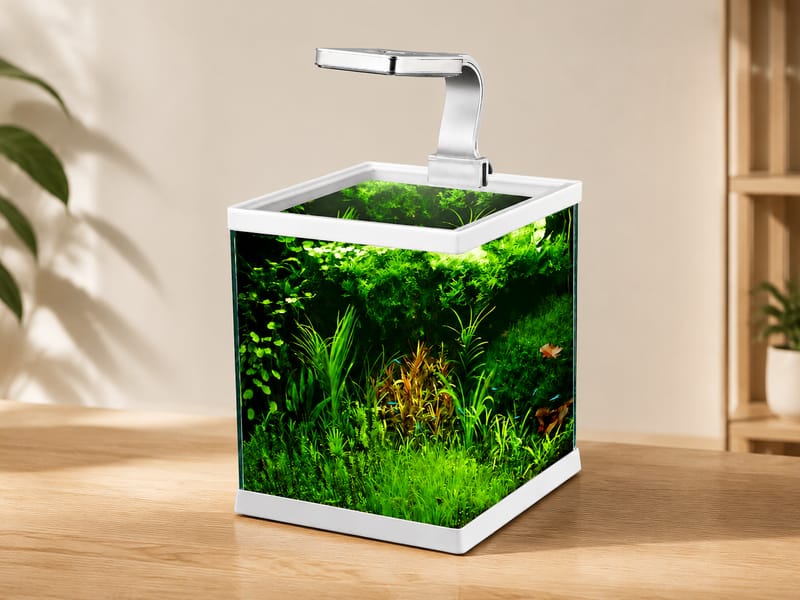
An aquarium starter kit with LED light can be a practical entry-level retail product when the tank, light, filtration, and included accessories are matched to a clear user type. For wholesale buyers, the best choice is rarely the kit with the longest feature list. It is the one with verified specifications, intuitive setup, dependable transit protection, and a retail position that customers can understand quickly.
Before placing an order, evaluate the complete system rather than the aquarium tank alone. Confirm usable tank volume, glass construction, light output and controls, filtration capacity, heater compatibility, included parts, replacement-part availability, packaging, and labeling requirements. These checks help prevent common problems such as undersized filters, mismatched electrical components, confusing setup instructions, and freight damage.
Which Customers Need an Aquarium Starter Kit
Starter kits serve different customers, so a single assortment should not treat every compact aquarium as interchangeable. Retailers and distributors should first define the intended user, livestock type, and expected price tier before comparing models.
Common buyer segments include:
- First-time fishkeepers: Usually need a straightforward kit with clear instructions, an easy-access filter, and a light suited to basic freshwater viewing.
- Families and gift buyers: Often value simple setup, compact placement, secure packaging, and a visually appealing presentation.
- Apartment and dorm residents: May prioritize a smaller footprint, low operating noise, convenient lid access, and manageable water-change routines.
- Betta keepers: Need an appropriate tank footprint, gentle water movement, a cover or lid design that limits jumping risk, and compatibility with a suitable heater where needed.
- Desktop and office users: Typically look for a compact, contained aquarium system with a clean appearance and uncomplicated maintenance.
- Beginner planted-tank hobbyists: May need more deliberate lighting information, adequate access for plant maintenance, and filtration that does not create excessive surface disturbance.
A starter kit should be positioned according to what it is designed to do. For example, a compact freshwater display kit may be a good retail choice for a beginner community setup, but it should not automatically be marketed as suitable for every fish species, planted aquarium style, or aquatic reptile application.
For a broader assortment, consider offering a good-better range:
| Retail role | Typical customer priority | What buyers should verify |
|---|---|---|
| Entry-level compact kit | Simple first aquarium | Basic filtration, light operation, clear instructions, protected packaging |
| Mid-range all-in-one kit | Better appearance and convenience | Light controls, access points, filter performance, replacement components |
| Specialty nano aquarium | Small-space or planted setup | Tank proportions, lighting suitability, flow adjustment, equipment compatibility |
| Family or gift-oriented kit | Easy assembly and presentation | Included items, safety messaging, carton graphics, damage resistance |
The important decision is not whether a kit has more components. It is whether its components support the promised use case without creating unnecessary customer confusion.
Tank Dimensions, Glass, and Construction Quality
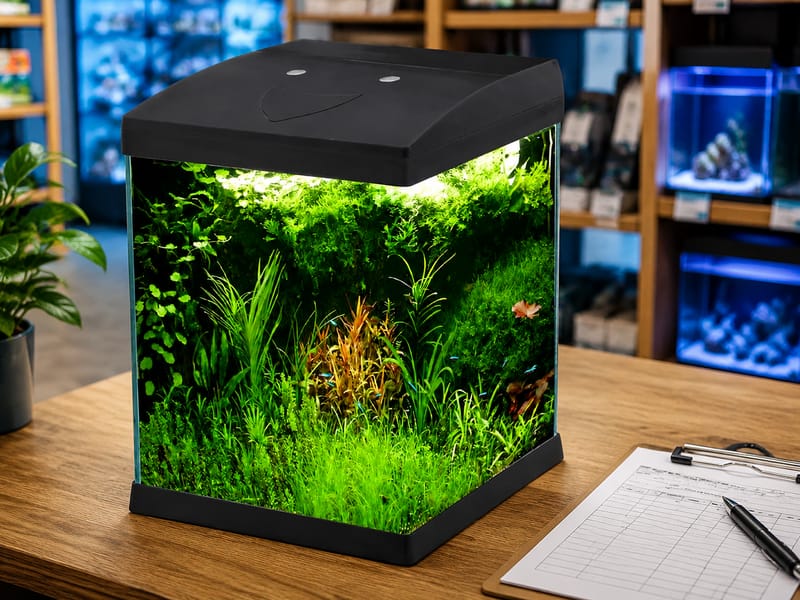
Tank dimensions affect both retail appeal and fishkeeping practicality. Two tanks with similar nominal volume can perform very differently if one is tall and narrow while another has more front-to-back depth and surface area.
Ask for the external dimensions, internal usable dimensions, nominal volume, and filled weight. These details influence shelf planning, carton size, shipping cost, countertop suitability, and the customer’s ability to place decor, a heater, or a filter intake.
Evaluate proportions, not just volume
A compact tank with more horizontal swimming space may suit certain small freshwater fish better than a narrow, tall design. A taller aquarium may create an attractive display profile, but it can also make routine maintenance and planting less convenient.
For each prospective kit, confirm:
- Tank length, width, and height
- Approximate water capacity and whether it excludes displacement from substrate or equipment
- Glass thickness or other tank material details
- Rimmed, frameless, or molded construction
- Lid or cover configuration
- Available openings for feeding, filters, airline tubing, and heater cords
- Base support requirements and whether a protective mat is included or recommended
- Whether the kit is intended for freshwater, saltwater, or another specified application
Do not assume that a tank’s nominal gallon capacity establishes livestock suitability. Fish stocking depends on the tank’s footprint, filtration, water temperature, cycling status, maintenance routine, and the needs of the species being kept.
Inspect construction details in samples
A pre-order sample should be checked under normal handling conditions. Inspect glass panels for scratches, chips, uneven edges, visible sealant inconsistencies, and fit between the tank, lid, frame, and equipment compartments. If the kit includes a molded base or canopy, check for warping, sharp edges, uneven color, and poor alignment.
A buyer should also ask how the tank is supported inside its retail carton. An attractive aquarium can still be a poor wholesale choice if corner protection, internal bracing, or drop-resistance measures are inadequate for the planned shipping channel.
Evaluating the Included LED Light
The included LED light is often the most visible feature in an aquarium starter kit with LED light, but “LED” alone does not describe whether the lighting is appropriate for the intended display. Buyers should evaluate brightness, coverage, color appearance, controls, power configuration, heat management, and serviceability.
For a basic freshwater starter kit, the key requirement is generally even illumination that allows customers to view fish and decor clearly. For a beginner planted aquarium, lighting performance becomes more important, but light alone does not guarantee plant growth. Plant species, nutrient management, water conditions, photoperiod, and carbon availability also matter.
LED light questions to ask before ordering
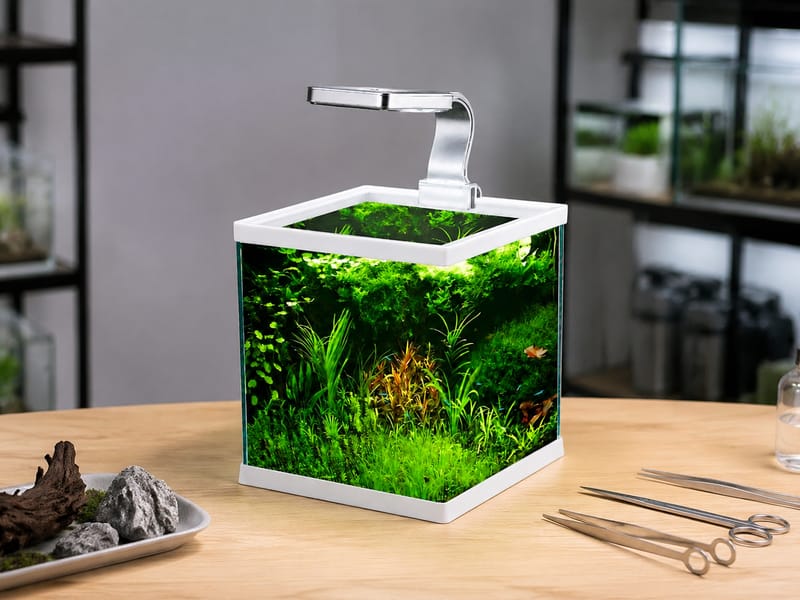
Confirm the following with the supplier for the specific model:
- LED wattage and input voltage
- Power adapter or USB power arrangement, if applicable
- Plug type and electrical-market suitability
- Color temperature or LED color mix, if specified
- Dimming, day/night, timer, or multi-mode functions
- Whether the light is integrated into the lid or removable
- Coverage across the entire tank footprint
- Clearance above the water and splash-exposure design
- Replacement-light availability or replaceable parts
- Heat buildup during extended operation
- Whether the light is intended for general viewing, basic plants, or another stated use
Avoid using broad claims such as “plant-ready” or “high-output” unless the supplier provides model-specific performance information that supports that positioning. Likewise, do not assume a color-changing mode is more valuable than a stable white-light setting. For many entry-level customers, a reliable on/off control or simple timer can be easier to use and explain.
Consider the retail experience
A light that looks bright in a showroom may create problems if it produces glare, uneven shadows, or excessive algae-promoting use because the timer instructions are unclear. Review how the light is demonstrated on the carton and in the user guide. The customer should be able to identify:
- How to power the light.
- How to select or change modes.
- How long to run it each day.
- What parts should stay dry.
- What to do if the light does not operate.
Good instructions reduce avoidable returns caused by setup errors rather than product defects.
Filtration, Heating, and Accessory Compatibility
A starter kit is only as practical as its equipment layout. The included filter should fit the tank’s usable volume and intended livestock load, while leaving room for routine cleaning and other essential equipment.
Confirm whether filtration is included and, if it is, identify the filter style: internal, hang-on-back, top filter, compartment filter, sponge filter, or another configuration. Then verify the rated flow information, media arrangement, intake protection, power requirement, and cleaning access for that exact model.
Check filtration against real beginner use
An overly powerful filter can create excessive current in a small aquarium. An undersized or difficult-to-maintain filter may lead to poor water quality if customers delay cleaning. Buyers should look for a balanced system with a manageable maintenance process rather than relying on a generic “all-in-one” label.
Ask these practical questions:
- Is the flow adjustable?
- Does the intake need a guard for small fish or shrimp?
- Which media are included, and are replacements standardized?
- Can the filter be removed without dismantling the whole lid or tank setup?
- Does the filter require priming or a specific minimum water level?
- Is the filter suitable for the marketed tank size and intended use?
- Are noise expectations or vibration-control features documented?
Heater compatibility is essential for tropical fish positioning
Not every starter kit includes a heater, and a compact kit should not be assumed to include one. If the product is being marketed for tropical freshwater fish, confirm whether a compatible heater can be installed safely without interfering with the lid, filter, or light.
Check:
- Heater compartment or mounting space
- Cable routing through the lid or rear panel
- Maximum practical heater dimensions
- Voltage and plug requirements
- Recommended heater wattage range for the tank and indoor conditions
- Clearance from plastic components and water-flow areas
- Whether a thermometer is included, optional, or sold separately
Heating needs vary with room temperature, tank size, and livestock requirements. Retail instructions should make clear that a heater’s suitability must be matched to the aquarium and the fish being kept.
Included accessories can help or create confusion
Common kit accessories may include a net, water conditioner sample, thermometer, filter media, artificial decor, or feeding tool. Their value depends on quality, relevance, and how clearly they are explained.
Avoid presenting basic accessories as a substitute for proper aquarium cycling, water testing, or regular maintenance. A helpful retail bundle can include education about what customers may still need, such as a suitable stand, substrate, water test kit, fish food, heater, or replacement filter media.
Setup Convenience and Maintenance Access
Beginner products should reduce unnecessary setup steps, not hide necessary care tasks. A well-designed kit makes routine feeding, cleaning, water changes, and equipment access easier without requiring customers to remove multiple components.
Review the physical access points during sample evaluation. Open the lid, remove the filter, route a heater cord, lift the light assembly, and simulate a partial water change. This reveals issues that are not obvious from product photos.
Look for:
- Feeding openings that are easy to use but secure when closed
- A lid that opens without straining hinges or obstructing wall placement
- Clear access to filter media and pump components
- Enough clearance for a gravel vacuum or algae-cleaning tool
- Equipment placement that does not block the viewing area
- Cord-routing channels that do not pinch wires
- A stable base that sits flat on an appropriate aquarium stand or furniture surface
Maintenance messaging should be realistic. Small aquariums are compact, but they do not eliminate the need for cycling, partial water changes, filter care, and water-quality monitoring. Claims of “maintenance-free” operation can create unrealistic customer expectations and increase returns or dissatisfaction.
Transit Protection, Carton Design, and Shipping Risk
Glass aquarium kits need packaging that protects the tank and also keeps accessories from shifting during transport. For distributors and retailers, this is a commercial issue as much as a product-quality issue: breakage, crushed cartons, and loose internal components can affect receiving labor, claim rates, sellable inventory, and customer perception.
Request packaging details before confirming an order, especially if products will move through parcel networks, fulfillment operations, or multi-stage distribution.
What to inspect in the master carton and retail box
Evaluate the following during sampling and packaging review:
- Individual retail carton dimensions and gross weight
- Master-carton quantity, dimensions, and total weight
- Corner protection around the glass tank
- Internal partitions, foam, molded pulp, or other stabilizing materials
- Protection for loose components such as pumps, lights, lids, and adapters
- Moisture resistance and print durability of carton materials
- Pallet-loading plan where relevant
- Handling marks and orientation messaging
- Whether retail packaging can withstand expected warehouse handling
- Carton barcode placement and space for retail labels
A compact kit may appear inexpensive to ship based on its tank volume, yet the outer carton can be disproportionately large because of protective cushioning. Compare both product dimensions and packed dimensions when estimating freight, warehouse storage, and shelf allocation.
Do not assume that one packaging design fits every route. Shipping conditions, carrier handling, sales channels, and destination requirements can change the level of protection needed. Discuss any drop-test expectations, retailer packaging rules, or labeling needs before production rather than after product approval.
Retail Positioning, Branding, and Instructions
Retail presentation should tell the customer what the kit is for, what is included, and what additional items may be needed. This reduces purchase uncertainty and helps store associates explain the product accurately.
For private-label and OEM programs, branding, colors, carton artwork, inserts, and user instructions should be reviewed as part of the sourcing process—not treated as final details after the product has been selected.
Make the box easy to understand
A clear package usually communicates:
- Tank dimensions and stated capacity
- Included components
- Electrical input details for the light and other powered equipment
- Intended general use, such as a beginner freshwater aquarium
- Setup overview
- Important care and safety reminders
- Items not included, when relevant
- Replacement-media or accessory information, if available
Avoid imagery that suggests livestock, dense planted layouts, or advanced equipment is included when it is not. If the photo shows fish, plants, gravel, or decorations beyond the package contents, the distinction should be clear.
Instructions are part of the product
A usable instruction booklet should cover assembly, equipment placement, water preparation, filter startup, LED operation, cleaning, basic troubleshooting, and safety precautions. It should also explain that fish should not be added to an unprepared aquarium immediately without appropriate cycling and water-conditioning steps.
For U.S. retail, buyers should confirm the appropriate electrical configuration, labeling, warning language, and any testing or certification requirements applicable to their sales channel. These requirements vary by product, retailer, state, and intended use, so they should be confirmed for the exact kit and market plan.
When developing a coordinated aquarium assortment, buyers can review individual model pages such as the WK004 aquarium product specifications, WK072 aquarium product specifications, WK076 aquarium product specifications, and WK102 aquarium product specifications alongside supplier-provided current specifications. Confirm the actual included components and configuration for each inquiry rather than assuming model pages represent every available option.
Pre-Order Sample and Specification Checklist
A sample review should confirm the product customers will receive, not only the appearance of an early prototype. Record findings in a specification sheet that purchasing, quality, packaging, and marketing teams can all use.
Use this checklist before issuing a purchase order:
Product and tank checks
- Confirm model number, tank dimensions, nominal capacity, and materials.
- Verify glass thickness or alternative tank construction details.
- Inspect panel alignment, sealant, edges, frame, lid, and base.
- Check the tank for scratches, chips, leaks, and instability on a flat surface.
- Confirm all included components against the packing list.
LED and electrical checks
- Verify LED wattage, voltage, adapter type, plug configuration, and cord length.
- Test each light mode, switch, timer, or dimming feature included in the sample.
- Check light coverage, fit, heat buildup, and splash-exposure design.
- Confirm current electrical documentation and any required market-specific test requirements.
- Verify warning labels and operating instructions.
Filtration and compatibility checks
- Test filter installation, startup, water flow, noise, and maintenance access.
- Confirm filter-media type, replacement options, and intake protection.
- Verify compatibility with the planned heater size and placement, if relevant.
- Check cable routing and lid fit with all equipment installed.
- Confirm whether decor, thermometer, net, or other accessories are included.
Packaging and commercial checks
- Measure retail and master-carton dimensions and weights.
- Inspect internal protection for glass and loose accessories.
- Confirm carton artwork, brand colors, barcode areas, and required markings.
- Approve user instructions, assembly diagrams, and included-item list.
- Confirm MOQ, sample terms, retail packaging requirements, production schedule, current lead time, and shipping terms.
- Document acceptable quality criteria and the process for addressing defects or missing components.
The most effective sourcing decision is one that aligns the kit’s actual configuration with its customer promise. Choose a compact aquarium system based on the intended user, verify the technical and packaging details on a sample, and make sure retail instructions explain both setup and ongoing care.
For a private-label, wholesale, or multi-category aquarium assortment, WKAQOO can help buyers discuss product selection, current specifications, packaging, branding, samples, and order coordination. Before committing, request confirmation of the exact configuration, customization options, MOQ, packaging details, and current production lead time for the model under consideration.