An air pump cannot fully replace a filter in most aquariums. In the United States market, the two devices serve different but complementary jobs: an air pump mainly moves air to improve gas exchange and circulation, while a filter removes suspended debris and supports the beneficial bacteria that convert toxic waste. For many beginners in cities such as Miami, Houston, Los Angeles, Seattle, and Chicago—where aquarium keeping ranges from compact apartment tanks to fish room installations—this distinction is the difference between a tank that looks lively for a week and one that stays stable for years.
The confusion is understandable. Bubbles make water look active, fish often respond positively to more surface movement, and sponge filters powered by air pumps can blur the line between aeration and filtration. But the key point remains simple: an air pump by itself provides oxygenation support, not complete waste management. If you keep a lightly stocked quarantine tank, a shrimp setup with dense plants, or a fry rearing system, an air-driven solution may be enough when paired with the right filter media. In a typical community aquarium, however, relying on air alone leaves uneaten food, fish waste, and dissolved organics in place.
Across the United States, hobbyists are also shopping more strategically. Supply chains through ports like Long Beach, Savannah, New York/New Jersey, and Houston have expanded product options, while online buying has made quiet mini pumps, high-efficiency sponge systems, and compact internal filters easy to compare. That matters because the best setup is rarely about choosing one device over the other. It is about matching fish load, tank size, maintenance habits, noise tolerance, and long-term biological stability.
If your goal is reliable oxygenation in a nano or mid-sized aquarium, a compact and efficient air system is often a smart starting point. A well-designed mini aquarium air pump for U.S. fish tanks can power air stones or sponge filters effectively while keeping energy use and noise under control. Still, product choice should be tied to tank biology, not marketing language. This guide explains exactly where air pumps shine, where filters are non-negotiable, and how to build an optimized setup for U.S. hobbyists in 2026 and beyond.
Air Pump vs Filter: Core Differences
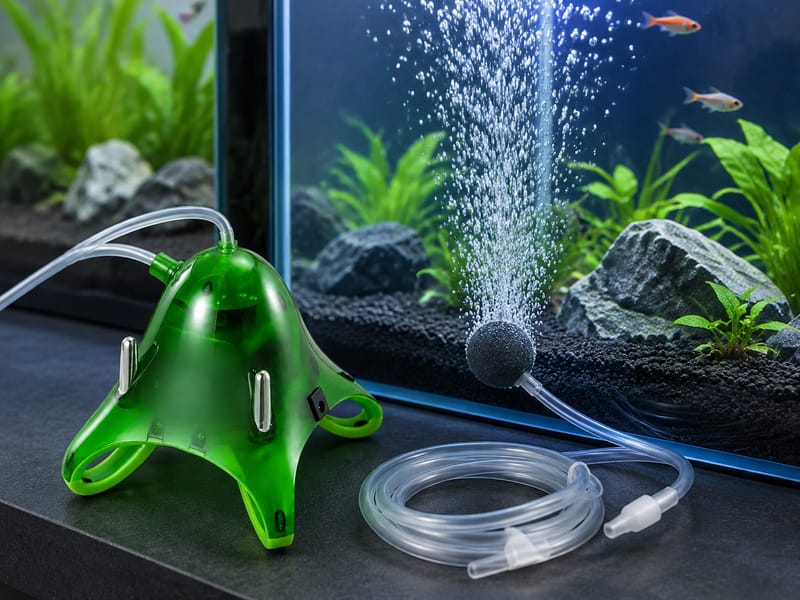
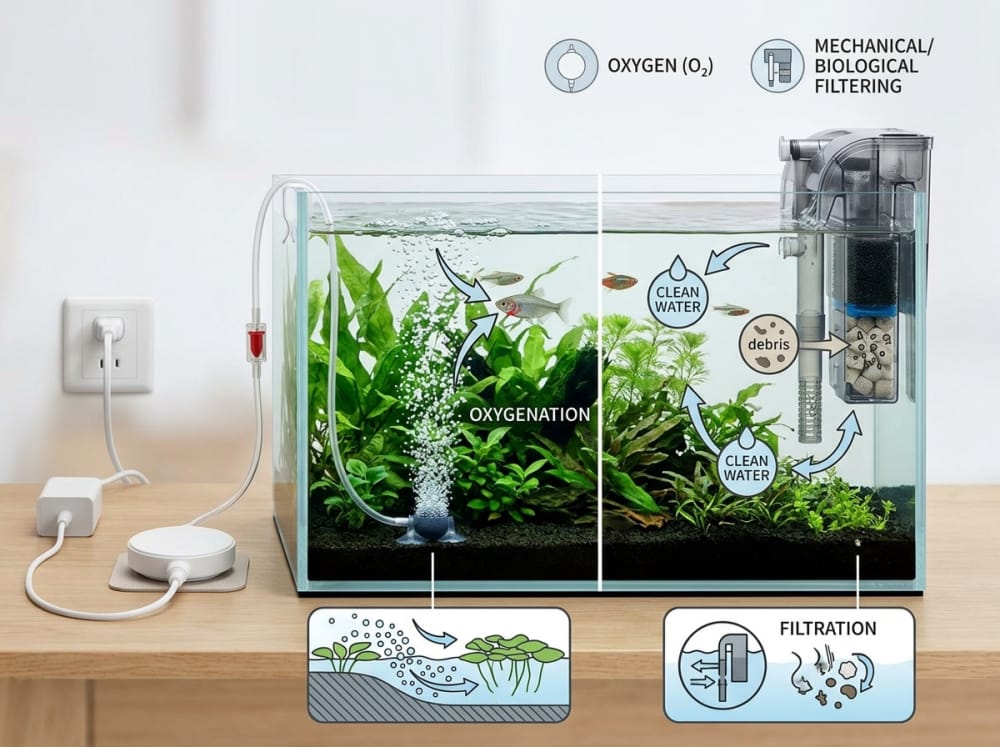
The core difference is functional. An air pump moves air from the room into the aquarium system, usually through airline tubing, check valves, gang valves, air stones, sponge filters, or decoration devices. A filter moves water through mechanical, biological, and sometimes chemical media. That distinction determines what each device can and cannot do.
When bubbles rise, they do not “add oxygen” simply because oxygen is inside each bubble. Most of the real oxygenation effect comes from improved surface agitation and better water turnover, which increase gas exchange at the water surface. That means an air pump is a support tool for dissolved oxygen levels and circulation. It is helpful, often very helpful, but it does not physically trap waste the way filter floss, sponges, or cartridges do, and it does not automatically provide enough bacterial surface area unless it is attached to a sponge filter or similar medium.
A filter, by contrast, actively moves aquarium water through media. Hang-on-back filters, canister filters, internal filters, sponge filters, and matten filters all create a path where debris can be intercepted and where nitrifying bacteria can colonize. Those bacteria convert ammonia from fish waste into nitrite and then into nitrate. Without that process, water quality degrades even if the tank looks sparkling on the surface.
| Feature | Air Pump | Filter | Why It Matters |
|---|---|---|---|
| Primary job | Moves air | Moves water through media | Defines whether the system supports oxygenation or waste control |
| Oxygen support | High when surface agitation is improved | Moderate to high depending on outflow | Both can help, but by different mechanisms |
| Mechanical cleanup | None by itself | Yes | Visible debris remains in the tank without proper filtration |
| Biological support | Only if attached to sponge media or similar | Yes, usually built in | Critical for ammonia and nitrite control |
| Circulation effect | Localized uplift and turbulence | Directed flow across the aquarium | Flow patterns influence fish comfort and dead spots |
| Typical beginner use | Air stone, sponge filter, decoration | Main filtration system | Beginners often overestimate bubbles and underestimate media |
| Can replace the other? | Usually no | Sometimes can provide enough aeration | The answer depends on stocking, flow, and filter design |
The practical takeaway from this table is that bubbles are not the same thing as filtration. A tank can look highly active and still accumulate invisible toxins. Conversely, a properly sized filter with strong surface ripple may keep oxygen levels healthy even without a separate air pump. That is why experienced aquarists in markets from Dallas to Portland evaluate water movement, bioload, and maintenance capacity before deciding what equipment is truly necessary.
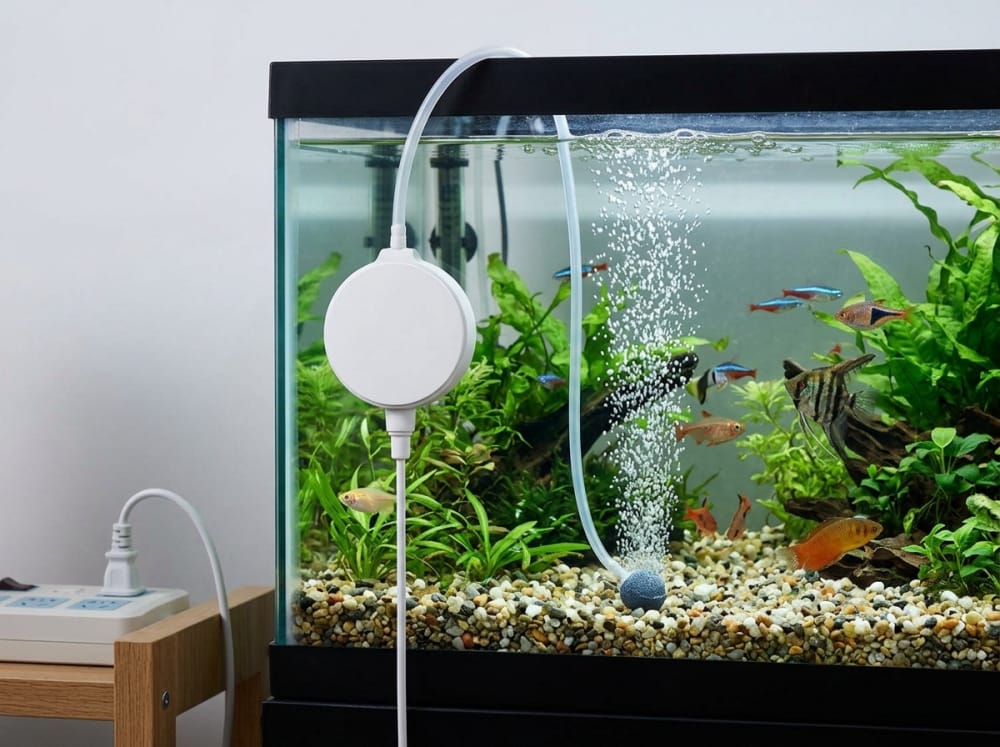
Mechanical vs Biological Filtration
Mechanical and biological filtration are the two most important concepts behind the “filter versus air pump” question. Mechanical filtration captures physical particles: fish waste, food fragments, plant debris, and suspended cloudiness. Biological filtration houses beneficial bacteria that stabilize the nitrogen cycle. An air pump alone handles neither function unless it powers a filter design that includes media, such as a sponge filter.
This is why sponge filters are so often recommended in breeder rooms, shrimp tanks, hospital tanks, and nano setups across the United States. A sponge filter uses an air pump to draw water through porous foam. The foam catches debris and provides a large area for bacterial colonization. In that case, the air pump is not replacing a filter. It is powering one. That wording matters because it prevents costly equipment mistakes.
Mechanical filtration tends to improve the tank’s appearance quickly. Water clears, particles are removed, and maintenance becomes more predictable. Biological filtration is less visible but more important over time. A tank can survive a little cloudiness; it cannot safely ignore ammonia. For small fish rooms in New Jersey basements, apartment tanks in San Francisco, or classroom aquariums in Atlanta, biological stability usually determines whether livestock thrives.
| System Type | Mechanical Strength | Biological Strength | Maintenance Pattern | Best Use Case |
|---|---|---|---|---|
| Air stone only | Very low | Very low | Low equipment care, high water quality risk | Decoration, temporary aeration support |
| Sponge filter with air pump | Moderate | High | Rinse sponge regularly in tank water | Breeding tanks, shrimp tanks, quarantine |
| Hang-on-back filter | High | Moderate to high | Frequent pad checks, media rotation | Most community tanks |
| Internal filter | Moderate to high | Moderate | Compact cleaning schedule | Small to medium aquariums |
| Canister filter | High | High | Less frequent but deeper maintenance | Heavily stocked or larger tanks |
| Matten filter | Moderate | Very high | Long service intervals | Breeding systems and fish rooms |
| Undergravel filter with air lift | Low to moderate | Moderate | Substrate-dependent care | Legacy setups, simple hardy species tanks |
The explanation behind these differences is straightforward. Systems that force water through media provide a place for solids to be caught and bacteria to grow. Systems that only move bubbles do not create that reliable pathway. U.S. hobbyists often ask if a planted tank changes the equation. Plants do help by consuming nitrogen compounds, but they are not a substitute for mechanical cleanup in most tanks, especially where feeding is generous or fish density is higher than minimal.
Oxygenation vs Waste Removal
Oxygenation and waste removal are often discussed together because they both affect fish health, yet they solve different problems. Oxygenation concerns dissolved oxygen, carbon dioxide exchange, and overall respiratory comfort. Waste removal concerns solid debris and dissolved pollutants. An air pump is strongest in the first category. A filter is strongest in the second, though many filters also contribute to oxygenation through water movement.
In warm climates like Florida, Arizona, and southern Texas, oxygenation becomes especially important because warm water holds less dissolved oxygen than cooler water. In those regions, U.S. aquarists often use air pumps to stabilize summer tanks, especially in rooms without constant air conditioning. Likewise, in heavily stocked goldfish aquariums or cichlid tanks, adding aeration can prevent nighttime oxygen dips. But if waste is not being removed, better oxygen levels alone will not stop ammonia accumulation.
Waste removal also extends beyond what the eye sees. Filters remove particulates mechanically, but their more valuable contribution is enabling the beneficial microbes that process dissolved waste. Activated carbon or specialty media can add chemical filtration, but biological filtration remains the foundation of a healthy aquarium. This is why “the fish seem fine because there are lots of bubbles” is not a safe long-term standard.
| Aquarium Situation | Oxygenation Need | Waste Removal Need | Recommended Priority |
|---|---|---|---|
| Heavily stocked goldfish tank | High | Very high | Strong filter plus supplemental air pump |
| Nano shrimp tank | Moderate | Moderate | Air-driven sponge filter works well |
| Betta tank with low current preference | Moderate | High | Gentle filtration; optional low-output aeration |
| Quarantine tank | High during medication | Moderate | Sponge filter with dependable air flow |
| Planted community aquarium | Moderate | High | Balanced filtration; add air at night if needed |
| Breeder fry grow-out | High | Moderate to high | Air-driven sponge filtration for safety and stability |
| Large predator tank | High | Very high | Powerful filtration plus aeration backup |
The explanation is practical: oxygenation helps fish breathe, but waste removal helps the entire system remain chemically safe. If you are choosing between the two because of budget, most U.S. beginners should buy a proper filter first, then add an air pump where oxygen demand, stocking density, medication use, or flow design make it valuable.
This line chart reflects a realistic growth pattern in U.S. demand for aquarium support equipment, especially compact pumps, quiet indoor systems, and combination filtration products. Growth has been supported by urban hobbyists, online specialty retailers, and rising interest in planted nano tanks. By 2026, sustainability concerns and energy efficiency standards are likely to make quieter, lower-wattage pumps even more desirable.
When an Air Pump Is Not Enough
An air pump is not enough when the tank produces more solid or dissolved waste than natural processes, plants, and water changes can safely manage. That includes most community tanks, nearly all goldfish systems, larger cichlid aquariums, and any tank with messy feeding habits. If your water clouds quickly, debris settles around decorations, ammonia readings rise, or fish gasp despite visible bubbles, the tank needs proper filtration—not just more aeration.
Common red flags include uneaten food accumulating under hardscape, a persistent surface film, foul odor, and nitrate climbing too fast between water changes. In many homes from Boston to Phoenix, beginners first notice stress in the fish: clamped fins, sluggish swimming, or repeated trips to the surface. Because bubbles are visible, they often assume oxygen is fine and overlook the actual issue—waste breakdown is outpacing biological capacity.
This is particularly important in mini and mid-sized aquariums, where volume is limited and water quality can change fast. A 10-gallon tank in a New York apartment has less buffering capacity than a larger suburban setup in Denver or Minneapolis. In smaller tanks, missing filtration can lead to swings in ammonia, nitrite, and dissolved organic load within days.
| Warning Sign | Likely Cause | What an Air Pump Can Do | What It Cannot Do | Better Solution |
|---|---|---|---|---|
| Cloudy water | Suspended particles or bacterial bloom | Improve movement slightly | Remove particles consistently | Add mechanical filtration and test water |
| Ammonia present | Insufficient biological filtration | Support oxygen for bacteria indirectly | Provide enough media by itself | Install a filter or sponge system with mature media |
| Debris on substrate | Poor waste capture | Create some uplift flow | Trap solids | Use a filter and regular gravel cleaning |
| Fish gasping | Low oxygen or toxic water | Help immediately with surface agitation | Fix ammonia and nitrite fast enough alone | Emergency aeration plus water change and filtration review |
| Bad odor | Organic buildup | Increase movement | Remove dissolved and trapped waste | Filter maintenance, water changes, feeding control |
| Frequent algae spikes | Nutrient imbalance and waste accumulation | Minor circulation support | Control nutrient source alone | Improve filtration and husbandry |
| Dirty decorations | Insufficient mechanical capture | Move water around objects | Polish water | Use filter floss, sponge, or better flow pattern |
In short, an air pump can buy time in an emergency and improve comfort under heavy oxygen demand. It cannot replace a complete life-support system in a typical stocked aquarium. That is the central reason so many long-term hobbyists treat aeration as supplemental unless the air pump is actively powering a biological filter.
When They Work Best Together
Air pumps and filters work best together when one device improves water quality and the other improves gas exchange, circulation, or redundancy. This partnership is especially useful in heavily stocked tanks, warm-water systems, medication periods, breeding projects, and fish rooms where maintaining dissolved oxygen is a constant priority.
For example, a hang-on-back or canister filter may handle the bulk of mechanical and biological filtration in a 40-gallon U.S. community aquarium, while a small air pump with an air stone keeps the surface active during summer heat waves. In a breeder rack, a centralized air system may power multiple sponge filters, giving each tank both aeration and biofiltration with lower electrical complexity. In shrimp and fry tanks, air-driven filters are often preferred because they are gentle and reduce the risk of sucking in delicate livestock.
There is also a resilience advantage. If a filter outflow becomes partially restricted, additional aeration helps maintain oxygen levels until maintenance can be done. Many advanced hobbyists in hurricane-prone regions such as the Gulf Coast or coastal Carolinas also value air systems because battery backup options are common for aeration during outages.
The bar chart shows where combined aeration and filtration demand is strongest. Breeding rooms and retail systems rank high because redundancy, oxygen stability, and low-risk fry-safe filtration matter more than minimalist equipment design. For mainstream home hobbyists, the demand score remains strong because quieter technology has made pumps easier to integrate into living rooms, offices, and bedrooms.
Common Beginner Confusion
Beginners often confuse movement with filtration, bubbles with oxygen saturation, and sponge filters with “just an air pump.” These misunderstandings are common because aquarium marketing sometimes highlights visible effects instead of explaining system biology. A bubbling ornament appears active, but unless water is being pulled through filter media, it is not cleaning the tank in a meaningful way.
Another common misconception is that if a filter creates current, an air pump is never useful. In reality, many tanks benefit from extra aeration during transport, treatment, high temperatures, or overnight plant respiration. The opposite misconception is equally risky: that an air pump can replace a filter because fish seem lively near bubbles. Fish may gather near high-flow zones for oxygen, but that behavior can also signal stress in low-quality water.
There is also confusion around “low-tech” aquariums. Some experienced aquarists maintain planted tanks with minimal hardware, but they compensate with very light stocking, disciplined feeding, dense plant growth, and strong maintenance habits. Beginners who copy the aesthetic without understanding the biological balance often run into problems quickly.
In U.S. retail settings from local fish stores in Orlando to specialty shops in Southern California, staff often see the same pattern: a new hobbyist buys a small tank, an air pump, and decorative accessories, then returns after a week with cloudy water and stressed fish. The issue is rarely that the air pump failed. The issue is that filtration was underbuilt or misunderstood from the start.
This area chart highlights a realistic trend shift toward compact, quieter, and lower-energy air-driven solutions. The rise reflects apartment living, better noise-dampening designs, and stronger interest in shrimp tanks, nano aquariums, and modular fish room systems. By 2026, policy and consumer expectations around power efficiency and materials sustainability are likely to favor durable pumps that last longer and waste less energy.
Optimized Setup Recommendations
The best setup depends on tank size, stocking density, fish type, and maintenance style. For U.S. hobbyists, the most effective rule is simple: choose filtration for waste load first, then add aeration where oxygen demand, backup needs, or gentle biological filtration justify it.
For nano aquariums under 10 gallons, a sponge filter powered by a quiet mini air pump is often an excellent solution, especially for shrimp, fry, and lightly stocked betta support setups where current must stay soft. For 10- to 40-gallon community tanks, a hang-on-back or internal filter usually forms the main system, with an optional air stone for heat, medication, or nighttime oxygen support. For larger or messy tanks, strong primary filtration is mandatory, and air support should be viewed as an enhancement rather than a substitute.
Setup design should also account for where the aquarium is located. In dense urban apartments like those in Manhattan, Seattle, or downtown Los Angeles, low-noise operation matters more. In warmer Southern climates, oxygen reserve matters more in summer. In fish rooms in Ohio, Pennsylvania, or North Carolina, centralized air systems can reduce equipment clutter and simplify maintenance across multiple tanks.
| Tank Type | Tank Size | Main Filter Recommendation | Air Pump Role | Reasoning |
|---|---|---|---|---|
| Nano shrimp tank | 3–10 gallons | Sponge filter | Primary power source | Gentle flow, strong bio support, livestock safety |
| Betta aquarium | 5–10 gallons | Gentle internal or sponge filter | Optional low-flow support | Avoid strong current while keeping water stable |
| Community tank | 10–40 gallons | Hang-on-back filter | Supplemental oxygenation | Balanced waste removal and flexible aeration |
| Breeder grow-out | 10–30 gallons | Multiple sponge filters | Core system driver | Reliable biofiltration and fry-safe intake |
| Goldfish setup | 20+ gallons | Strong HOB or canister | Recommended supplement | High waste load and high oxygen need |
| Cichlid or predator tank | 40+ gallons | Canister or sump-style filtration | Backup and circulation aid | Heavy feeding and intense metabolic demand |
| Quarantine/hospital tank | 5–20 gallons | Mature sponge filter | Essential | Medication-safe, simple, dependable oxygenation |
These recommendations work because they separate primary filtration from supportive aeration. They also reflect the strongest use case for specialized pump makers: compact, efficient air delivery for mini and mid-sized aquariums where noise, consistency, and footprint matter. Our own focus in this segment comes from years spent refining performance around air pumps and air stones rather than trying to be a generic supplier of every aquarium component.
From a technological capability standpoint, that specialization matters. A company centered on mini and mid-sized aeration systems can improve diaphragm balance, noise reduction, airflow consistency, and compatibility with sponge filters and fine-pore air stones. For U.S. users, this translates into practical benefits: steadier output in nano tanks, more reliable overnight aeration, and cleaner installation in compact living spaces.
Manufacturing capability also influences real-world performance. Consistent assembly tolerances, quality-tested housings, and repeatable pump output are especially important when a device runs continuously. In the United States market, where buyers compare value not just by price but by durability, a manufacturer with long experience in precision pump production can offer better long-term stability than a generic private-label option built with inconsistent internal components.
Service capability is the third piece. U.S. hobbyists increasingly expect fast product guidance, clearer sizing advice, and better application matching. That means helping a buyer understand whether they need a mini pump for a single sponge filter, a stronger unit for multiple outlets, or a quieter model for a bedroom setup. Good service does not oversell; it matches airflow to the biological needs of the aquarium.
Best Product Options
The best product choice depends on whether you need aeration only, air-driven filtration, or a mixed system. For most U.S. beginners, products fall into four practical groups: stand-alone air pumps with air stones, air pumps paired with sponge filters, conventional power filters, and hybrid systems where a filter handles the waste load and an air pump improves oxygenation or redundancy.
For mini and mid-sized aquariums, a compact low-noise air pump is one of the most versatile options because it can start as an aeration tool and later power a sponge filter in quarantine, breeding, or shrimp applications. This is particularly useful in urban U.S. households where space is limited and one device may serve several tank roles over time.
When comparing products, buyers should look at airflow stability, outlet pressure, noise level, power draw, outlet configuration, check-valve compatibility, and intended tank size. Marketing terms like “silent” or “high oxygen” are less useful than clear performance matching. A pump that is too weak will underdrive sponge media. One that is too strong may create excessive turbulence in a small tank.
| Product Category | Best For | Main Benefit | Limitation | Recommended U.S. Buyer Type |
|---|---|---|---|---|
| Mini air pump + air stone | Oxygen support | Simple, compact, affordable | No true filtration by itself | Beginners adding aeration to existing filtered tanks |
| Mini air pump + sponge filter | Nano and breeding tanks | Biological filtration with gentle flow | Moderate mechanical polishing only | Shrimp keepers, fry raisers, quarantine users |
| Hang-on-back filter | General community aquariums | Strong all-around filtration | Can add current and evaporation | Mainstream hobbyists |
| Internal filter | Compact medium tanks | Space-saving water polishing | Uses in-tank space | Apartment and classroom tanks |
| Canister filter | Large or messy tanks | High media volume and strong filtration | Higher cost and maintenance complexity | Advanced hobbyists |
| Dual system: filter + air pump | High-demand setups | Best balance of waste control and oxygenation | More equipment to manage | Goldfish, cichlid, summer heat, backup-focused owners |
| Central air system | Multi-tank rooms | Efficient multi-outlet operation | Overkill for one small tank | Breeders and service professionals |
The explanation behind these categories is straightforward: the “best” product is the one that matches the tank’s biological demands and the user’s maintenance capacity. If the goal is dependable aeration in a small aquarium, a compact specialized pump can be an excellent choice. If the tank lacks a real filtration pathway, however, the best product is the one that solves that gap first.
This comparison chart illustrates a pattern many U.S. buyers notice when comparing specialized pump suppliers with generic budget options. Purpose-built mini and mid-sized pump systems often perform better in noise control, energy use, and sponge filter compatibility, while generic models may look cheaper at checkout but deliver less consistency over time. In a bedroom tank, office setup, or shrimp rack, those differences are easy to hear and see.
From a market perspective, the United States continues to favor application-specific products. Buyers in large logistics and trade regions such as Los Angeles/Long Beach, Houston, Savannah, and the New York/New Jersey corridor often have access to a broad range of imported aquarium equipment, but the most successful products are increasingly those that solve a clear use case: quiet mini pumps for nano aquariums, reliable air systems for breeders, and practical add-on aeration for seasonal heat management.
Product types are also becoming more segmented. Entry-level hobbyists want simple, quiet, plug-and-play devices. Intermediate aquarists want modular compatibility with sponge filters, gang valves, and manifold systems. Professional service firms and small commercial facilities want dependable multi-tank airflow and easier maintenance. That segmentation supports specialist manufacturers that focus deeply on aeration technology instead of spreading attention across unrelated categories.
Buying advice for U.S. customers should therefore focus on fit rather than hype. Choose your filter based on bioload. Choose your air pump based on oxygen demand, the number of outlets required, tank depth, and the resistance created by accessories such as fine-pore stones or multiple sponge filters. If silence matters, prioritize enclosure design and vibration control. If livestock is delicate, prioritize stable and moderate airflow over raw power.
Industries beyond home hobby use also affect demand. Educational institutions use simple, safe systems for classroom biology tanks. Retail fish stores use sponge filters in holding systems because they are inexpensive, gentle, and easy to service. Small aquaculture and research facilities value redundant aeration. Aquarium maintenance companies in metropolitan areas often keep portable air equipment available for transport, medication, and emergency support.
Applications vary accordingly. In a quarantine tank, an air-powered sponge filter is often ideal because it is easy to disinfect, avoids strong current, and remains medication-friendly. In a community display tank, aeration can enhance night-time gas exchange and reduce stagnant zones. In fish shipping or temporary holding, emergency battery-backed air systems can mean the difference between safe arrival and preventable losses.
Consider a few practical case studies from the U.S. market. A hobbyist in Tampa keeps fancy goldfish in a warm room and runs a strong hang-on-back filter plus supplemental aeration in summer; fish activity and surface comfort improve notably during heat spikes. A shrimp breeder in Portland powers multiple sponge filters from a compact air system because the setup is quiet, modular, and safe for young stock. A teacher in suburban Chicago uses a small internal filter on a classroom tank but adds a mini pump during holiday periods when room temperatures fluctuate. In all three cases, the air pump does not “replace” filtration; it solves an oxygenation or system-design need.
Local suppliers in the United States range from neighborhood fish stores to large e-commerce sellers and regional warehouse distributors. Specialty local fish stores remain valuable because they can match pump output to sponge size, recommend check valves, and troubleshoot noise placement on actual home setups. Online suppliers offer convenience and broader comparison shopping, especially for customers outside major metro areas. The smartest approach is often mixed: use local expertise when available, but compare technical specifications carefully before buying.
As for our company, our role in this space is clear and deliberately narrow. We focus on high-performance mini and mid-sized air pumps and air stones because specialization produces better outcomes. Rather than trying to be every kind of aquarium brand, we refine the areas where airflow consistency, compact design, and dependable aeration matter most. That focus is especially relevant to U.S. hobbyists who want practical performance in nano tanks, shrimp setups, quarantine systems, and supplemental oxygenation applications.
Looking toward 2026, several trends are likely to shape aquarium equipment decisions in the United States. First, quieter and more energy-efficient aeration systems will continue gaining market share as more hobbyists keep tanks in living spaces and home offices. Second, sustainability will matter more: longer-lasting diaphragms, lower power consumption, less wasteful packaging, and replaceable parts will become stronger selling points. Third, policy and retail pressure may increase around product safety labeling, energy transparency, and materials compliance. Finally, smart monitoring will grow, but even as sensors and app-based tools become more common, the core biology of aquariums will not change: oxygenation and filtration are related, but they are not interchangeable.
FAQ
Can fish survive with just an air pump? Sometimes, but only in very specific setups, such as a mature sponge-filter system or a lightly stocked temporary tank. An air pump alone is usually not enough for a standard aquarium because it does not remove waste.
Is a sponge filter considered a filter or just aeration? It is a real filter. The air pump powers it, but the sponge provides mechanical and biological filtration.
Do I need an air pump if I already have a filter? Not always. Many filters provide enough surface movement. Add an air pump if oxygen demand is high, temperatures are warm, fish load is heavy, or you want extra redundancy.
What is the best setup for a beginner in the United States? For most beginners, a properly sized filter is the first purchase. A mini air pump is a useful add-on for sponge filters, quarantine tanks, summer aeration, or extra surface agitation.
How do I choose between an air stone and a sponge filter? Choose an air stone if you only need aeration. Choose a sponge filter if you need both aeration and biological filtration in a gentle-flow setup.
What is the direct answer to the original question? In most aquariums, no—an air pump cannot replace a filter. It supports oxygenation and circulation, while filtration handles solid waste capture and biological processing.