Wholesale buyers should build a hang-on-back (HOB) filter range around aquarium volume, rim compatibility, media flexibility, and maintenance expectations—not flow rate alone. A dependable lineup usually includes compact models for small tanks, mid-range options for common community aquariums, and higher-capacity units for larger or more heavily stocked setups.
When comparing hang-on-back aquarium filters wholesale, verify each model’s actual operating fit before committing to an assortment. Published ratings may vary by media load, intake position, tank stocking, and maintenance condition. For retail success, buyers also need to assess replacement-media availability, noise behavior, priming recovery, packaging clarity, and the spare-parts plan.
How Hang-On-Back Filtration Works
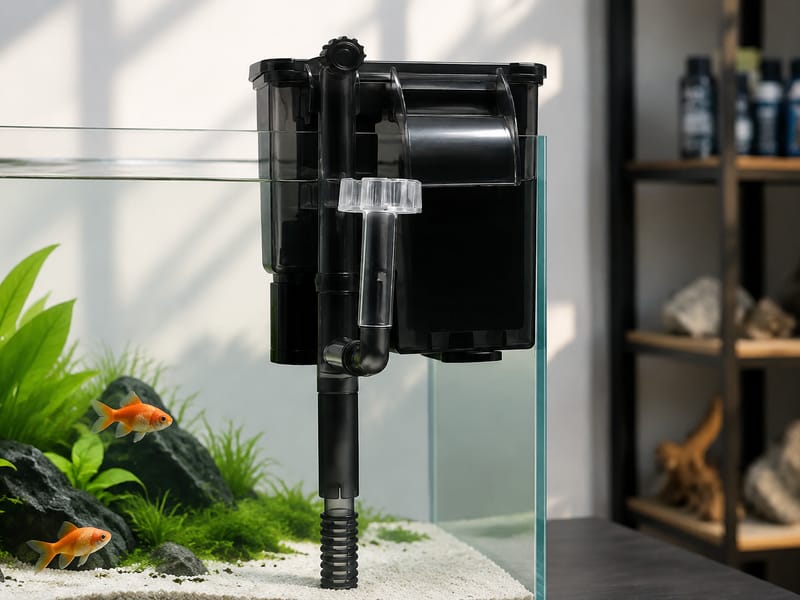
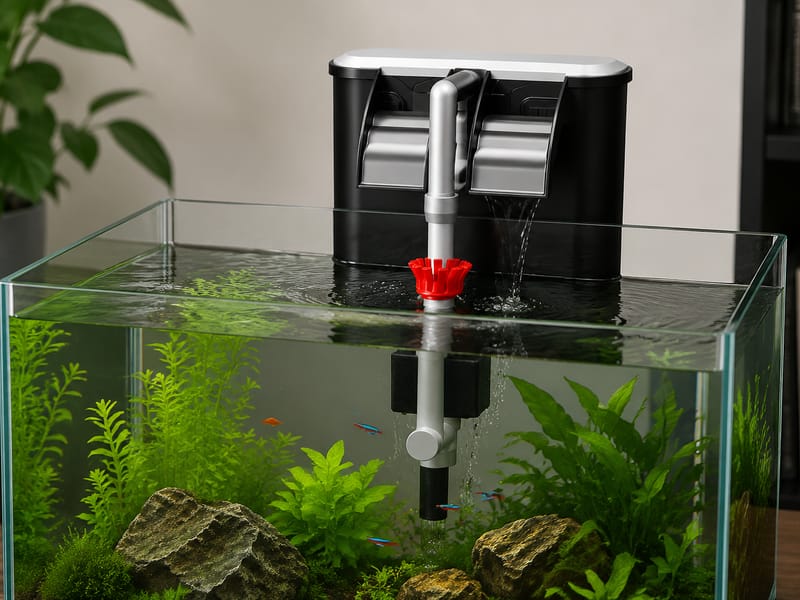
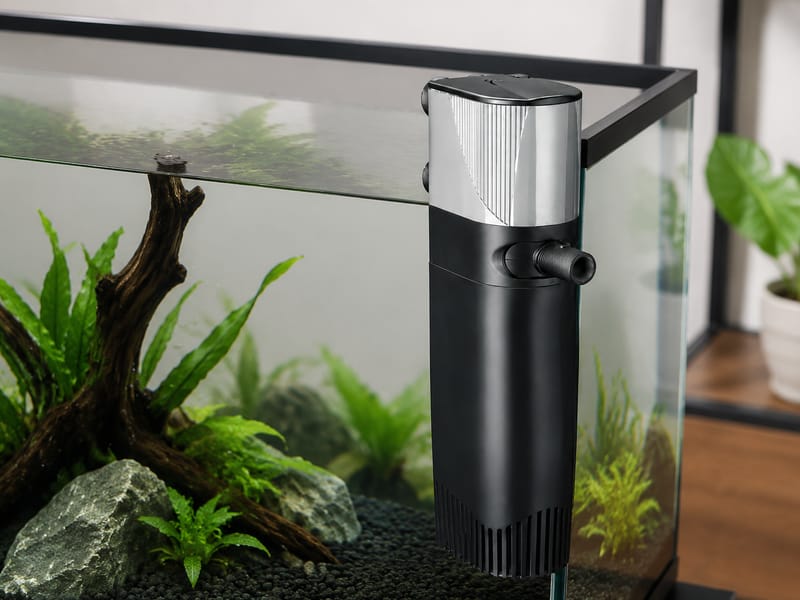
A HOB filter mounts on the outside back wall of an aquarium. An intake tube draws aquarium water into the filter body, where it passes through filter media before returning to the tank by a spillway or waterfall-style outlet.
This layout makes HOB filters popular for entry-level and community aquarium systems because the filter is accessible without placing the main motor body inside the tank. It can also provide useful surface agitation, which may support gas exchange when flow is set appropriately.
A typical HOB filter includes:
- An intake tube, often with a strainer to keep fish, shrimp, and debris out
- An impeller and motor assembly that moves water upward
- A media chamber, basket, cartridge, or combination of these
- A return lip or spillway that sends filtered water back into the aquarium
- A hanging bracket or adjustable mounting arrangement
For a wholesale range, distinguish between cartridge-oriented and media-basket designs. Cartridge systems can be simple for first-time aquarium owners, while reusable baskets often appeal to hobbyists who want to choose their own sponge, biomedia, or chemical media. Neither format is automatically better; the right mix depends on the retailer’s customer base and planned replacement-sales strategy.
Flow Rate and Aquarium Volume Matching
Flow rate is useful for comparing HOB filters, but it is not a complete measure of filtration performance. Buyers should compare the stated flow rate with the recommended tank-volume range, media capacity, intake design, and intended livestock use.
A practical starting point is to group filters by the aquarium sizes they are designed to support. However, stocking density, aquarium shape, planted layouts, and species behavior can change the appropriate choice. A lightly stocked planted aquarium may need a different flow pattern than a crowded freshwater community tank of the same volume.
| Buyer consideration | Why it matters | What to verify |
|---|---|---|
| Rated aquarium volume | Helps position the model in a retail assortment | Whether the stated range reflects freshwater use, typical stocking, and media installed |
| Flow rate | Affects circulation and debris pickup | Rated versus adjustable flow, and how media loading may affect output |
| Media chamber size | Influences mechanical and biological filtration capacity | Internal dimensions, basket count, and acceptable media formats |
| Return-flow pattern | Affects surface movement and current in the tank | Spillway width, outlet direction, and whether flow can be reduced |
| Intake design | Impacts debris collection and livestock safety | Strainer openings, extension options, and minimum water depth |
| Motor capacity | Influences suitability for larger tanks | Wattage, voltage, and operating requirements for the target market |
A common buying mistake is to list a HOB filter for an aquarium at the top end of its advertised volume range without considering the intended livestock. Fish that produce more waste, aquariums with frequent feeding, or tanks with substantial debris may need more media capacity, more circulation, or a secondary filtration method.
Conversely, excessive current can stress slow-swimming fish, disturb fine substrate, or create too much surface turbulence in a small aquarium. If a model offers adjustable flow, confirm whether adjustment meaningfully changes the outlet flow and whether it remains stable at lower settings.
For product-line planning, avoid large gaps. A retailer benefits from a clear upgrade path: small-tank filtration, standard community-tank filtration, and larger-capacity filtration. Buyers reviewing potential models can compare the available WKAQOO aquarium filter product options and request model-specific ratings before assigning them to a tank-size category.
Mechanical, Biological, and Chemical Filter Media
HOB filtration works best when the filter media arrangement matches its role. The three common functions are mechanical, biological, and chemical filtration.
Mechanical filtration
Mechanical media captures suspended particles such as uneaten food, plant fragments, and waste. Coarse sponge catches larger debris, while finer floss or pads can polish water by trapping smaller particles.
The trade-off is restriction: fine media can clog faster. If a filter’s flow falls sharply as a cartridge or pad loads with debris, customers may perceive it as underpowered even when the motor is operating normally. Assess whether the media arrangement allows users to rinse or replace the mechanical stage without discarding all biological media.
Biological filtration
Biological media provides surface area for beneficial bacteria that process nitrogen waste. Sponges, ceramic-style media, sintered media, and other porous materials may serve this purpose, depending on the filter configuration.
For buyers, the key question is not simply whether a model includes “biological filtration.” Ask how much usable space it provides and whether the media can remain in place during routine cleaning. A design that encourages customers to replace all media at once can disrupt an established biological colony.
Chemical filtration
Activated carbon and other chemical media can remove certain dissolved compounds, odors, or discoloration. They are useful in selected situations, but are not mandatory for every aquarium all the time.
A versatile HOB filter should allow retailers to explain chemical media as an optional treatment stage rather than a substitute for water changes, appropriate stocking, and mechanical or biological filtration. Confirm whether the basket or cartridge system can accommodate different media types and whether loose media requires a separate bag.
Priming, Noise, Energy Use, and Overflow Design
HOB filters are expected to restart after normal maintenance or a brief power interruption, but restart behavior should be tested rather than assumed. Many HOB designs need the filter body filled with water before operation. If a unit is not properly primed, the impeller may run without moving water, potentially creating noise and preventing filtration.
What to assess during sample evaluation
- How much water is needed to prime the filter body
- Whether the unit resumes flow after a controlled power interruption
- Whether the intake retains water well enough for routine restart conditions
- How the filter behaves when the aquarium water level drops
- Whether the motor produces vibration, rattling, or intermittent impeller noise
- Whether the return creates excessive splashing at normal operating water levels
- Whether the filter body or spillway can overflow if media becomes clogged
Noise should be evaluated in a quiet indoor setting, not only in a busy showroom or production environment. Common causes include an uneven mounting position, low tank water, air trapped in the impeller chamber, debris in the impeller, or an intake tube that is not fully seated. A product manual should help the end user diagnose these issues clearly.
Energy use is another comparison point, especially for retailers selling multiple aquarium systems to hobbyists. Confirm the model-specific voltage, frequency, wattage, plug type, and applicable electrical requirements for the intended market. Do not assume that two visually similar filters have the same electrical configuration.
Overflow design deserves particular attention. A blocked or heavily loaded media path can cause water to rise inside the filter. Buyers should inspect whether the housing provides a controlled bypass path, how the return performs when media is dirty, and what conditions are identified in the instructions as requiring cleaning.
Cartridge Replacement and Maintenance Access
Replacement-media planning can make or break the long-term retail value of a HOB filter. A filter may be easy to sell initially but difficult to support if customers cannot obtain compatible cartridges, sponges, impellers, intake parts, or lids.
Cartridge filters are convenient when replacement sizes are consistent and clearly labeled. However, proprietary dimensions can limit customer choice. Reusable media baskets are more flexible, but they require better instructions so users understand how to rinse mechanical media without replacing all biological material.
When evaluating maintenance access, check:
- Whether the lid lifts off easily without interfering with an aquarium hood.
- Whether the media can be removed without dripping excessively outside the tank.
- Whether the impeller cover can be opened for cleaning.
- Whether the intake tube separates into sections for cleaning and adjustment.
- Whether replacement parts are identifiable by model and part number.
- Whether instructions explain cleaning intervals without implying a fixed schedule for every aquarium.
A filter that is simple to open, rinse, reassemble, and restart can reduce returns driven by avoidable user frustration. Product pages such as the WK038 aquarium equipment listing can serve as an initial reference point, but buyers should still request the applicable media and replacement-part details for the exact model under consideration.
Rim Fit, Intake Depth, and Tank Compatibility
A HOB filter must physically fit the aquarium before filtration performance matters. Buyers should request dimensions for the hanger, back clearance, intake length, filter-body depth, and lid clearance. These measurements are particularly important for framed aquariums, tanks with thick rims, glass lids, canopies, and compact aquarium systems.
Compatibility checks for a wholesale assortment
- Tank rim thickness: Confirm the mounting bracket accommodates the intended rim style.
- Back-wall clearance: Make sure the aquarium can sit near a wall without compressing the filter body or power cord.
- Lid and canopy clearance: A standard glass lid or hood may conflict with the hanging bracket or filter lid.
- Minimum and maximum water level: HOB filters can become noisy or splashy when the water level is too low.
- Intake depth: Confirm the intake reaches the intended lower water zone without touching substrate.
- Livestock safety: Shrimp, fry, and small fish may need a prefilter sponge or a finer intake guard.
- Tank material and shape: Curved, rimless, unusually thick, or integrated-lid tanks may require separate fit confirmation.
Retailers should avoid presenting a single HOB filter as universal. A compact unit may fit a small glass aquarium but not a framed tank with a thick top rim. A larger model may have adequate flow but interfere with a canopy or require more rear clearance than the customer has available.
For a broader comparison of aquarium equipment configurations, review the WK064 product information and confirm physical measurements, included components, and compatibility with the final supplier documentation.
Sample Testing, Spare Parts, and Packaging
A pre-order sample review should mimic normal customer setup and maintenance as closely as possible. Visual appearance alone cannot reveal restart behavior, vibration, fit tolerance, media access, or instruction quality.
Recommended sample test checklist
| Test area | Questions to ask |
|---|---|
| Assembly | Are all components clearly identified and easy to install correctly? |
| Fit | Does the hanger fit the intended rim thickness and leave lid clearance? |
| Startup | Is priming straightforward, and does flow begin consistently? |
| Flow | Does output remain acceptable after media is installed and lightly loaded? |
| Noise | Are there vibration, rattling, air-lock, or water-splash issues? |
| Maintenance | Can the user access media and the impeller without unnecessary disassembly? |
| Restart | Does the unit resume operation after a controlled power interruption? |
| Parts | Are intake sections, impellers, covers, media pieces, and seals available separately? |
| Packaging | Does the carton protect the body, lid, intake parts, and fragile components? |
| Instructions | Are setup, cleaning, water-level, safety, and troubleshooting steps understandable? |
Test multiple samples when possible, especially when evaluating a private-label launch. One unit can identify obvious design issues, but more than one sample provides a better view of assembly consistency and packaging protection.
Packaging should support the retail channel. Confirm the carton dimensions, artwork requirements, barcode placement, language needs, inner protection, accessory organization, and whether user instructions are included. For online retail, also consider whether the package can tolerate parcel handling without crushed corners, cracked housings, or loose internal parts.
If your assortment includes multiple aquarium categories, it is useful to coordinate packaging style and product information across the range. The WK074 aquarium product page may be relevant when reviewing additional product options for a more cohesive assortment.
Supplier and OEM Questions Before Ordering
Before placing a wholesale order, get written confirmation for the exact model—not a general product family description. HOB filters can differ in electrical specifications, media configuration, accessories, and fit even when their housings look similar.
Ask suppliers these questions:
- What are the confirmed voltage, frequency, wattage, plug, and electrical requirements for this version?
- What aquarium-volume range and flow rate apply with the supplied media installed?
- Is flow adjustable? If so, how is adjustment made?
- Which media, cartridges, baskets, intake tubes, and accessories are included?
- What replacement-media dimensions and spare parts are available?
- What are the filter body, hanger, intake, and packaging dimensions?
- What rim thickness and water-level range does the model accommodate?
- What priming and restart procedure is required?
- What cleaning and troubleshooting guidance will appear in the user instructions?
- Are product labels, brand artwork, colors, packaging, and manuals customizable for this order?
- What sample terms, minimum order quantity, testing requirements, production schedule, and current lead time apply?
- Which documents, certifications, or market-specific test requirements must be confirmed for the planned sales channel?
For OEM or private-label programs, provide a concise product brief rather than only a target price. Include the intended aquarium-size segment, preferred media format, expected retail channel, packaging style, branding elements, accessories, and required documentation. This helps prevent a mismatch between a sample configuration and the final order configuration.
A strong HOB filter assortment is one that customers can fit, operate, maintain, and support with confidence. Start with tank-size coverage, then validate the practical details: media flexibility, restart behavior, noise, rim fit, replacement parts, and packaging. WKAQOO can help business buyers discuss product selection, samples, branding, packaging, and order requirements; contact sales@wkaqoo.com to confirm model-specific specifications, customization options, MOQ, packaging, and current lead time before ordering.