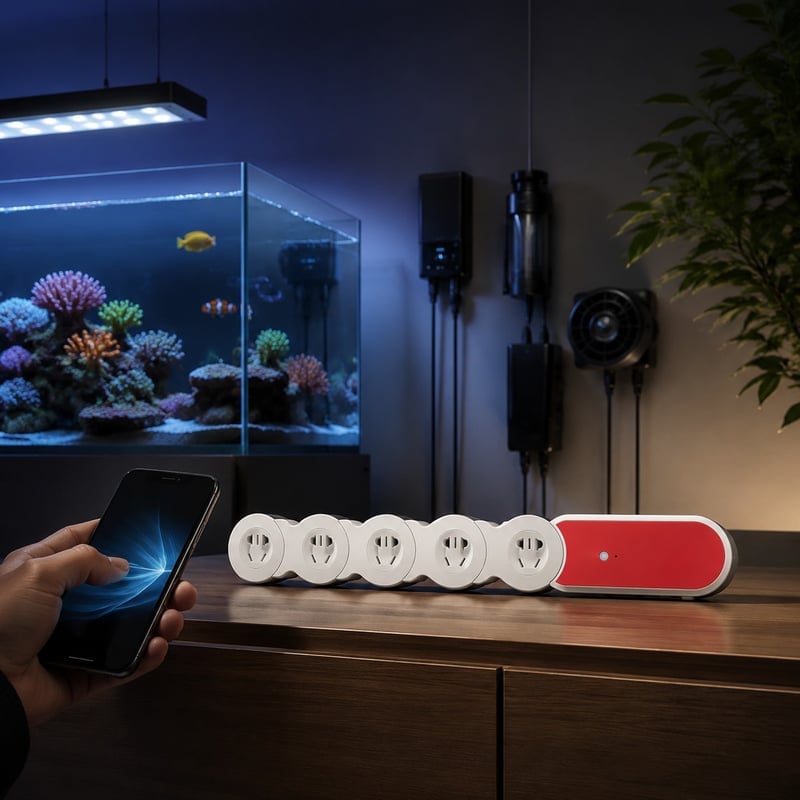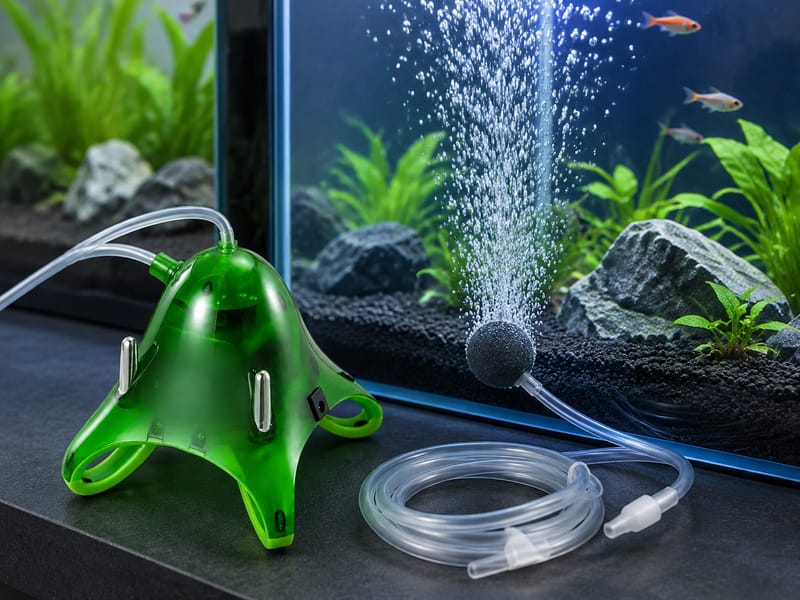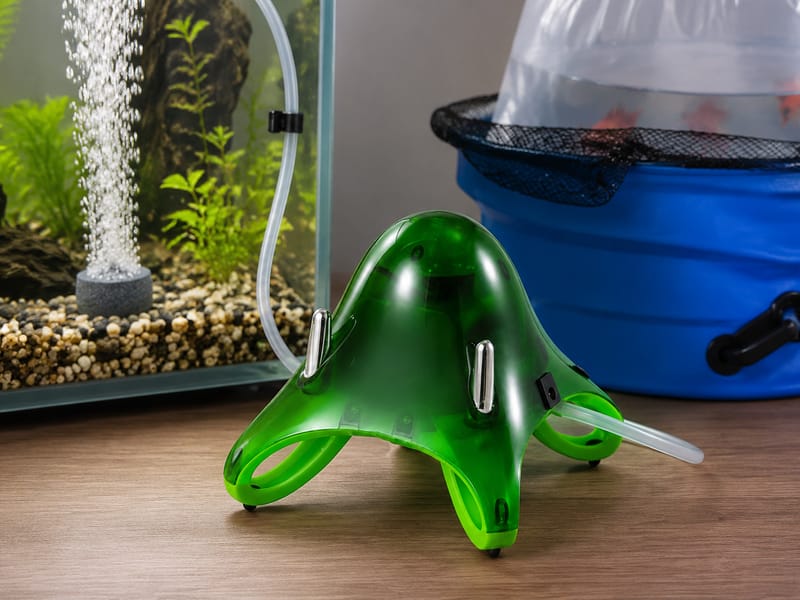
A rechargeable aquarium air pump can be a practical backup for short power outages, fish transport, quarantine setups, and locations without convenient outlet access. For buyers, the most reliable choice is not simply the pump with the largest battery claim. It is the model whose tested runtime, airflow, charging behavior, outlet configuration, noise level, accessories, and instructions match the intended aquarium or transport use.
When evaluating a rechargeable aquarium air pump supplier, separate emergency backup needs from everyday portable use. A compact unit that keeps a small transport container aerated may not provide enough airflow, runtime, or outlet flexibility for a stocked display aquarium during an extended outage. Request model-specific specifications and test samples before setting expectations for end users.
When Rechargeable Aeration Is Most Useful
Rechargeable air pumps serve several distinct use cases. Each one places different demands on battery capacity, airflow consistency, portability, and included accessories.
| Use case | Main buying priority | Typical selection concern |
|---|---|---|
| Short power outages | Runtime and automatic backup behavior | Whether the pump starts or switches modes reliably when AC power fails |
| Fish transport | Portability, quiet operation, and secure tubing | Battery life during loading, travel, and delays |
| Retail bagging or temporary holding | Fast setup and compact size | Ease of charging between uses |
| Quarantine or hospital tanks | Stable continuous output | Noise, vibration, and compatibility with a small air stone |
| Outdoor or mobile displays | Charging options and enclosure practicality | Exposure to splashes, battery status visibility, and recharge access |
| Everyday aquarium aeration | Continuous-duty performance | Heat, noise, charging cycles, and long-term user expectations |
For outage preparedness, a rechargeable pump is usually most valuable when it can maintain surface agitation and air-stone operation until main power returns or a larger backup plan is available. It should be treated as one component of a response plan, not a replacement for an appropriately sized generator or battery backup where long outages are possible.
For transport, the priority shifts. A unit should be compact enough for the container, stable enough not to slide or rattle, and simple for staff or customers to operate. An oversized air pump may create excessive agitation in a small transport vessel, while a weak pump may provide insufficient aeration for a heavily stocked container.
Retailers should consider whether they need one universal SKU or a tiered assortment. A small single-outlet portable model may suit casual hobbyists and fish transport, while a higher-capacity or multi-outlet option may be better positioned for emergency preparedness and multiple container use.
Battery Capacity, Runtime, and Charging Methods
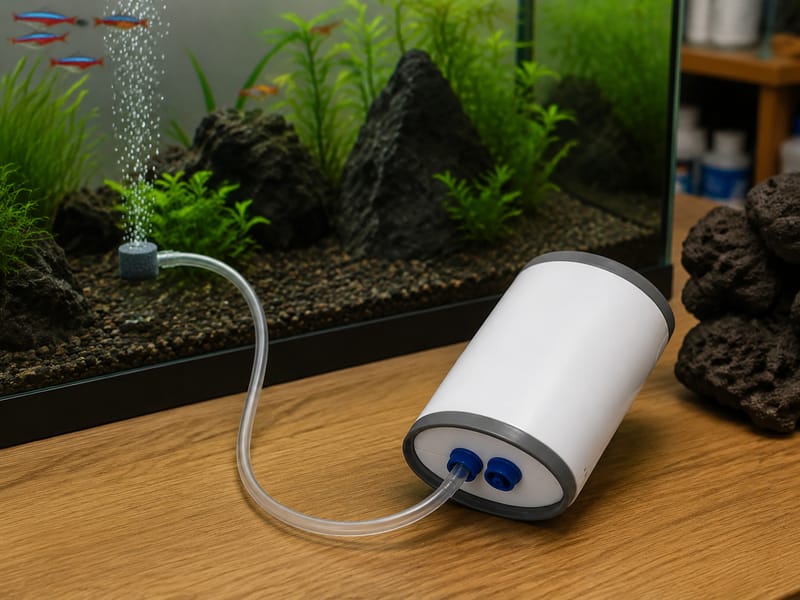
Battery capacity is important, but the capacity number alone does not tell a buyer how long an air pump will operate. Actual runtime depends on the pump’s power draw, selected output setting, battery condition, airflow resistance, ambient temperature, and whether the unit is operating continuously or intermittently.
Ask suppliers to state runtime by operating mode, not as a single unqualified claim. For example, if a pump has low and high output settings, the buyer should receive separate expected runtime information for each setting. If an intermittent mode is available, clarify the on/off cycle used to determine the stated runtime.
What to verify about the battery
A sourcing specification should clarify:
- Battery chemistry and nominal capacity
- Whether the capacity is stated in mAh, Wh, or both
- Expected runtime by output mode
- Charging input type and connector
- Approximate recharge time under defined input conditions
- Whether a charging cable or power adapter is included
- Battery indicator design and low-battery notification
- Whether the pump can operate while charging
- Storage recommendations for periods when the pump is not in use
- Battery replacement policy, if applicable
Watt-hours are often more useful than milliamp-hours for comparing batteries with different nominal voltages. However, neither figure should be used as a direct runtime promise without knowing the pump’s actual operating load.
Charging options affect retail suitability
USB charging can be convenient because many customers already have compatible power sources. But the buyer should still confirm the required input voltage and current, cable type, adapter inclusion, and any limitations on charging from power banks, vehicle adapters, or lower-output USB ports.
For a retail program, packaging and instructions should clearly explain:
- How to charge the unit before first use.
- What the battery indicator means.
- Whether it is safe to run while charging.
- How to select operating modes.
- When to recharge after storage.
- Which charging accessories are included and which are not.
Avoid presenting a rechargeable pump as an unlimited emergency solution. Long-term outage performance depends on the model’s actual runtime and the stocking density, water temperature, filtration loss, and oxygen demand of the aquarium.
Air Output, Outlets, and Supported Tank Size
Airflow should be assessed as a system, not as a headline number. The useful airflow at the air stone can be reduced by tubing length, tubing kinks, water depth, check valves, clogged stones, splitters, and other restrictions.
A rechargeable air pump supplier should be able to help confirm the model’s outlet count, airflow rating, operating modes, and intended application. Buyers should also ask how airflow is measured and whether the stated figure represents unrestricted output or output under a defined operating condition.
Match the pump to the job, not just the aquarium volume
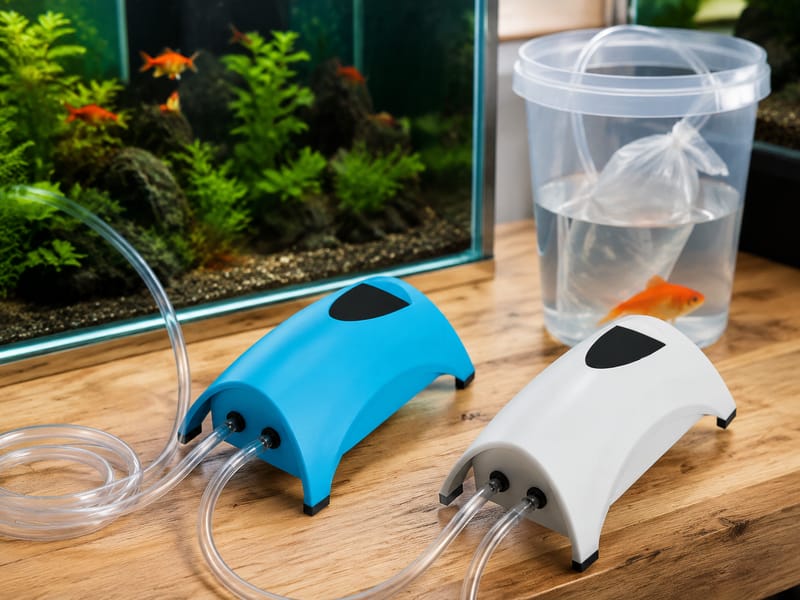
Tank size can be a useful retail reference, but it is not enough on its own. A lightly stocked aquarium with a shallow water depth may need far less emergency aeration than a densely stocked holding tank. Likewise, a tank with a large air stone and deep placement may create more resistance than a small transport container using a compact stone.
Use these questions to build a better recommendation:
- Is the pump intended for temporary emergency aeration or routine use?
- What is the water volume and approximate water depth?
- What livestock is being supported, and how heavily stocked is the system?
- Will the pump run one air stone or several?
- Is an adjustable output setting needed?
- Does the buyer need one outlet or the ability to aerate multiple containers?
- Will a splitter reduce airflow below a useful level?
A dual-outlet pump can add flexibility, but it does not automatically provide twice the practical support. If both outlets share the same motor and battery, output distribution and runtime need to be confirmed in the model documentation.
For merchandising, it is often better to describe the use case clearly—such as “portable aeration for transport and short-term backup”—than to make broad tank-size claims that overlook stocking and setup variables.
Noise, Vibration, and Continuous Operation
Noise and vibration matter in home aquariums, retail displays, transport vehicles, and temporary holding areas. Small portable pumps can transmit vibration into a countertop, tank lid, plastic container, or shipping box even when the motor itself is relatively quiet.
Evaluate noise as a complete installation issue. During sample review, place the pump on the intended surface, connect the planned tubing and air stone, and listen at normal user distance. A pump may sound different when hung, placed on a hard surface, enclosed in packaging, or operated at a higher output setting.
Sample checks for noise and operating stability
Ask a sample reviewer to check:
- Audible motor noise at low and high settings
- Vibration against hard and soft surfaces
- Whether rubber feet, a hanging feature, or a protective housing reduce movement
- Changes in noise as battery level decreases
- Airflow consistency during a full operating cycle
- Heat buildup during sustained use
- Whether tubing pulls the unit over or kinks at the outlet
- Ease of switching modes with wet hands or in low light
Continuous operation also raises a practical question: is the unit designed mainly for intermittent emergency use, or can it support a regular aeration routine? Do not assume that a portable rechargeable pump is intended for indefinite operation. Confirm the manufacturer’s recommended use pattern, charging behavior, and operating limitations for each model.
Power Outage and Fish Transport Planning
A rechargeable air pump is most effective when it is prepared before an outage or transport event. A pump stored uncharged, paired with brittle tubing, or missing a check valve can fail at the moment it is needed.
Build a basic outage aeration kit
For a retail-ready or home-ready emergency kit, consider including or recommending:
- A fully charged rechargeable air pump
- Spare airline tubing
- A compatible air stone
- A check valve
- A backup air stone in case of clogging
- Clear battery and operation instructions
- A labeled storage pouch or carton compartment, where appropriate
During an outage, users should prioritize stable water conditions. Avoid unnecessary feeding, avoid stirring debris, and monitor livestock behavior. If filtration is off, water movement and surface agitation become especially important. The right response depends on the aquarium’s stocking level, temperature, water volume, and outage duration.
For fish transport, avoid treating aeration as the only consideration. Container size, stocking density, temperature control, trip duration, secure lids, and prevention of spills are equally important. A compact pump should be positioned where it cannot fall into water, become blocked, or pull tubing loose during movement.
A common mistake is selecting a high-output air stone for a small transport container. Excessive turbulence can stress fish and cause splashing. Buyers serving fish stores or shipping operations may benefit from offering multiple stone sizes and advising customers to match bubble intensity to the container.
Tubing, Check Valves, and Air Stone Compatibility
The pump, tubing, check valve, and air stone should be treated as a compatibility set. Even a capable pump can underperform if the tubing diameter does not fit securely, the air stone is clogged, or the check valve is installed in the wrong direction.
Compatibility details to confirm
Before ordering, verify:
- Air outlet diameter and compatible airline tubing size
- Included tubing length and material, if tubing is supplied
- Whether a check valve is included
- Check valve flow direction markings
- Compatible air stone types and connection sizes
- Number of outlets and whether splitters are supported
- Recommended maximum tubing length or water depth, if stated
- Whether replacement accessories can be sourced separately
A check valve helps reduce the risk of water moving backward through airline tubing toward the pump when the pump is below the water line or loses power. It must be installed in the correct direction and tested before use. A check valve is helpful, but placement still matters: keeping the pump above the aquarium water level is generally the simpler and safer setup when practical.
Air stones also change over time. Mineral buildup or fine debris can increase resistance and reduce bubble output. User instructions should tell customers to inspect and replace clogged stones rather than assuming the pump is defective.
Sample Testing, Packaging, and User Instructions
A pre-production sample review should simulate the actual customer use case. For a portable consumer product, a desk test is not enough. Test the pump with the planned tubing, check valve, air stone, packaging components, and charging accessories.
A practical sample test checklist
Test at least the following points:
- Charging: Verify connector fit, indicator behavior, recharge process, and included accessories.
- Startup: Check that the pump starts consistently after charging and after sitting unused.
- Output modes: Confirm airflow changes, mode labels, and control usability.
- Runtime: Run the unit under a defined setup and record the mode, tubing length, air stone, and timing.
- Airflow under load: Test with realistic water depth and accessories rather than an open outlet only.
- Noise and vibration: Check on the surface and mounting arrangement customers will use.
- Leak and backflow setup: Test tubing connections and check-valve orientation.
- Transport handling: Confirm that the pump, cable, and accessories remain organized in the package.
- Instructions: Have someone unfamiliar with the product follow the instructions without assistance.
- Retail presentation: Check barcode placement, warning labels, color consistency, and protective packaging.
For private-label programs, user instructions should avoid vague statements such as “long-lasting battery” or “suitable for all aquariums.” More useful instructions explain charging, setup, mode selection, placement, check-valve installation, basic troubleshooting, and realistic limits of emergency operation.
Packaging requirements can vary substantially by retail channel. Confirm carton dimensions, included accessories, label content, branding position, inner pack requirements, master carton details, and any testing or marking expectations before approving production.
OEM and Wholesale Questions to Confirm
Wholesale and OEM buyers should define the required product configuration before comparing quotes. A lower unit price can be misleading if it excludes a charging cable, air stone, check valve, retail-ready packaging, or required instructions.
Use this checklist when speaking with a rechargeable aquarium air pump supplier:
Product and performance
- What are the model-specific battery capacity, charging input, and runtime by mode?
- How many outlets does the pump have?
- Is output adjustable or intermittent?
- What accessories are included?
- What tubing and air stone configurations are compatible?
- What use cases is the model intended to support?
- Are there operating, storage, or temperature limitations to communicate?
Quality and documentation
- What sample configuration will be supplied for evaluation?
- What inspection points can be agreed upon before shipment?
- Are battery, charging, and safety details documented for the selected model?
- What certifications, test reports, markings, or market requirements can be provided or confirmed for the intended sales channel?
- What warnings and user instructions are required for the final package?
Private label and logistics
- Can the product color, logo, package design, insert, or user instructions be customized for the selected model?
- What are the applicable MOQ, sample terms, packaging options, and production schedule?
- Which artwork files and approval stages are needed?
- How will accessories be packed and counted?
- What carton information will be available for inventory planning and freight coordination?
WKAQOO supports aquarium product buyers with product selection, specification confirmation, sample discussion, private-label requirements, packaging coordination, and sourcing communication across aquarium equipment categories. Because specifications and commercial terms vary by model and inquiry, buyers should confirm the final configuration rather than relying on general product assumptions.
A good sourcing decision starts with a defined use case: emergency backup, fish transport, or everyday portable aeration. Then compare samples using the same tubing, air stone, depth, and operating mode that customers will use. For a private-label or wholesale program, contact WKAQOO at sales@wkaqoo.com to confirm the selected model’s specifications, sample options, MOQ, branding, packaging, and current lead time.