T5 HO aquarium lights remain a practical wholesale category when buyers need broad, even light coverage, replaceable lamps, and a familiar format for planted freshwater and many marine aquarium setups. They are not automatically the best choice for every tank: LED systems often reduce heat and routine lamp replacement, while T5 HO fixtures can be easier to merchandise around lamp spectrum choices and linear tank coverage.
For a sound bulk-buying decision, evaluate the complete lighting system rather than only fixture length or lamp count. Confirm lamp type, reflector design, ballast and electrical configuration, usable coverage, heat management, mounting method, replacement-lamp availability, packaging, and buyer-facing instructions before adding a T5 HO line to a retail or distribution assortment.
Where T5 HO Lighting Still Fits
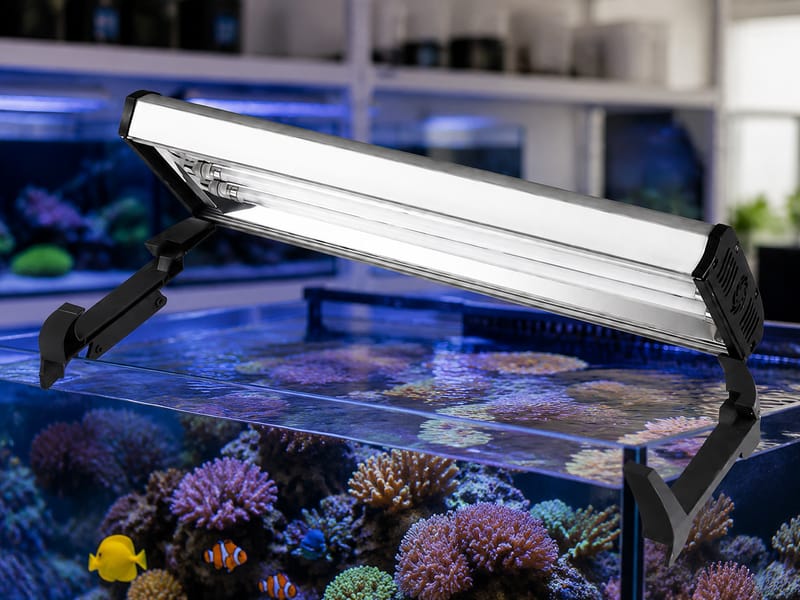
T5 HO refers to high-output fluorescent lamps in a slim tubular format. In aquarium use, these lamps are typically installed in multi-lamp fixtures with individual or shared reflectors, electronic ballasts, cooling provisions, and a splash-resistant housing design. The format remains relevant because it delivers light over a long, linear area rather than from several concentrated points.
For wholesalers and retailers, T5 HO aquarium lights wholesale programs can make sense in several situations:
- Replacement-oriented markets: Established aquarium owners may already own compatible fixtures and need lamps, reflectors, mounting parts, or replacement units.
- Planted-tank retail programs: Buyers can build an assortment around different spectrum choices instead of relying on a single fixed LED spectrum.
- Marine and reef-oriented displays: Multi-lamp configurations can support spectrum blending and wide coverage when properly selected for tank dimensions and livestock goals.
- Long or shallow aquariums: A linear fixture may provide more consistent front-to-back illumination than a compact point-source light, depending on fixture layout and mounting height.
- Value-tier lighting ranges: Some retail programs need a conventional fluorescent option alongside premium programmable LED lighting.
The key limitation is operating cost over time. Fluorescent lamps generate heat and have a usable service life that declines before the lamp stops turning on. A lower initial fixture cost can be offset by replacement lamps, electricity use, cooling needs, and service labor. Buyers should present T5 HO as a system with a predictable maintenance cycle, not as a fit-and-forget lighting choice.
T5 HO compared with LED aquarium lighting
| Buying factor | T5 HO fluorescent fixtures | LED aquarium fixtures |
|---|---|---|
| Light distribution | Broad, linear illumination across the fixture length | Depends on diode layout, optics, mounting height, and fixture design |
| Spectrum changes | Often achieved by changing individual lamps | Usually adjusted through channels, controls, or a fixed diode mix |
| Heat | Produces fixture and ambient heat that needs management | Usually lower radiant heat to the aquarium, but still requires heat sinking |
| Ongoing maintenance | Periodic lamp replacement is expected | Diodes are generally not user-replaced; drivers and controls may be service points |
| Retail conversation | Lamp selection and replacement planning are central | Features, controls, color channels, and programming are often central |
| Compatibility checks | Lamp length, pin style, ballast, reflector, and fixture design | Voltage, controls, mounting, output, and app or controller compatibility may matter |
This is not a simple “old versus new” decision. T5 HO can be a strong fit where customers value lamp interchangeability and even coverage. LED may be more suitable where buyers prioritize reduced routine relamping, adjustable controls, or lower heat. A complete retail lighting range can include both, provided each product’s intended customer and tank application are clearly defined.
Freshwater Planted and Marine Applications
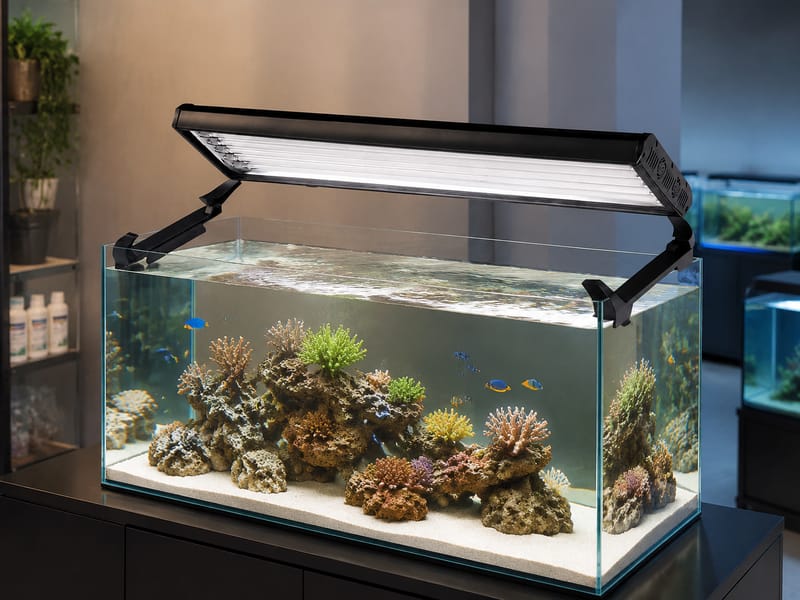
T5 HO lighting should be selected according to the aquarium’s biological goals, dimensions, and maintenance capacity. A fixture that works well over a low-demand freshwater display may be inadequate—or unnecessarily intense—over another aquarium with different plants, corals, depth, or water clarity.
Freshwater planted aquariums
For freshwater planted tanks, the useful questions are not simply whether a lamp is labeled “plant” or “daylight.” Buyers should assess the desired plant density, tank depth, carbon dioxide use, nutrient-management approach, and whether the fixture can be mounted at an appropriate height.
A moderate lighting setup can be easier for beginning plant keepers to manage. High light can promote faster plant growth, but it may also increase the need for consistent fertilization, carbon management, circulation, and algae control. Retail instructions should avoid suggesting that more lamps always mean better plant growth.
Useful assortment options may include:
- A general freshwater daylight lamp or fixture configuration for community aquariums and undemanding plants.
- Spectrum options intended for plant-focused displays, with clear guidance that spectrum is only one part of plant performance.
- Fixtures with practical mounting choices for open-top tanks.
- Replacement lamps and maintenance accessories sold near the original fixture.
Marine and reef aquariums
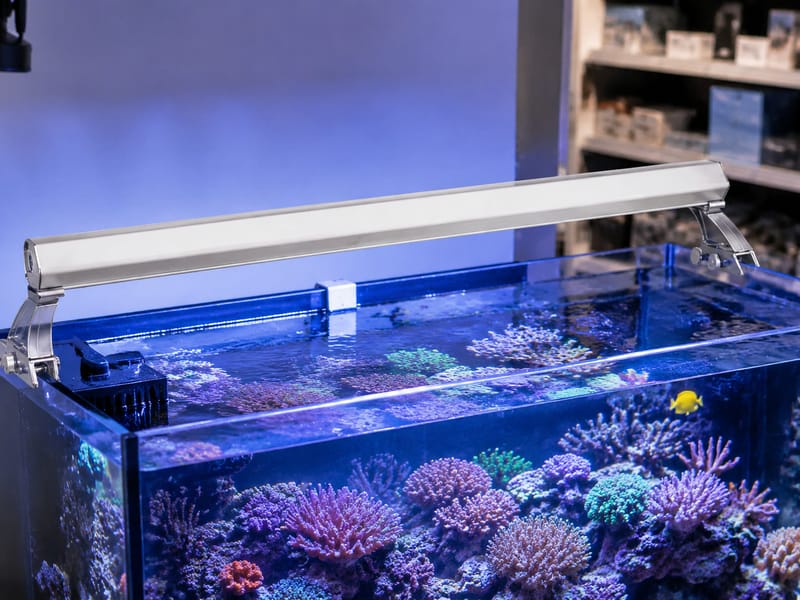
T5 HO remains familiar in marine applications because multiple lamps can be combined to shape the aquarium’s visual appearance and spectral balance. Blue-weighted and daylight-oriented lamps are commonly mixed based on the keeper’s display preference and livestock requirements. However, a lamp’s color appearance does not prove its biological suitability.
Marine buyers should confirm the actual fixture output and coverage for the intended tank. Tank depth, aquascape height, coral placement, water clarity, surface agitation, and fixture mounting distance all affect the light that reaches the livestock. A fixture that appears bright to the eye may not deliver the required usable intensity at lower positions in the tank.
For retail teams, the most responsible approach is to separate these claims:
- Visual appearance: How blue, white, violet, or warm the aquarium looks.
- Coverage pattern: How evenly light reaches the aquarium footprint.
- Measured output: The usable intensity at a stated distance and location.
- Livestock suitability: A recommendation that should be based on confirmed output, tank geometry, and husbandry needs.
Do not market a T5 HO fixture as universally suitable for corals or demanding planted tanks without application-specific output information.
Lamp Spectrum, Output, and Tank Coverage
Lamp spectrum, fixture output, and coverage are related but not interchangeable. A spectrum label describes the lamp’s color profile or intended visual effect. It does not by itself state how much usable light reaches plants or corals.
For a wholesale comparison, request information that helps buyers evaluate the full system:
- Lamp brand or compatible lamp specification
- Number of lamps and their nominal length
- Lamp wattage and ballast configuration
- Reflector arrangement and material
- Whether lamps are independently switched or controlled in groups
- Output information measured at a stated distance, if available
- Recommended mounting height and intended aquarium footprint
- Any included lamps, versus lamps sold separately
Why reflectors matter
A quality reflector system can materially affect how light is directed into the aquarium. A fixture with multiple lamps may not perform equally if the reflector design, lamp spacing, thermal conditions, or ballast operation differ. When comparing quotations, do not assume two fixtures with the same lamp count produce equivalent aquarium coverage.
Ask whether reflectors are individual, shared, removable, or integrated into the housing. Also confirm whether replacement reflectors or lamp guards are available where relevant. These details affect both output management and long-term serviceability.
Use tank footprint, not gallon claims alone
“Suitable for X gallons” is a weak purchasing shortcut because aquariums with the same water volume can have very different lengths, widths, and depths. A long, shallow aquarium and a short, deep aquarium need different coverage planning.
A better product listing states or confirms:
- Fixture length
- Aquarium length range
- Effective front-to-back coverage
- Recommended mounting height
- Approximate water depth or application range, where validated
- Whether the recommendation is for viewing, low-demand plants, planted aquariums, fish-only marine tanks, or coral-focused systems
For a more technical evaluation, buyers can request light measurements at several points across the tank footprint and at more than one depth. Measurement method, meter type, mounting height, water condition, and lamp age should be documented; otherwise, comparisons can be misleading.
Fixture Length, Heat, and Power Requirements
Fixture length must match the aquarium and its mounting arrangement. A nominal fixture size can differ from the exact end-to-end housing length, including brackets, end caps, cords, or adjustable legs. For canopy installations, interior clearance is especially important.
Before ordering, confirm these dimensions:
- Overall fixture length, width, and height
- Lamp length and replacement compatibility
- Width of adjustable mounting legs, if supplied
- Clearance needed above the fixture for ventilation
- Cord exit location and cord length
- Space needed to remove lamps safely
- Canopy interior dimensions and access openings
Heat is both a performance and safety consideration
T5 HO lamps and ballasts create heat. Excess heat can shorten lamp life, affect output consistency, raise aquarium water temperature, and reduce fixture reliability. This is particularly relevant for enclosed canopies, warm rooms, multi-fixture display racks, and marine aquariums already running pumps and other heat-producing equipment.
A sourcing review should identify:
- Whether the fixture has passive vents, active cooling, or both
- Where heat exits the housing
- Whether vents could be blocked by a canopy or shelf
- How much clearance the instructions require
- Whether the fixture is designed for an open-top installation, canopy use, or both
- Any temperature-related operating limitations provided by the manufacturer
Avoid positioning a fixture where it is tightly enclosed without a documented ventilation plan. A retailer should also avoid giving a generic “safe for all canopies” recommendation when the available installation data does not support it.
Electrical configuration needs early confirmation
For the U.S. market, buyers should confirm the voltage range, plug type, frequency compatibility, power consumption, switching arrangement, and any required electrical markings or test documentation before purchase. These details may vary by model and order configuration.
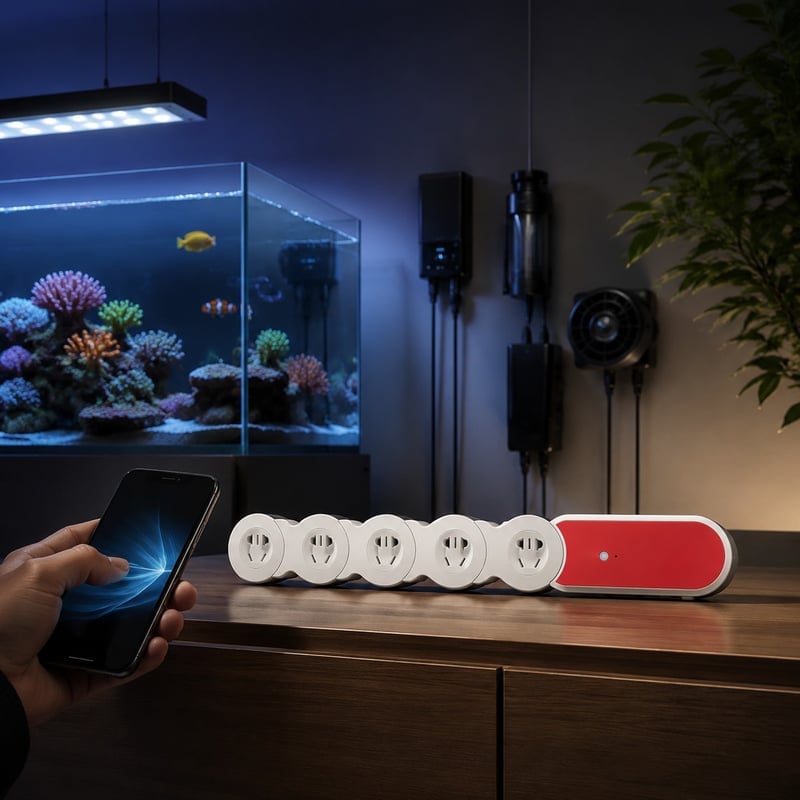
Do not assume that a fixture with a familiar-looking plug is automatically suitable for a particular sales channel. Importers and private-label buyers should verify applicable product, labeling, and documentation requirements with their qualified compliance resources. If timers, dimmers, controllers, or smart plugs are part of the intended retail package, confirm whether the fixture can be used with them and what operating behavior to expect after power cycling.
Mounting, Ventilation, and Electrical Compatibility
Mounting is a frequent source of returns because tank rims, glass thickness, canopy dimensions, and open-top layouts vary widely. A lighting fixture may be electrically functional yet still be a poor fit for a customer’s aquarium.
Common mounting approaches include adjustable tank legs, suspended hanging kits, canopy placement, and shelf or rack installation. Each has different risks:
- Tank-mounted legs: Confirm the supported rim style, adjustment range, and whether the legs fit rimmed and rimless tanks.
- Hanging systems: Confirm whether a hanging kit is included, optional, or excluded. Verify weight support, cable length, and ceiling or rack attachment requirements.
- Canopy placement: Check heat clearance, splash exposure, access for lamp changes, and whether the canopy blocks ventilation.
- Retail display racks: Plan for cable routing, timer access, and enough air movement around each fixture.
Electrical safety also depends on installation. Instructions should address drip loops, keeping connectors away from splashes, disconnecting power before service, and avoiding use with damaged cords or housings. Product-specific ingress protection, safety features, certifications, and included accessories must be confirmed rather than assumed.
When comparing candidate items, buyers can review the available details on the WK136 aquarium product page and WK135 aquarium product page alongside the supplier’s current specification sheet. Confirm that the actual order configuration—not just a catalog image—matches the intended mounting and electrical requirements.
Replacement Lamps and Maintenance Planning
Replacement lamps are central to the T5 HO value proposition. Customers can refresh spectrum and output without replacing the full fixture, but only if compatible lamps remain accessible and the fixture is designed for straightforward service.
A complete maintenance plan should cover:
- Compatible lamp type, nominal length, and pin configuration
- Recommended replacement interval supplied for the specific lamp and application
- Whether all lamps should be replaced together or in stages
- Safe lamp-removal instructions
- Fixture cleaning procedure and approved cleaning materials
- Inspection of end caps, reflectors, fans, switches, and cords
- Disposal guidance consistent with local requirements for fluorescent lamps
Lamp replacement schedules should not be presented as universal. Output decline varies with lamp type, operating hours, heat, fixture design, and desired application. A fish-only display may tolerate a different replacement plan than a high-light planted or coral-focused system.
From a retail standpoint, carrying compatible replacement lamps can reduce customer frustration and create logical repeat purchases. It also reduces the risk of selling fixtures that become difficult to maintain after the initial purchase. Before committing to a bulk fixture order, ask how replacement-lamp continuity will be managed and whether lamp packaging is suitable for individual retail sale.
Retail Assortment, Packaging, and Instructions
A well-planned T5 HO lighting assortment does not need every fixture length and every spectrum variation. It needs enough choices to cover the tank sizes and customer segments a retailer actually serves, with accessories that make installation and maintenance understandable.
A focused assortment may include:
- One or more core fixture lengths aligned with common tank footprints in the retailer’s market.
- A straightforward freshwater option for general displays and planted-tank customers.
- A marine-oriented configuration only when the product data supports that positioning.
- Compatible replacement lamps in clearly differentiated spectrum options.
- Mounting parts, replacement legs, or hanging accessories where applicable.
- Clear instructions for fit, ventilation, electrical setup, and routine lamp replacement.
Packaging needs special attention because fluorescent lamps are fragile. Confirm carton construction, lamp protection, retail labeling, barcode requirements, master-carton quantity, handling marks, and whether lamps are packed with the fixture or separately. A fixture package should clearly state what is included, such as lamps, legs, hanging hardware, splash guards, timers, or adapters. If an item is not included, say so plainly.
Private-label and OEM buyers should also review branding placement, color options, retail-box artwork, instruction manuals, warning labels, and any market-specific packaging requirements. WKAQOO can support sourcing discussions involving product selection, branding, retail packaging, and user instructions, but all customization options and commercial terms should be confirmed for the specific model and order.
For broader product-range comparison, the WK007 aquarium product page and WK137 aquarium product page can be used as starting points for checking listed product information against your planned assortment requirements.
Supplier Questions Before a Bulk Purchase
A bulk purchase should be approved only after the supplier answers configuration-specific questions in writing. Product photos and a generic feature list are not enough for a lighting category with electrical, heat, fitment, and lamp-compatibility variables.
Use this checklist before issuing a purchase order:
Product and performance
- What is the exact model number and current specification sheet?
- What lamps are included, and what compatible replacements are required?
- What are the fixture’s exact exterior dimensions and weight?
- What is the lamp count, lamp wattage, and total power consumption?
- What reflector and ballast arrangement is used?
- Is output data available, and under what measurement conditions was it obtained?
- What aquarium dimensions and applications is the fixture intended to cover?
Installation and safety
- What mounting hardware is included?
- Does the fixture fit rimmed tanks, rimless tanks, canopies, or only specific setups?
- What ventilation clearance is required?
- What voltage, plug, and frequency configuration will be supplied?
- What electrical, labeling, test, or certification documentation is available for the target market?
- Are splash resistance, grounding, power-switch behavior, and timer compatibility specified?
Commercial and packaging details
- What is the minimum order quantity for the fixture, lamps, and private-label packaging?
- Are samples available for fit, packaging, and functional evaluation?
- What retail packaging and master-carton options are available?
- Can branding, colors, manuals, warnings, or barcodes be customized?
- How are fragile lamps protected during shipment?
- What are the current production schedule and lead-time estimates for the confirmed configuration?
The practical next step is to create a one-page buying specification for each planned T5 HO fixture: tank fit, lamp configuration, electrical version, mounting method, included accessories, packaging, and replacement-lamp plan. Then ask WKAQOO at sales@wkaqoo.com to confirm model-specific specifications, sample options, MOQ, private-label requirements, packaging details, and current lead time before placing a bulk order.